



arXiv: 2606.12828 | Published: June 2026
Researchers: Rasul Khanbayov, Hasan Kurban
Most executives understand that AI moves fast. What this paper proves is that it moves in phase transitions, not gradual curves.
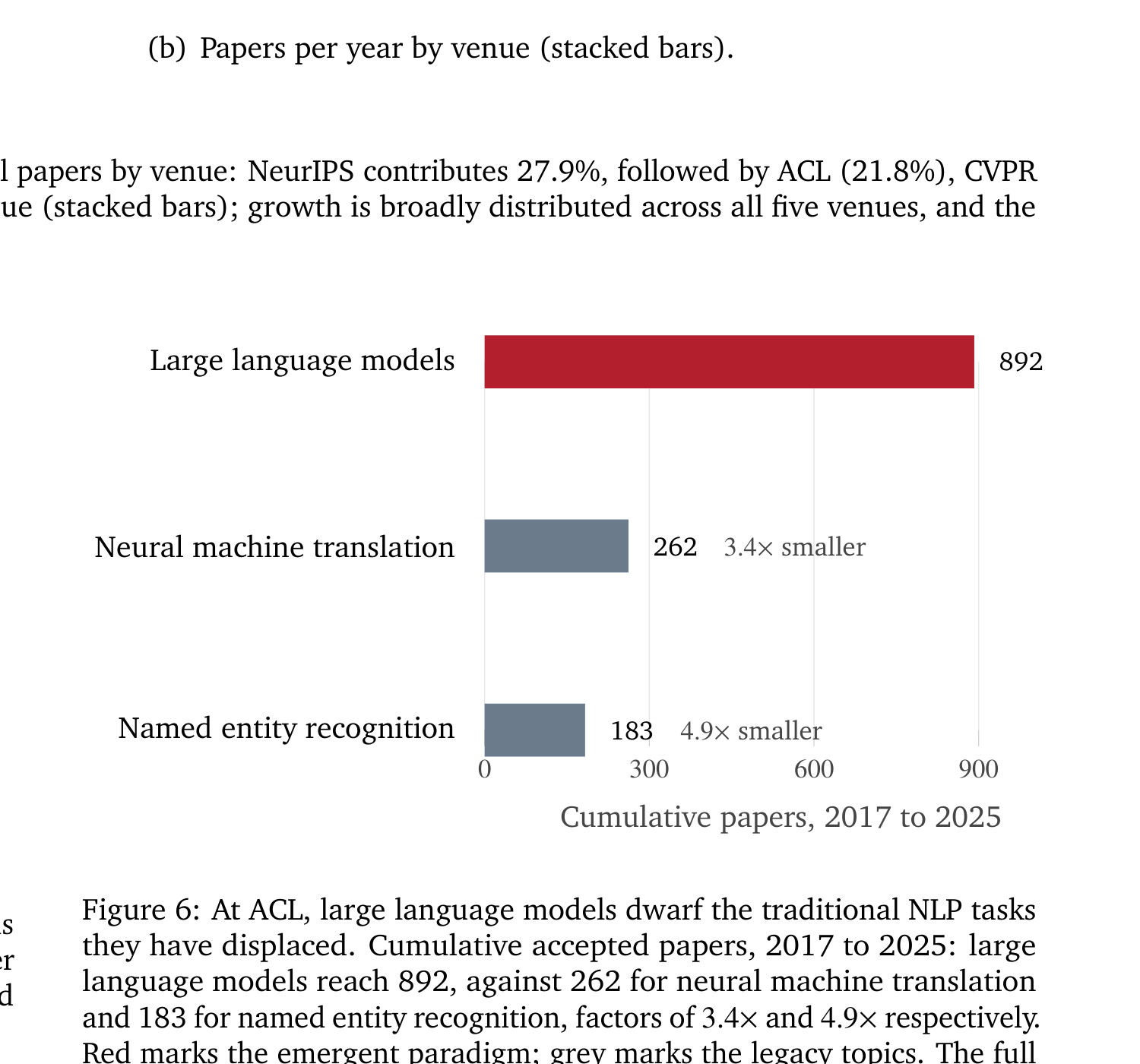
Researchers Rasul Khanbayov and Hasan Kurban analyzed 80,814 papers from five top AI conferences across nine years. They found that major AI research topics stay marginal for years, then explode across every conference simultaneously within one to three years. LLMs are the textbook case: fewer than 10 papers at the top conferences in 2020, more than 1,000 by 2025.
Well… what makes this more than an interesting observation is that the authors found the warning signal that appears before a transition peaks. The Composite Leading Indicator, a four-signal framework, would have flagged LLMs in 2021. Before ChatGPT. Before enterprise adoption. Before most organizations had any AI strategy at all. That is a two-year early-warning lead time your competitors almost certainly did not have.
LLM PAPERS AT TOP AI CONFERENCES — THE PHASE TRANSITION
Analysis of 80,814 papers from ACL, CVPR, ICLR, ICML, NeurIPS (2017–2025) — Khanbayov & Kurban, arXiv 2606.12828
Why This Paper Matters for Silicon Valley Certification Hub Chief AI Officer Strategy
Conventional competitive intelligence is structurally late. By the time a topic dominates analyst reports, VC conversations, and conference keynotes, the transition has already peaked. Organizations relying on trend reports are systematically 12 to 18 months behind organizations that monitor research dynamics directly.
The CLI provides something genuinely rare for any Chief AI Officer building a strategic radar: a repeatable, empirically grounded method for detecting what is coming next before it becomes obvious. The methodology can be adapted beyond academic papers to patent filings, startup formation data, government R&D funding, and internal research output monitoring.
Methodology, Explained Simply
The researchers used KeyBERT and BERTopic to extract and cluster research topics from all 80,814 papers. Temporal analysis then tracked each topic’s prominence trajectory across nine years. A phase transition is defined as a structural breakpoint in the growth rate — not ordinary fluctuation, not a spike, but a permanent shift in trajectory.
The Composite Leading Indicator combines four signals into a single early-warning framework:
The rate at which a topic is accelerating in the literature. Topics entering a pre-transition phase show a distinct acceleration pattern before the full explosion.
How many of the five conferences are publishing on the topic. Cross-venue penetration is the most reliable indicator that a topic has escaped its niche.
Whether the growth is sustained or spike-and-fade. True phase transitions show persistent growth across multiple years, not a single-conference surge followed by decline.
Whether all venues are accelerating simultaneously. Synchronized cross-venue acceleration is the final signal that separates genuine transitions from ordinary topic drift.
Results and Practical Insights
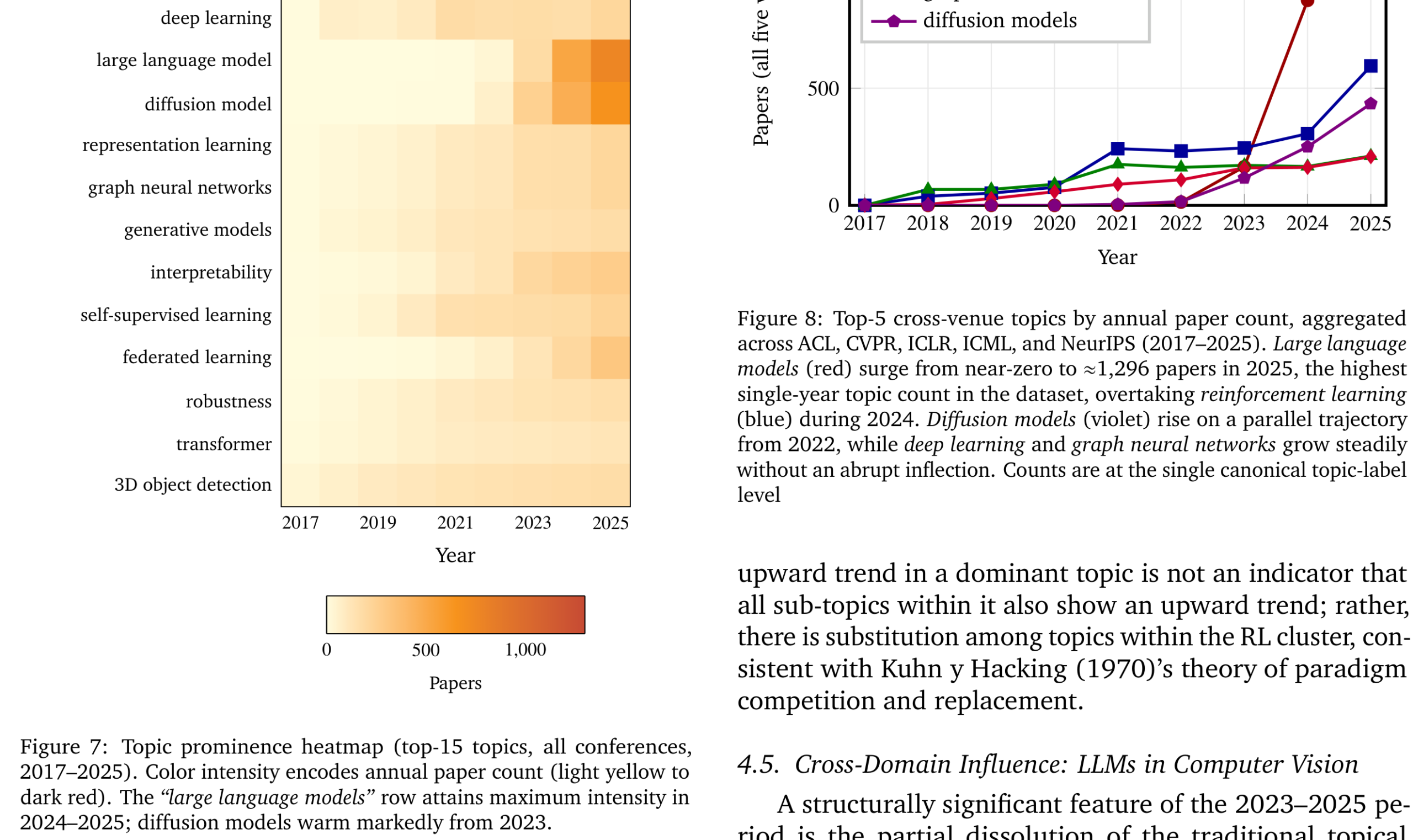
LLMs passed all four CLI thresholds simultaneously in 2021, two years before ChatGPT made the transition visible to most executives. The Topic Prominence Heatmap shows 25+ research topics across nine years. Only LLMs and Foundation Models produce a striking vertical band of concentrated activity. Everything else shows normal ebb and flow.
Two topics currently show pre-transition CLI signals: diffusion models and interdisciplinary AI. If the pattern holds, there transition could peak within the next one to two years. Organizations positioned in these areas now are making the same type of early bet that would have flagged LLMs in 2021.
THE STRATEGIC PROBLEM
Conventional intelligence is a lagging indicator. The CLI is not.
Trend reports, VC activity, and expert opinion all describe what is already happening. The CLI detects what is about to happen. The LLM case proves the methodology works: the signal was there in 2021. The question for every Chief AI Officer is whether your organization has a process to see the next signal before it peaks.
Key Takeaways for Strategy Leaders
Audit your intelligence sources for structural lag
If your AI strategy is built on analyst reports and VC activity, you are using lagging indicators. The CLI methodology can be adapted to patent filings, startup formation, government R&D data, and internal research monitoring. Include this in every AI Assessment for companies.
Watch diffusion models and interdisciplinary AI
These two topics show current pre-transition CLI signals. Organizations positioning now are making the same type of early bet that would have flagged LLMs two years before ChatGPT.
Reframe the strategic question
Stop asking “what is hot in AI today?” Start asking “which topics are showing pre-transition signals right now?” That reframe is worth more than any trend report. For enterprise AI strategy, this is now a baseline competency, not an advanced one.
Thanks to the Authors
Rasul Khanbayov — Independent Researcher
Hasan Kurban — Independent Researcher
Frequently Asked Questions
What does this mean for a Chief AI Officer?
It means the standard tools of competitive intelligence, analyst reports, conference buzz, VC activity, are structurally late by 12 to 18 months. A Chief AI Officer who builds a CLI-style monitoring system gains a genuine early-warning advantage. The LLM case proves this is not theoretical: the signal was detectable in 2021, two years before most organizations reacted.
Can the Composite Leading Indicator be applied outside academic research papers?
Yes, and that is one of the paper’s practical contributions. The CLI framework, velocity, venue penetration, persistence, and acceleration, can be adapted to patent filings, startup formation data, government R&D funding, and internal research output. Any domain where topic activity is measurable over time can support a CLI-style monitoring system.
How does Silicon Valley Certification Hub incorporate this type of research intelligence into an AI Assessment for companies?
Silicon Valley Certification Hub includes research-dynamics monitoring as a component of the AI readiness assessment. When we evaluate an organization’s AI strategy, we look at whether the competitive intelligence function is using leading or lagging indicators. This paper provides a rigorous framework for that distinction and for building a monitoring practice that sees transitions before they peak.
What is the risk of acting on pre-transition signals that do not materialize?
The CLI requires all four signals to align simultaneously before flagging a transition. Topics that spike on one or two signals but not all four are filtered out. The methodology is conservative by design, specifically to avoid false positives. The paper validates this against the historical LLM data, where all four signals aligned in 2021 and the transition confirmed within 18 months.
What should executives do this quarter based on this research?
Three actions: audit whether your AI competitive intelligence is using leading or lagging indicators, assign someone to monitor diffusion model and interdisciplinary AI research activity using the four CLI signals, and include research-dynamics monitoring in your next strategic planning cycle. The window before a phase transition peaks is the only time to position at a real advantage.
Want to know how this applies to your company?
At Silicon Valley Certification Hub, we help you align AI + Strategy. Our team works directly with your directors and teams to assess AI readiness, identify gaps, and build a clear path forward — tailored to your business context.
Book a time with our CEO, Alejandro Cuauhtemoc-Mejia
Silicon Valley Certification Hub | 3000 El Camino Real, Building 4, Palo Alto, CA


0 Comments