
SVCH STRATEGIC GUIDE
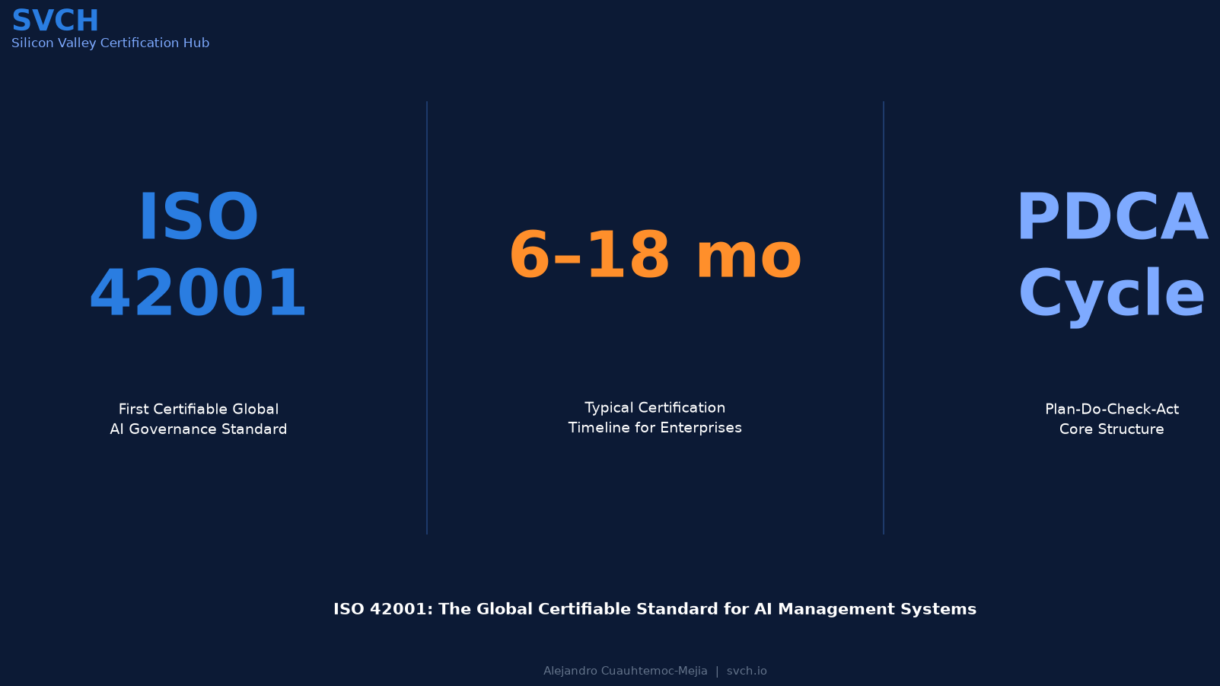
ISO 42001 is the first certifiable global standard for AI governance.
Here is what it covers, what it requires, and how to use it.
Published December 2023. Designed to make AI accountability concrete, auditable, and verifiable. Every enterprise with significant AI exposure needs to understand what it requires.
ISO/IEC 42001:2023 is the first international standard specifically designed for artificial intelligence management systems. Published by the International Organization for Standardization in December 2023, it gives organizations a systematic and certifiable framework for responsible AI, from development and deployment to monitoring and continuous improvement.
ISO 42001 translates principles such as transparency, fairness, human oversight, and risk management into documented management system requirements that can be audited, certified, and improved over time. For organizations facing customer due diligence requests, regulatory pressure, or board-level AI governance expectations, ISO 42001 is the credential that makes AI accountability externally verifiable.
What ISO 42001 Is and Is Not
ISO 42001 certifies AI management systems. It does not certify individual AI models or algorithms.
Certification under ISO 42001 means your organization has documented, implemented, and had independently audited a management system that governs how you develop, deploy, and monitor AI. It does not mean your AI models are certified as fair, accurate, or safe. The distinction matters enormously for how you communicate certification to customers, regulators, and the board.
What Is an AI Management System?
An AI Management System (AIMS) is the set of policies, processes, objectives, and controls an organization uses to govern its AI throughout the full lifecycle, from initial use-case identification through deployment, monitoring, and eventual decommissioning. ISO 42001 specifies what an AIMS must contain to meet internationally agreed standards of responsible AI governance.
How ISO 42001 Relates to Other ISO Standards
| ISO Standard | Focus | High Level Structure? | Integration with ISO 42001 |
|---|---|---|---|
| ISO 42001:2023 | AI management systems | Yes | Core framework |
| ISO 27001:2022 | Information security management | Yes | Data security controls apply directly to AI training data and model security |
| ISO 9001:2015 | Quality management systems | Yes | Quality processes apply to AI testing, validation, and release management |
| ISO 31000:2018 | Risk management guidelines | No | Risk methodology informing the AI risk assessment component of AIMS |
The Core Requirements of ISO 42001
Organizational context and stakeholder requirements. Document the internal and external context that shapes your AI activities: regulatory environment, stakeholder expectations, organizational objectives, and the AI systems you develop or deploy. This is the scoping document that defines what your AIMS covers.
Top management commitment and AI policy. Senior leadership must demonstrate commitment to the AIMS through a documented AI policy, clear role assignments, and integration of AI governance into strategic planning. ISO 42001 requires named executive accountability, not just an AI ethics statement.
Risk assessment and objectives. Systematic identification and assessment of AI risks across the organization, with documented treatment plans and measurable AI governance objectives. This maps directly to the AI risk categories in your risk management framework.
Resources, competence, and awareness. Evidence that staff involved in AI development and deployment have the competence required for their roles, including documented training programs, role-based AI governance awareness, and awareness of the AI policy.
AI development and deployment controls. The operational controls that govern how AI systems are developed, tested, deployed, and monitored. This is the core of the AIMS: the documented processes that turn your AI policy into consistent practice.
Monitoring, measurement, and audit. Regular assessment of whether the AIMS is achieving its objectives, including internal audits, management reviews, and performance indicators. This is the continuous improvement mechanism that keeps the AIMS current as AI technology and regulatory requirements evolve.
The ISO 42001 Certification Process
Gap assessment against ISO 42001 requirements
Map your current AI governance practices against each ISO 42001 clause. Identify what exists, what is documented, and what needs to be built. This assessment produces the roadmap for your AIMS implementation.
AIMS design and documentation
Design the policies, procedures, risk assessment process, and controls required by ISO 42001. Documentation does not need to be bureaucratic, but it does need to be complete, consistent, and demonstrably followed.
Implementation and staff training
Implement the documented AIMS across the AI functions in scope. Train relevant staff on their roles within the management system. Build the evidence trail that auditors will review.
Internal audit
Conduct an internal audit against ISO 42001 requirements before engaging an external certification body. Internal audit surfaces gaps in implementation before they become findings in the certification audit.
Stage 1 audit (documentation review)
The certification body reviews your AIMS documentation against ISO 42001 requirements. Stage 1 identifies any critical gaps that must be addressed before Stage 2.
Stage 2 audit (implementation assessment)
The certification body assesses whether the documented AIMS is implemented in practice. Auditors review records, interview staff, and observe processes. Successful Stage 2 completion results in ISO 42001 certification.
Frequently Asked Questions
What does this mean for a Chief AI Officer?
A Chief AI Officer pursuing ISO 42001 certification is building the external evidence base that AI governance is real, documented, and audited. The CAIO owns the AIMS design, the certification process, and the ongoing surveillance audits. More practically, ISO 42001 certification gives the CAIO a governance framework that can withstand regulatory scrutiny and customer due diligence without building a custom answer every time.
How long does ISO 42001 certification take?
For a mid-sized enterprise with existing ISO management system infrastructure, the certification process typically takes six to twelve months from gap assessment to certification. Organizations starting from scratch with no existing management system processes should plan for twelve to eighteen months. The timeline depends heavily on scope, documentation readiness, and internal resource allocation.
Does Silicon Valley Certification Hub certify organizations under ISO 42001?
Silicon Valley Certification Hub certifies the executives and professionals who build and lead AI governance programs, not the organizations themselves. ISO 42001 organizational certification requires a formal accredited third-party audit. Our Chief AI Officer Certification program and AI Assessment for companies prepares your leadership team to design and implement the AIMS that an ISO 42001 audit would verify.
How does ISO 42001 relate to the EU AI Act?
ISO 42001 is not a EU AI Act compliance tool, but the two frameworks are highly complementary. An organization with ISO 42001 certification has documented risk assessment processes, management system controls, and governance structures that directly support EU AI Act compliance for high-risk AI systems. The conformity assessement requirements of the EU AI Act are easier to satisfy with an ISO 42001-certified AIMS already in place.
What should executives do this quarter?
Commission an ISO 42001 gap assessment against your current AI governance practices. The assessment identifies which clauses you already satisfy, which require documentation improvements, and which require new processes. The gap report becomes the AIMS implementation roadmap and gives you a realistic timeline and resource estimate for certification.
Want to know how this applies to your company?
At Silicon Valley Certification Hub, we help you align AI + Strategy. Our team works directly with your directors and teams to assess AI readiness, identify gaps, and build a clear path forward — tailored to your business context.
Book a time with our CEO, Alejandro Cuauhtemoc-Mejia
Silicon Valley Certification Hub | 3000 El Camino Real, Building 4, Palo Alto, CA


0 Comments