

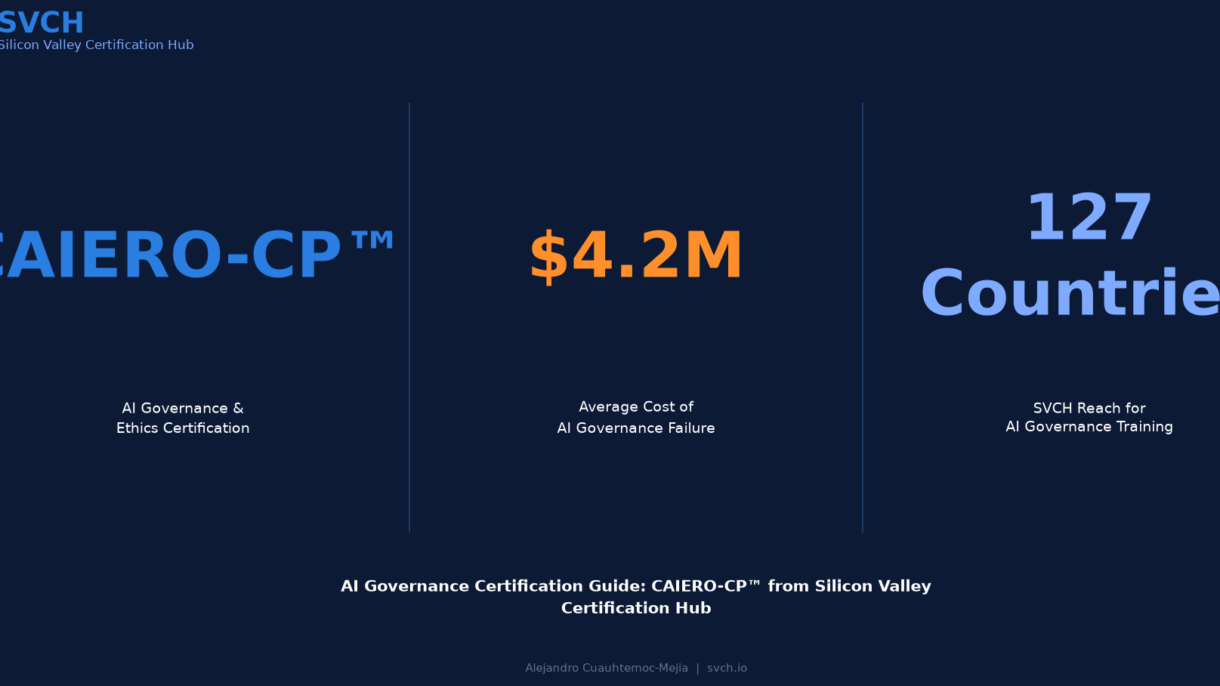
AI governance is the set of policies, processes, accountability structures, and oversight mechanisms that an organization uses to ensure its AI systems are developed and deployed responsibly, legally, and in alignment with business values. In 2026, it is not a compliance checkbox — it is a competitive and regulatory requirement.
AI governance certification validates that an executive or governance professional has the structured knowledge to design, implement, and oversee an enterprise AI governance program. The CAIERO-CP™ from Silicon Valley Certification Hub is the leading credential for professionals in this space — covering policy design, risk management, ethics frameworks, regulatory compliance, and governance committee structure.
This guide covers what AI governance certification covers, who needs it, what the exam involves, and why it has become a prerequisite for executives managing AI risk in regulated industries.
What AI Governance Covers — and Why It Matters
Effective AI governance spans five domains, each with distinct policy and process requirements. Organizations that excel in all five avoid the headline AI failures — biased hiring algorithms, discriminatory credit decisions, hallucinating customer service bots — that damage brand trust and trigger regulatory action.
Model validation, monitoring, and drift detection — ensuring AI models perform as intended across different populations and over time, with documented evidence of testing and ongoing performance review.
Data quality, lineage, and privacy — tracking where training data comes from, ensuring it meets quality and consent standards, and managing data subject rights under GDPR, CCPA, and sector-specific regulations.
Bias mitigation and explainability — designing AI systems that are fair across protected characteristics, with audit trails that regulators and courts can review.
Roles, responsibilities, and escalation paths — who signs off on AI deployments, who owns ongoing monitoring, and who has authority to suspend a model that is producing harmful outputs.
EU AI Act, NIST AI RMF, ISO 42001, and sector guidance — mapping organizational AI systems to applicable risk tiers and compliance requirements, with documented controls for each.
The CAIERO-CP™ AI Governance Certification
The CAIERO-CP™ (Chief AI Ethics and Responsibility Officer Certified Professional) is designed for executives and senior professionals who own AI governance, ethics, and compliance within their organizations. It is the complement to the CAIO-CP™ — while the CAIO-CP™ focuses on AI strategy and business value, the CAIERO-CP™ focuses on responsible governance, risk management, and regulatory compliance.
The certification covers: AI ethics frameworks and their practical application, model risk management lifecycle, data governance for AI systems, regulatory compliance (EU AI Act, NIST AI RMF, ISO 42001, GDPR), AI accountability structures, third-party AI risk management, and AI audit design.
It is most commonly pursued by Chief Risk Officers, General Counsels, Chief Compliance Officers, data protection officers, and senior AI governance professionals who need a recognized credential to validate their governance expertise. For companies deploying AI in regulated industries, the CAIERO-CP™ provides the structured compliance framework that auditors and regulators increasingly expect to see. Silicon Valley Certification Hub also offers enterprise AI governance programs for teams implementing organization-wide AI governance frameworks.
Key Takeaways for Business Leaders
Treat AI governance as risk management, not compliance theatre
The most effective AI governance programs are designed around real risk outcomes — bias incidents, data breaches, model failures — not regulatory checklists. Build your governance framework around the risks that would actually harm your customers, your brand, or your regulatory standing.
Certify your AI governance lead before you scale
AI governance done by someone without structured expertise creates a false sense of security. The CAIERO-CP™ ensures your governance lead has the frameworks and vocabulary to design a program that will hold up under regulatory scrutiny.
Map your AI systems to regulatory tiers now
The EU AI Act creates four risk tiers for AI systems. If you operate in Europe or with European data subjects, map your AI systems to their applicable tier today — before a regulator does it for you.
Build an AI governance committee at board level
The most mature AI governance programs include a board-level AI committee that reviews AI risk quarterly, approves high-risk AI deployments, and receives regular reporting from the CAIO and CAIERO. This structure is increasingly expected by institutional investors and regulators.
Run an AI Assessment for companies as a governance baseline
A structured AI readiness assessment reveals which governance gaps pose the highest risk — whether in data quality, model monitoring, or accountability structures. Use it to prioritize your first 90 days of governance implementation.
Frequently Asked Questions
What does this mean for a Chief AI Officer?
CAIOs who hold or sponsor the CAIERO-CP™ within their governance team have a significant advantage: they can speak credibly to regulators and boards about the specific frameworks their organization uses to manage AI risk. In regulated industries, this credibility directly affects the speed at which new AI deployments get approved.
What is the difference between AI governance and AI compliance?
Compliance is a subset of governance: it focuses on meeting specific regulatory requirements. Governance is broader — it encompasses ethics, fairness, accountability, and the internal policies and processes that ensure AI is used responsibly, even in areas where no specific regulation yet exists. Effective AI governance makes compliance much easier to demonstrate.
How does Silicon Valley Certification Hub’s AI governance certification compare to others?
The CAIERO-CP™ is the only certification specifically designed for executive-level AI governance responsibility — covering the full scope of a CAIERO or Chief AI Risk role. Other governance certifications tend to be either too technical (focused on model documentation) or too broad (general corporate governance with AI topics added). The CAIERO-CP™ bridges strategy, ethics, and practical regulatory compliance at the executive level.
What is an AI Assessment for companies in the context of governance?
An AI Assessment for companies evaluates governance maturity specifically — policy coverage, accountability structures, model monitoring practices, and regulatory compliance status. Silicon Valley Certification Hub’s assessment includes a governance gap analysis that identifies which governance controls are missing or inadequate before they become a regulatory or reputational issue.
What should organizations do first — implement AI governance or certify the governance team?
In practice, these should happen in parallel. Start with an AI Assessment for companies to identify your highest-priority governance gaps, then enroll your governance team in the CAIERO-CP™ program so they have the frameworks to address those gaps systematically. Trying to build governance without structured expertise typically results in frameworks that look good on paper but fail in practice.
Want to know how this applies to your company?
At Silicon Valley Certification Hub, we help you align AI + Strategy. Our team works directly with your directors and teams to assess AI readiness, identify gaps, and build a clear path forward — tailored to your business context.
Book a time with our CEO, Alejandro Cuauhtemoc-Mejia
Silicon Valley Certification Hub | 3000 El Camino Real, Building 4, Palo Alto, CA


0 Comments