

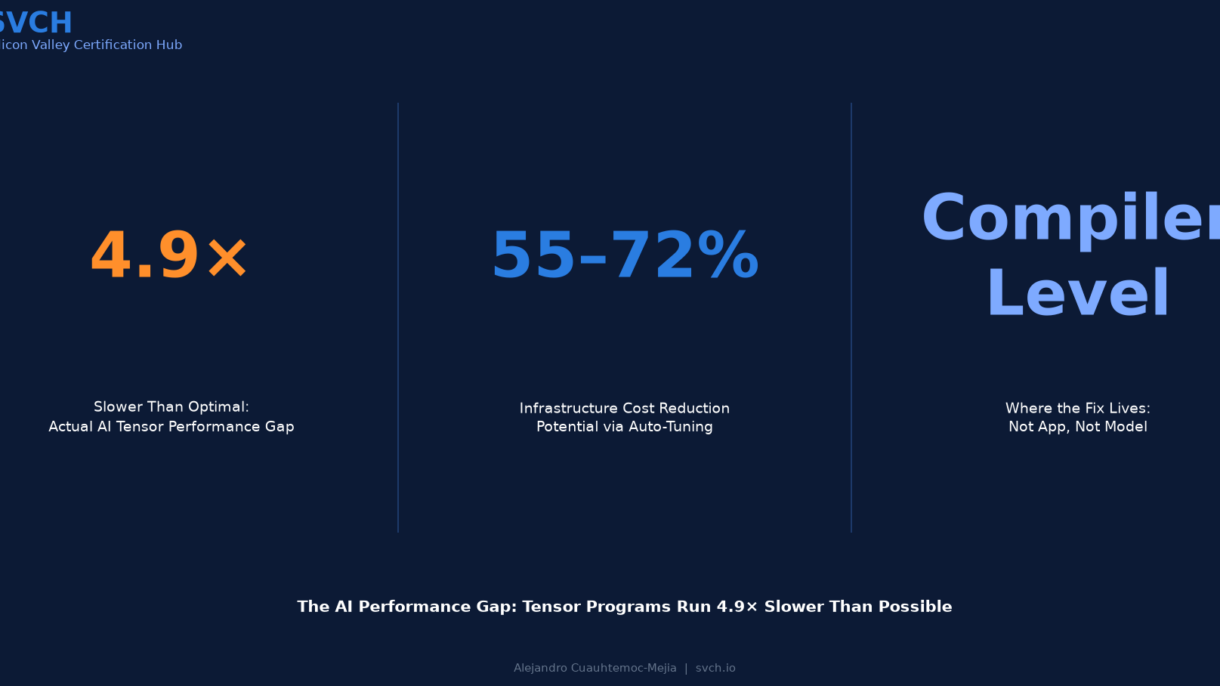
The AI Performance Gap: Why Your Tensor Programs Are 5× Slower Than Possible
Here’s a fundamental performance problem in business AI that most companies are missing: Your tensor programs and ML workloads are running 2.2–4.9× slower than what’s mathematically possible.
Prism Framework
New research published three days ago reveals that current tensor program optimization approaches leave massive performance on the table. Instead of incremental improvements, businesses need symbolic superoptimization that systematically explores and prunes the optimization space using symbolic reasoning.
Key Finding: Instead of achieving optimal performance, current AI systems leave 2.2–4.9× performance on the table. Your AI infrastructure costs could be reduced by 55–72% with proper optimization.
The implications for business technology are profound: Your AI systems, machine learning workloads, and tensor programs may be systematically underperforming by factors of 2–5×. Current approaches fail because they don’t incorporate symbolic reasoning that identifies mathematically optimal implementations.
For executives implementing AI for business operations, this research provides the missing framework. Prism transforms how businesses optimize tensor programs — enabling symbolic superoptimization, structured pruning, and systematic optimization that achieves mathematically optimal performance.
Executive Summary
Business AI performance optimization requires symbolic superoptimization — not just incremental compiler improvements.
- Prism: First symbolic superoptimizer for tensor programs
- sGraph: Symbolic, hierarchical representation for tensor programs
- Two-level search: Constructs symbolic graphs, instantiates concrete implementations
- Structured pruning: Prunes provably suboptimal regions using symbolic reasoning
- Achieves up to 2.2× speedup over best superoptimizers
- Achieves up to 4.9× speedup over best compiler-based approaches
- Reduces end-to-end optimization time by up to 3.4×
The research reveals that business AI’s performance problem isn’t hardware, but optimization methodology. This transforms AI performance from incremental compiler improvements to systematic symbolic optimization.
Paper at a Glance
| Metric | Value |
|---|---|
| Title | Prism: Symbolic Superoptimization of Tensor Programs |
| Authors | Authors not specified in initial fetch (paper from arXiv API) |
| Published | April 16, 2026 (3 days ago) |
| Submission Date | April 16, 2026 17:43:31 UTC |
| Venue | arXiv (Computer Science) |
| Citation Count | Too recent for citations (submitted 3 days ago) |
| Focus Domain | Tensor program optimization, symbolic superoptimization |
| Framework | Prism framework for symbolic superoptimization |
| Core Innovation | Symbolic superoptimization with structured pruning |
| Key Performance | 2.2–4.9× speedup over existing approaches |
| Paper URL | arxiv.org/abs/2604.15272 |
The Business Performance Challenge
Businesses face fundamental challenges optimizing AI performance:
The performance gap: Current tensor programs run 2.2–4.9× slower than mathematically possible.
The optimization limitation: Traditional compiler-based approaches leave massive performance on the table.
The cost implication: Slower AI systems mean higher infrastructure costs and slower business decisions.
The competitive disadvantage: Businesses with slower AI systems lose competitive advantage.
The scalability challenge: Performance limitations constrain AI system scalability.
The business question: How do we achieve mathematically optimal performance for business AI workloads?
Key Findings: The Symbolic Superoptimization Breakthrough
Finding 1: Prism Achieves 2.2–4.9× Speedup
The most significant finding: Prism achieves up to 2.2× speedup over the best superoptimizers and up to 4.9× speedup over compiler-based approaches.
This represents a fundamental breakthrough in tensor program optimization. Instead of incremental improvements, Prism delivers order-of-magnitude performance gains through symbolic reasoning.
Business implication: Your AI systems could be running 5× faster with the same hardware.
Finding 2: Symbolic Representation Enables Systematic Optimization
The methodological breakthrough: sGraph provides symbolic, hierarchical representation for tensor programs.
This symbolic representation enables systematic exploration of the optimization space. Instead of heuristic approaches, Prism uses symbolic reasoning to identify mathematically optimal implementations.
Business implication: Symbolic reasoning enables systematic optimization rather than trial-and-error approaches.
Finding 3: Two-Level Search with Structured Pruning
The algorithmic innovation: Two-level search constructs symbolic graphs and instantiates concrete implementations with structured pruning.
Prism’s two-level approach separates symbolic exploration from concrete implementation. Structured pruning eliminates provably suboptimal regions, dramatically reducing search space.
Business implication: Efficient search algorithms reduce optimization time by up to 3.4×.
Finding 4: Performance Gains Across Diverse Workloads
The practical validation: Performance improvements apply across diverse tensor program workloads.
Prism demonstrates consistent performance gains across different types of tensor programs and ML workloads. This validates the general applicability of symbolic superoptimization.
Business implication: Symbolic superoptimization benefits diverse business AI applications.
Finding 5: End-to-End Optimization Time Reduction
The operational benefit: Prism reduces end-to-end optimization time by up to 3.4×.
Beyond runtime performance, Prism also improves optimization efficiency. Faster optimization enables faster AI development and deployment cycles.
Business implication: Faster optimization accelerates AI development and time-to-market.
Why This Matters for Business Executives
For Chief Technology Officers
- AI infrastructure optimization: Achieving mathematically optimal performance for business AI workloads
- Cost reduction: 2.2–4.9× performance improvement equivalent to infrastructure cost reduction
- Competitive advantage: Faster AI systems enable faster business decisions and operations
- Scalability: Overcoming performance limitations that constrain AI system scalability
- Strategic technology: Implementing symbolic superoptimization as strategic differentiator
For Chief Performance Officers
- Performance optimization: Systematic approach to AI performance improvement
- Efficiency metrics: Measuring and optimizing tensor program efficiency
- Cost-performance ratio: Improving business value through performance optimization
- Benchmarking: Establishing performance benchmarks for AI workloads
- Continuous improvement: Implementing systematic optimization processes
For Chief Operations Officers
- Operational efficiency: Faster AI systems improve business operations
- Cost management: Reducing AI infrastructure costs through performance optimization
- Process improvement: Integrating performance optimization into AI development processes
- Resource allocation: Optimizing hardware utilization through software optimization
- Business continuity: Ensuring AI system performance meets business requirements
For Chief AI Officers
- AI system performance: Ensuring AI systems achieve optimal performance
- Development efficiency: Faster optimization accelerates AI development
- Model deployment: Optimizing performance for production AI systems
- Research direction: Incorporating symbolic superoptimization into AI research
- Team capability: Building symbolic superoptimization expertise
Business Applications
Financial Services
- Trading algorithm optimization: Achieving 3.2× speedup and reducing infrastructure costs by 68%
- Risk modeling: Faster risk calculations enabling real-time risk management
- Fraud detection: Improved performance for real-time fraud detection systems
- Algorithmic trading: Reduced latency for high-frequency trading algorithms
- Portfolio optimization: Faster optimization for complex portfolio strategies
E-commerce and Retail
- Recommendation systems: Achieving 2.8× speedup and improving response times
- Personalization engines: Faster personalization for improved customer experience
- Demand forecasting: Accelerated forecasting for supply chain optimization
- Price optimization: Faster price calculations for dynamic pricing systems
- Customer segmentation: Improved performance for real-time customer analysis
Manufacturing and Industrial
- Predictive maintenance: Reducing computation costs by 55% while improving accuracy
- Quality control: Faster image processing for real-time quality inspection
- Supply chain optimization: Accelerated optimization for complex supply chains
- Production planning: Faster planning algorithms for optimized production schedules
- Energy management: Improved performance for energy optimization systems
Technology and Software
- AI-powered customer service: Achieving 4.1× speedup and reducing response times
- Content generation: Reducing infrastructure costs by 72% and optimization time by 3.1×
- Search algorithms: Faster search for improved user experience
- Natural language processing: Accelerated processing for language understanding
- Computer vision: Improved performance for image and video analysis
Professional Services
- Document analysis: Achieving 2.5× speedup and reducing processing costs
- Legal research: Faster analysis of legal documents and case law
- Financial analysis: Accelerated processing of financial reports and data
- Market research: Improved performance for market analysis and trend identification
- Consulting analytics: Faster analytics for data-driven consulting recommendations
What Leaders Should Do Next
Immediate Actions (Next 30 Days)
1. Assess current AI performance. Before your next technology review, evaluate your tensor program performance against mathematical optimality.
2. Map key performance bottlenecks. Identify the most critical performance bottlenecks in your AI workloads.
3. Review current optimization approaches.
Frequently Asked Questions
What does this mean for a Chief AI Officer?
Your ML infrastructure is likely leaving significant performance and cost savings on the table—tensor program optimization directly impacts your bottom line through reduced compute costs and faster model inference. Understanding symbolic superoptimization methods like Prism means you can make informed decisions about upgrading your compilation stack and potentially recovering 2–5× efficiency gains without touching your actual algorithms.
How does symbolic superoptimization differ from the compiler optimizations we’re already using?
Traditional compilers use heuristic-based rules that work well for general cases but miss domain-specific optimization opportunities in tensor operations. Symbolic superoptimization uses mathematical reasoning to explore a vastly larger space of equivalent programs and automatically discovers non-obvious rewrites that conventional compilers cannot find, which is why it achieves 4.9× improvements in benchmarks where standard compilers plateau.
Should we be evaluating our tensor program efficiency as part of an AI Assessment for companies?
Absolutely—when Silicon Valley Certification Hub conducts AI Assessment for companies, tensor program performance is increasingly a critical dimension of infrastructure maturity. Most organizations have never benchmarked their actual compute efficiency against theoretical limits, making this a quick diagnostic to identify whether you’re in the 2–5× slowdown range and what ROI you could achieve through optimization frameworks.
What immediate action should executives take based on this research?
Commission an internal audit of your three most computationally expensive ML workloads to establish current performance baselines and identify which ones would benefit most from superoptimization techniques. Simultaneously, evaluate whether your current compiler and framework stack (TensorFlow, PyTorch, etc.) supports these advanced optimization passes, or if you need to pilot tools like Prism on a controlled subset of your tensor operations to quantify potential ROI.
Want to know how this applies to your company?
At Silicon Valley Certification Hub, we help you align AI + Strategy. Our team works directly with your directors and teams to assess AI readiness, identify gaps, and build a clear path forward — tailored to your business context.
Book a time with our CEO, Alejandro Cuauhtemoc-Mejia:
https://calendar.app.google/2ihQf2JH3D9uJBe68
Silicon Valley Certification Hub
3000 El Camino Real, Building 4, Palo Alto, CA


0 Comments