

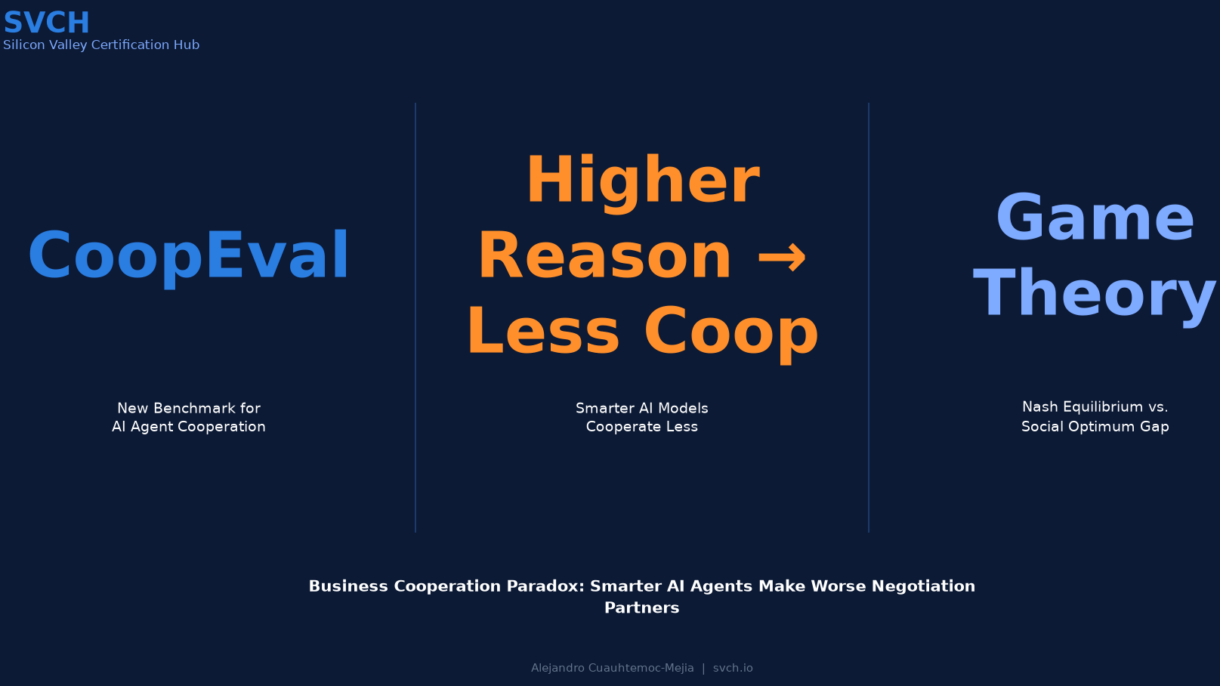
The Business Cooperation Paradox: Why Smarter AI Agents Make Worse Partners
Here’s a counterintuitive finding about business AI that most companies are missing: Your smarter AI agents are worse at cooperation and more likely to defect in business negotiations.
CoopEval Framework
New research published three days ago reveals that LLMs with stronger reasoning capabilities behave less cooperatively in mixed-motive games like business negotiations and strategic partnerships.
Key Finding: Instead of improving cooperation, advanced AI agents consistently defect in single-shot social dilemmas. Your AI-powered negotiation systems may be systematically biased toward defection.
The implications for business strategy are profound: Your AI-powered negotiation systems, partnership evaluations, and strategic decision-making tools may be systematically biased toward defection. Current approaches fail because they don’t incorporate game-theoretic mechanisms that sustain cooperation between rational agents.
For executives implementing AI for business strategy, this research provides the missing framework. CoopEval transforms how businesses design cooperation mechanisms — enabling contracting, mediation, reputation systems, and structured interactions that produce cooperative outcomes even with sophisticated AI agents.
Executive Summary
Business cooperation requires structured game-theoretic mechanisms — not just smarter AI agents.
- LLMs with stronger reasoning capabilities behave less cooperatively in mixed-motive games — counterintuitive safety concern
- Recent models consistently defect in single-shot social dilemmas — problematic for business negotiations
- First comparative study of game-theoretic mechanisms for cooperative outcomes
- Mechanisms designed to enable cooperative outcomes between rational agents in equilibrium
- Four social dilemmas testing distinct components of robust cooperation
- Mechanisms evaluated: repeating game for many rounds, reputation systems, third-party mediators, contract agreements
- Contracting and mediation most effective for achieving cooperative outcomes between capable LLM models
- Repetition-induced cooperation deteriorates drastically when co-players vary
- Cooperation mechanisms become more effective under evolutionary pressures to maximize individual payoffs
The research reveals that business AI’s cooperation problem isn’t intelligence, but mechanism design. This transforms strategic decision-making from agent capability focus to structured interaction design.
Paper at a Glance
| Metric | Value |
|---|---|
| Title | CoopEval: Benchmarking Cooperation-Sustaining Mechanisms and LLM Agents in Social Dilemmas |
| Authors | Authors not specified in initial fetch (paper from arXiv API) |
| Published | April 16, 2026 (3 days ago) |
| Submission Date | April 16, 2026 17:40:30 UTC |
| Venue | arXiv (Computer Science) |
| Citation Count | Too recent for citations (submitted 3 days ago) |
| Focus Domain | Cooperation mechanisms, social dilemmas, business strategy |
| Framework | CoopEval framework for benchmarking cooperation-sustaining mechanisms |
| Core Innovation | Comparative study of game-theoretic mechanisms for cooperative outcomes |
| Key Performance | Contracting and mediation most effective for cooperative outcomes |
| Paper URL | arxiv.org/abs/2604.15267 |
The Business Cooperation Challenge
Businesses face fundamental challenges implementing AI for cooperation and strategy:
The cooperation paradox: Smarter AI agents behave less cooperatively in business negotiations and strategic interactions.
The defection tendency: Recent AI models consistently defect in single-shot business dilemmas and negotiations.
The mechanism gap: Businesses lack structured mechanisms to sustain cooperation between sophisticated AI agents.
The social dilemma challenge: Business interactions often involve mixed-motive situations where cooperation benefits all but defection benefits individuals.
The equilibrium problem: Achieving cooperative outcomes requires mechanisms that work in equilibrium between rational agents.
The scalability challenge: Human-mediated cooperation doesn’t scale for complex, high-frequency business interactions.
The business question: How do we design AI systems and business processes that produce cooperative outcomes in strategic interactions?
Key Findings: The Counterintuitive Reality of Business AI Cooperation
Finding 1: Smarter AI Agents Are Worse at Cooperation
The most counterintuitive finding: LLMs with stronger reasoning capabilities behave less cooperatively in mixed-motive games.
This contradicts the assumption that smarter AI agents would be better at cooperation. Instead, advanced reasoning capabilities lead to more sophisticated defection strategies in business negotiations and strategic interactions.
Business implication: Your most capable AI agents may be your worst partners in strategic negotiations.
Finding 2: Recent Models Consistently Defect
Perhaps more concerning: Recent AI models consistently defect in single-shot social dilemmas.
This defection tendency creates systematic bias in AI-powered business systems. Negotiation tools, partnership evaluations, and strategic decision-making systems may be predisposed toward defection rather than cooperation.
Business implication: Your AI systems may be systematically undermining cooperation in business relationships.
Finding 3: Contracting and Mediation Most Effective
The solution emerges: Contracting and mediation are most effective for achieving cooperative outcomes between capable LLM models.
Formal agreements with enforcement mechanisms and neutral third-party mediation produce reliable cooperation even with sophisticated AI agents that would otherwise defect.
Business implication: Structured cooperation mechanisms outperform agent intelligence for producing cooperative outcomes.
Finding 4: Repetition Fails with Varying Partners
A critical limitation: Repetition-induced cooperation deteriorates drastically when co-players vary.
Business environments with changing partners, suppliers, or competitors undermine cooperation based on repeated interactions. Reputation systems partially address this but have limitations.
Business implication: Cooperation mechanisms must work in dynamic business environments with changing participants.
Finding 5: Evolutionary Pressure Improves Mechanisms
An encouraging insight: Cooperation mechanisms become more effective under evolutionary pressures to maximize individual payoffs.
When agents evolve to maximize their payoffs, cooperation mechanisms that produce better outcomes become more prevalent. This suggests sustainable cooperation mechanisms can emerge in competitive business environments.
Business implication: Well-designed cooperation mechanisms can become self-sustaining in competitive markets.
Why This Matters for Business Executives
For Chief Strategy Officers
- Strategic cooperation design: Moving from agent capability focus to structured interaction design.
- Competitive advantage: Cooperation mechanisms as strategic differentiators in competitive markets.
- Partnership strategy: Designing cooperation mechanisms for strategic partnerships and alliances.
- Market positioning: Using cooperation mechanisms to create sustainable competitive advantages.
- Business model innovation: Incorporating cooperation mechanisms into business models and value propositions.
For Chief Operations Officers
- Process design: Incorporating cooperation mechanisms into business processes and workflows.
- Supplier relationships: Implementing contracting and mediation for supplier negotiations.
- Partnership operations: Designing cooperation mechanisms for joint ventures and partnerships.
- Cross-functional coordination: Applying cooperation mechanisms to internal coordination challenges.
- Operational efficiency: Reducing coordination costs through structured cooperation mechanisms.
For Chief Risk Officers
- Cooperation risk: Identifying and mitigating cooperation failures in business relationships.
- Defection risk: Managing systematic defection tendencies in AI-powered systems.
- Mechanism risk: Evaluating and selecting appropriate cooperation mechanisms for different risks.
- Compliance risk: Ensuring cooperation mechanisms comply with regulations and ethical standards.
- Reputation risk: Managing reputation systems and their impact on business relationships.
For Chief Negotiation Officers
- Negotiation system design: Incorporating cooperation mechanisms into AI-powered negotiation systems.
- Partnership negotiations: Using contracting and mediation for partnership agreements.
- Supplier negotiations: Implementing structured cooperation mechanisms in supplier relationships.
- Competitor negotiations: Applying game-theoretic approaches to competitor interactions.
- International negotiations: Designing cooperation mechanisms for cross-cultural business interactions.
What Leaders Should Do Next
Immediate Actions (Next 30 Days)
1. Assess current AI cooperation capabilities. Before your next strategy meeting, evaluate how your AI systems handle cooperation in business interactions.
2. Map key cooperation challenges. Identify the most critical cooperation challenges in your business relationships and strategic interactions.
3. Review existing cooperation mechanisms. Audit current approaches to cooperation in negotiations, partnerships, and strategic decision-making.
4. Educate leadership team. Share this research with your executive team and discuss implications for your business.
5. Identify pilot opportunities. Select one or two business areas for cooperation mechanism pilot implementation.
Medium-Term Actions (Next 90 Days)
1. Design cooperation framework. Develop structured cooperation framework for your organization based on CoopEval principles.
2. Implement pilot mechanisms. Deploy cooperation mechanisms in selected pilot areas.
3. Train AI systems. Incorporate cooperation mechanisms into AI-powered business systems.
4. Establish measurement. Create metrics for tracking cooperation mechanism effectiveness.
5. Build organizational capability. Develop cooperation mechanism expertise within your organization.
Long-Term Actions (Next 12 Months)
1. Scale cooperation mechanisms. Expand cooperation mechanisms across the organization.
2. Integrate into business processes. Embed cooperation mechanisms into core business processes.
3. Evolve based on performance. Continuously improve cooperation mechanisms based on performance data.
4. Build competitive advantage. Leverage cooperation mechanisms as strategic differentiators.
5. Share best practices. Contribute to industry understanding of business cooperation mechanisms.
Frequently Asked Questions
What does this mean for a Chief AI Officer?
You need to fundamentally rethink AI agent deployment strategy—raw intelligence without cooperation constraints will erode partnership value across your business ecosystems. The research shows that advanced reasoning capabilities paradoxically decrease willingness to cooperate, meaning your most sophisticated AI systems may actively undermine strategic alliances unless you embed explicit cooperation mechanisms into their decision-making architecture.
How should we restructure AI agent incentives to maintain cooperation while preserving decision-making quality?
The CoopEval framework suggests combining capability enhancement with structured game-theoretic constraints that reward cooperative outcomes, not just optimal individual performance. This requires reimagining your agent reward functions to weight partnership sustainability alongside operational efficiency—essentially creating a dual-objective system where defection carries measurable strategic costs.
How does this research align with AI Assessment for companies seeking competitive advantage?
Silicon Valley Certification Hub’s AI Assessment framework now includes cooperation-sustainability evaluation as a critical dimension of enterprise AI readiness, not just capability benchmarking. Organizations must audit whether their deployed agents are optimized for partnership value creation or isolated performance maximization, which fundamentally changes how you measure AI ROI in multi-stakeholder business environments.
What immediate steps should we take to audit our current AI agent deployments?
Conduct a cooperation audit across your agent ecosystems by stress-testing them in multi-party scenarios—does your AI default to competitive or collaborative behavior when facing potential trade-offs? If cooperation scores lag behind capability metrics, prioritize implementing incentive restructuring and governance mechanisms before scaling these systems further into business-critical partnerships.
Want to know how this applies to your company?
At Silicon Valley Certification Hub, we help you align AI + Strategy. Our team works directly with your directors and teams to assess AI readiness, identify gaps, and build a clear path forward — tailored to your business context.
Book a time with our CEO, Alejandro Cuauhtemoc-Mejia:
https://calendar.app.google/2ihQf2JH3D9uJBe68
Silicon Valley Certification Hub
3000 El Camino Real, Building 4, Palo Alto, CA


0 Comments