

One Compromised AI Vendor, 194 Banks: How AI Concentration Became Financial Contagion — Silicon Valley Certification Hub Chief AI Officer Research
🏢 Independent Research
📅 September 2026
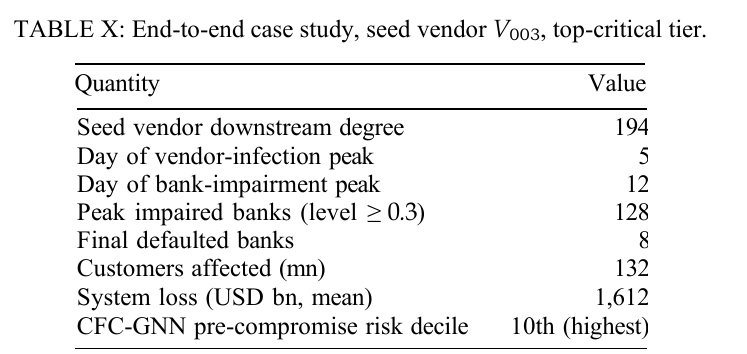
One compromised software vendor at the top of the stack put 194 banks in the path of the blast. Of those, 128 ended up impaired, 8 defaulted, and the model puts the mean system loss at 1,612 billion dollars. That is a single vendor in a single simulation.
The paper is called Cyber-Financial Contagion, and it looks at something most boards have not priced yet. Banks now run fraud screening, credit decisioning, anti-money-laundering triage, customer analytics, and internal decision support through a small set of shared AI vendors. The vendors are different companies on paper. In a crisis, they are the same choke point.
I read this paper twice. The first time I was looking for the technical trick. The second time I understood the point: this is not a cybersecurity story. It is a counterparty and concentration risk story, and every finance leader already knows how to reason about those.

Why This Paper Matters
Companies spent 2026 wiring AI into the decisions that move money. Fraud scoring, credit approval, AML alert triage, collections. Almost all of it was bought, not built, and almost all of it came from a handful of vendors that sell to everyone.
That creates a risk shape most risk registers still miss. Traditional vendor risk asks what happens to me if my vendor fails. This paper asks a harder question: what happens to the system when a vendor that all of us share fails at once?
For a Chief AI Officer, this is the missing connective tissue between AI governance and financial stability. You can have pristine model risk documentation, a clean AI Assessment for companies across every business line, and still be sitting on an unpriced concentration exposure because three of your critical AI vendors also happen to be three of your competitors’ critical AI vendors.
Methodology, Explained Simply
Picture four layers stacked on top of each other. At the top are the AI vendors. Below them sit the banks that buy their services. Below the banks are the loans and exposures banks have to each other. At the bottom are customer accounts, the millions of people whose money actually moves.
An incident does not stay in its layer. It enters at the top and walks down. A vendor gets compromised, its bank customers lose a service they cannot work around that day, those banks start leaning on their peers for liquidity, and eventually the strain reaches the depositors. The paper calls the model CFC-Prop, and the honest translation is a contagion simulator bolted onto a bank-stress simulator.
The second tool is the part I found more useful. CFC-GNN is an early-warning model. It watches incident telemetry on the vendor side plus the shape of the network and tries to flag which vendors carry the biggest cascade risk before anything has actually gone wrong. Think of it as a smoke detector for the vendor layer.
The authors ran this on a synthetic dataset and released the code, the data, and the scripts. Synthetic data has limits, and I will come back to that. Still, the structure is sound and the question it answers is real.
Results and Practical Insights
The early-warning model reaches AUROC 0.82 and AUPRC 0.60 against four baselines. That is strong enough to be worth building on and honest enough that it will miss things. The paper keeps its calibration errors bounded, which matters more than the headline number if you ever want a risk committee to trust it.
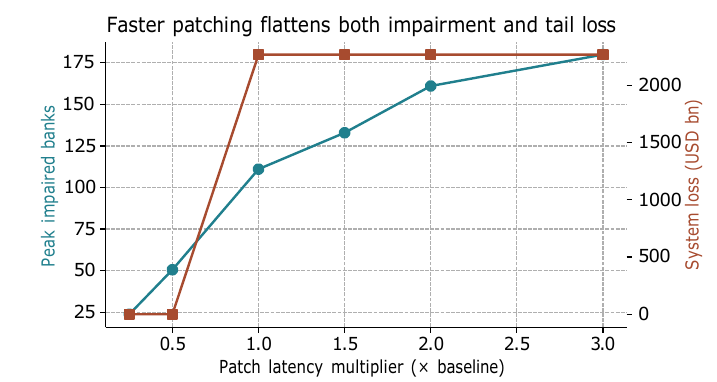
Here is the finding that changed how I think about this. Loss severity is dominated by patch latency. Not by how clever the attacker is. Not by which vendor got hit. How long it takes you to patch the hole.
The curve is convex. The damage climbs slowly at first and then falls off a cliff as the clock runs. Patch twice as fast and you do not halve the loss, you cut it far more than that. That convexity is the entire business case. It says spend on patch velocity instead of spreading your third-party risk budget evenly across a long list of vendors.
The case study is the one to put in front of a board. Seed vendor V003, top-critical tier. The infection peaks on day 5. Impairment peaks on day 12. By then 194 banks are downstream, 128 are impaired, 8 default, and 132 million customers are in the affected footprint. The early-warning model had already placed that vendor in its highest risk decile before impact.
That last sentence is the part worth arguing about internally. The paper is not claiming you can predict the future. It is claiming that a vendor concentrating this much systemic load gives off detectable signals, and nobody is watching for them.
If your three most critical AI vendors went dark for a week, could your finance team price the damage?
At Silicon Valley Certification Hub, we help finance and risk leaders evaluate and deploy AI that fits their actual business processes, including the concentration exposure nobody put on the risk register.
How This Changes AI Assessment for Companies
Most third-party risk programs were built for a world where vendors failed alone. They score vendors on their own security posture, their own financial health, their own uptime history. None of that captures what this paper is describing, because the danger is not the vendor’s weakness. The danger is the vendor’s reach.
A proper AI Assessment for companies now needs a concentration layer on top of the standard vendor review. How many of your critical processes depend on this vendor. How many of your peers depend on the same one. How fast could you actually switch if you had to. And what is your measured patch latency on a critical incident, not your policy, your actual median.
That reframing belongs to whoever owns AI at the top of the house. This is why the Chief AI Officer role has moved from a technology hire to a risk hire. The job is no longer just picking models. It is knowing which ones the whole system is standing on.
Key Takeaways for Finance and Risk Leaders
Thanks to All Authors
Want to know how this applies to your company?
At Silicon Valley Certification Hub, we help you align AI + Strategy. Our team works directly with your directors and teams to assess AI readiness, identify gaps, and build a clear path forward — tailored to your business context.
Book a time with our CEO, Alejandro Cuauhtemoc-Mejia:
https://calendar.app.google/2ihQf2JH3D9uJBe68
Silicon Valley Certification Hub — 3000 El Camino Real, Building 4, Palo Alto, CA

0 Comments