

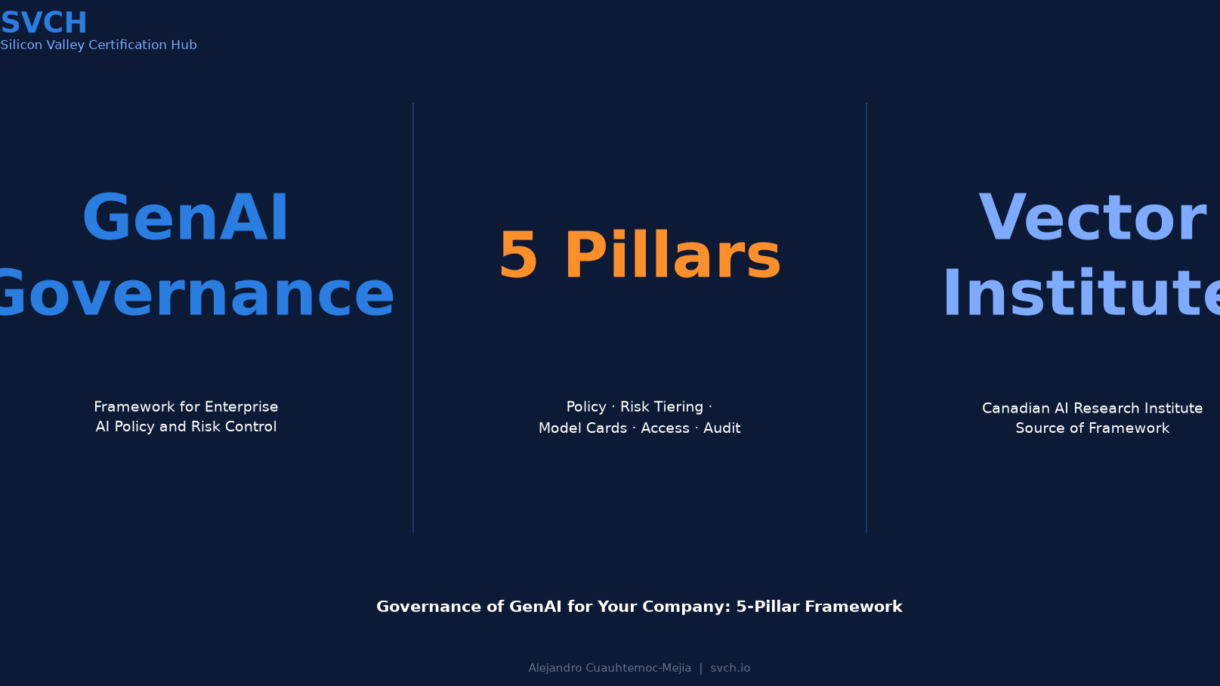
A new white paper from the Vector Institute and Western University, “Approaches to Responsible Governance of GenAI in Organizations,” offers a practical roadmap for embedding AI governance at every stage of enterprise adoption.
By Himanshu Joshi , Shabnam Hassani , Dhari Gandhi, PMP, MMAI Vector Institute , and Lucas Hartman Western University
The Governance Playbook for GenAI
Vector Institute for Artificial Intelligence and Western University have developed one of the most comprehensive frameworks for governing GenAI in organizations.
Their white paper “Approaches to Responsible Governance of GenAI in Organizations” offers a layered, practical roadmap for executives, compliance teams, and AI leads looking to scale innovation.
💡 5 Takeaways for Leaders & Builders
- Governance Must Be Embedded at Every Stage
- Balance Innovation and Risk
- Custom Tools for Real-World Use
- Cross-Functional Governance Teams
- Continuous Monitoring and Adaptation

At SVCH (Silicon Valley Certification Hub), we equip non-technical executives and professionals with the tools to lead responsibly in the age of AI. This paper reinforces exactly why governance can no longer be treated as an afterthought.
- How to evaluate GenAI risk and compliance
- How to build governance into AI project workflows
- How to align AI systems with organizational values and regulations
If you’re building or managing AI in your org, this framework is a must-read—and our certifications will help you turn these principles into practice.
📄 Read the full paper:
Approaches to Responsible Governance of GenAI in Organizations
Frequently Asked Questions
What does this mean for a Chief AI Officer?
This governance framework shifts your role from purely technical oversight to strategic risk management across the entire organization. You’re now accountable for embedding compliance, ethical standards, and cross-functional accountability into every AI initiative from conception through deployment, rather than addressing governance as a reactive compliance measure.
How should we balance moving fast with GenAI innovation while maintaining proper governance controls?
The Vector Institute’s framework advocates for embedding governance at each stage of development rather than treating it as a gate that slows projects down. This means establishing clear decision criteria, risk thresholds, and approval workflows upfront so teams can move quickly within a structured guardrail system that actually accelerates responsible deployment.
Where should we start if we don’t have a formal GenAI governance structure in place?
Begin with an AI Assessment for companies to understand your current AI footprint, identify compliance gaps, and establish baseline risk exposure across your organization. Resources like Silicon Valley Certification Hub’s certifications can help your leadership team develop the shared language and frameworks needed to build governance from the ground up rather than retrofitting it later.
What’s the first action our executive team should take after reading this governance playbook?
Establish a cross-functional governance committee with representation from legal, compliance, operations, and business units to collaboratively design your organization’s GenAI guardrails and decision-making process. This committee should map your current AI use cases against the Vector Institute’s framework and create a 90-day roadmap to implement the highest-priority governance controls.
Want to know how this applies to your company?
At Silicon Valley Certification Hub, we help you align AI + Strategy. Our team works directly with your directors and teams to assess AI readiness, identify gaps, and build a clear path forward — tailored to your business context.
Book a time with our CEO, Alejandro Cuauhtemoc-Mejia:
https://calendar.app.google/2ihQf2JH3D9uJBe68
Silicon Valley Certification Hub
3000 El Camino Real, Building 4, Palo Alto, CA


0 Comments