

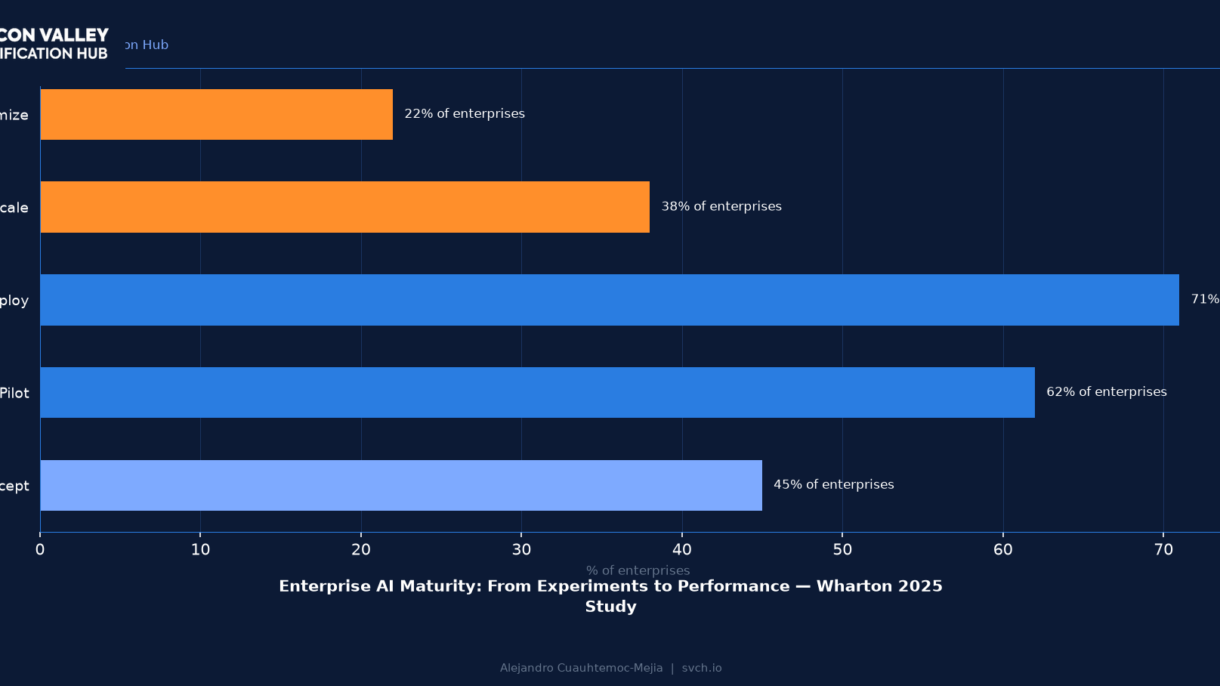
Based on the 2025 Wharton Human-AI Research & GBK Collective Report
The latest study from Wharton Human-AI Research and GBK Collective offers one of the clearest pictures to date of how organizations are evolving in their adoption of generative AI. The report is led by Dr. Stefano Puntoni, Professor of Marketing and Faculty Co-Director of Wharton Human-AI Research; Dr. Prasanna Tambe, Professor of Operations and Information at Wharton; and Jeremy Korst, Wharton MBA and Partner at GBK Collective.
Over the past three years, the enterprise relationship with AI has undergone a significant shift. What began as experimentation has now matured into what the authors call “Accountable Acceleration” — a stage where AI is no longer judged by its promise or novelty, but by its performance.

As the report notes:
“Three years in, the story is clear: from exploration to experimentation to everyday use. ROI is now measured, and people, not tools, set the pace.”
This transition marks an inflection point. The question is no longer whether companies are using AI, but how effectively, and with what measurable outcomes.
The study describes the end of the experimental phase and the arrival of what the authors call “Accountable Acceleration”: a phase where AI is evaluated not for novelty, but for outcomes, efficiency, confidence, and organizational capability. According to the report, 82% of enterprise leaders now use generative AI at least weekly.
How AI Tools Are Actually Being Used: A Market Consolidation Story
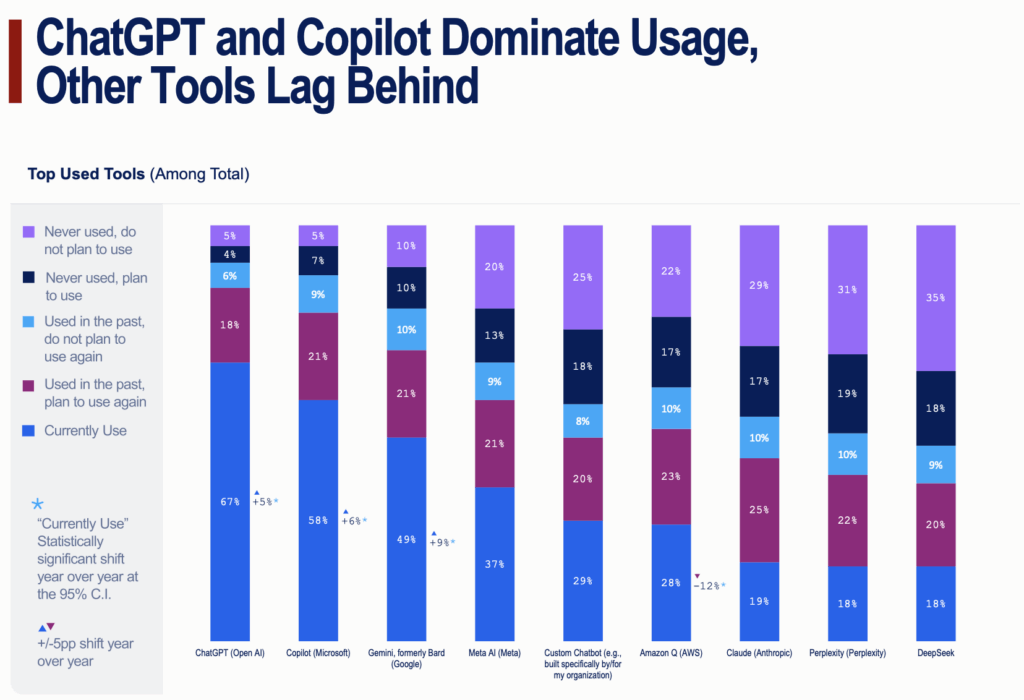
The first graph in the report compares usage patterns across major generative AI tools. The findings are unambiguous:
- ChatGPT and Microsoft Copilot dominate adoption.
- Google’s Gemini is gaining traction, but at a slower rate.
- Enterprise-specific or industry-specific chatbots are widely tested, but not yet widely standardized.
- Other tools like Perplexity, Claude, and DeepSeek see much lower sustained usage.
This reflects a natural consolidation dynamic familiar from previous platform eras (e.g., Windows in desktop OS, Salesforce in CRM). Once workflows and habits form, they reinforce themselves.
This matters because it means training, governance, and capability-building can now be designed around a smaller set of core tools, increasing efficiency and reducing complexity.
Speed of Adoption: Small and Mid-Sized Enterprises Are Moving Faster
The second graph compares adoption speed across organizations of different revenue sizes.
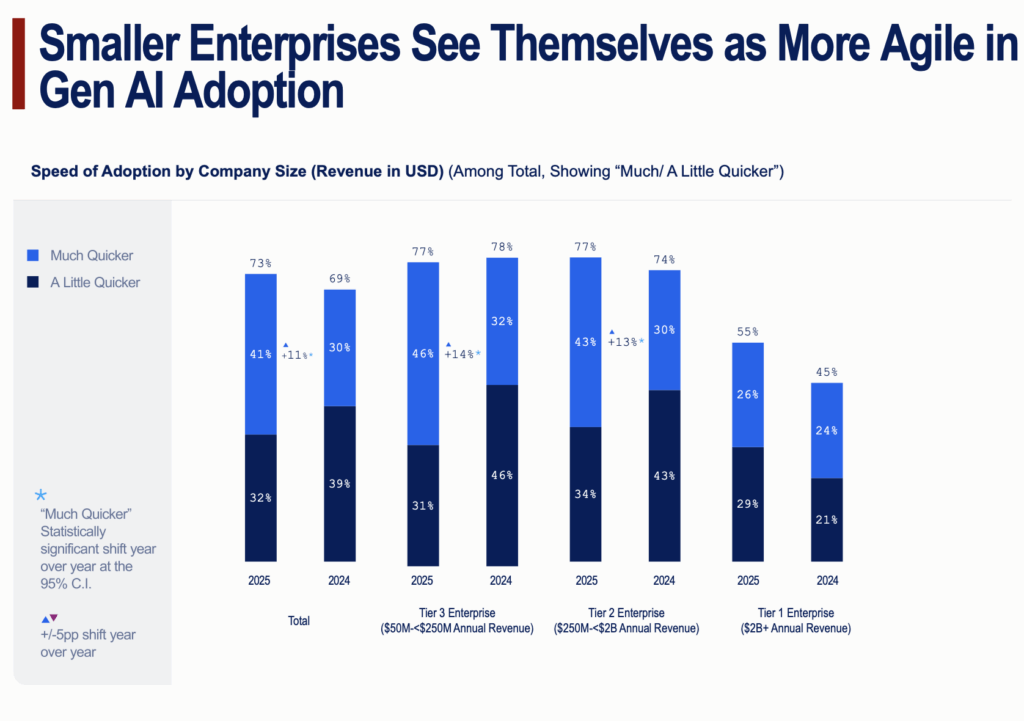
The data shows that:
- Smaller enterprises ($50M–$250M) are adopting AI the fastest.
- Mid-sized enterprises ($250M–$2B) follow closely.
- Large enterprises ($2B+) show the slowest perceived speed of internal AI rollout.
This reflects structural realities:
Large organizations are complex. They carry legacy systems, compliance constraints, and layered decision-making. Smaller organizations have fewer roadblocks and can reconfigure workflows faster.
This does not mean large organizations cannot catch up.
But it means enterprise AI transformation is now fundamentally a change-management discipline, not an AI-model selection challenge.
The authors highlight this clearly:
“Smaller and mid-sized enterprises report greater agility and faster adoption cycles, while larger enterprises face organizational inertia.”
Where AI Is Used Daily: The Work Has Become Practical
The third graph tracks daily use of Gen AI across functional roles.
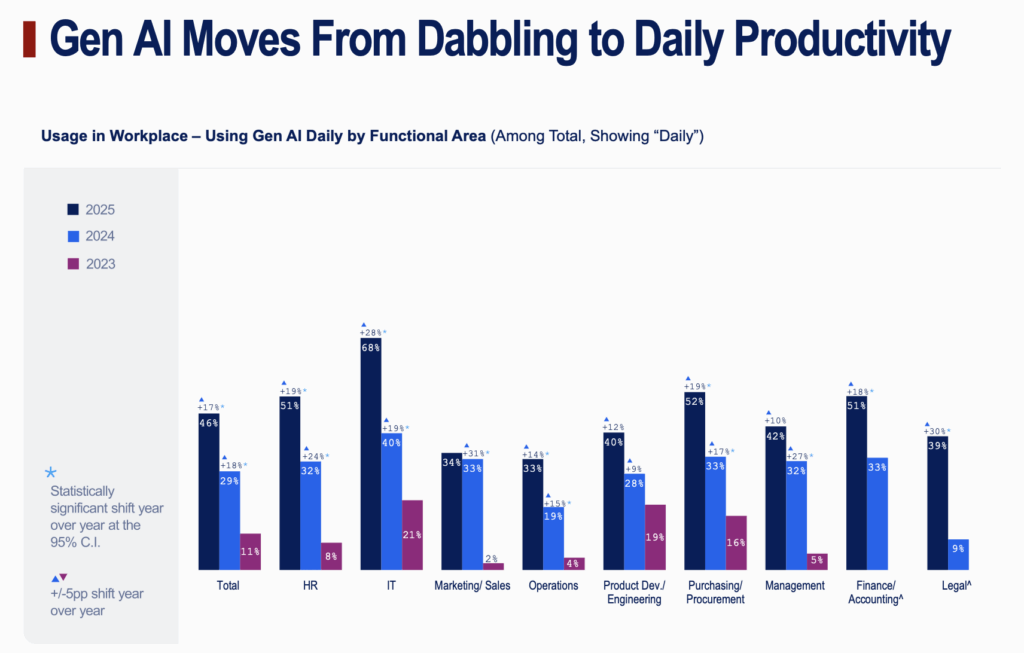
The progression over the last three years is dramatic:
- IT and Engineering show sustained, deep integration.
- HR and Finance now show strong adoption — signaling AI is no longer just a tool for technical teams.
- Legal sees one of the biggest jumps — driven by contract drafting, summarization, and document review.
- Marketing and Operations, while active, lag in structured enablement and workflow redesign.
The takeaway is clear:
AI has moved from specialized testing to general administrative and strategic utility.
The authors summarize this shift:
“Gen AI has moved from dabbling to daily productivity.”
This aligns with broader research from MIT Sloan and Harvard Business Review, where value emerges when AI supports knowledge coordination and reasoning tasks, not just automation.
Why This Moment Matters
Technology is ready.
Budgets are increasing.
ROI is measurable.
Usage is widespread.
The differentiating factor now is:
Leadership capability.
Organizations that succeed from here will not be the ones with the most tools —
but the ones with:
- Clear AI ownership (often in the CAIO role)
- Structured training and certification for managers and teams
- Governance that creates trust and confidence
- Redesign of workflows, not just layering tools onto old processes
This is why the enterprise AI maturity gap is widening — not because of access to models, but because of differences in organizational learning.
Frequently Asked Questions
What does this mean for a Chief AI Officer?
Your role has fundamentally shifted from proving AI’s potential to demonstrating measurable business impact—the study shows enterprises now measure ROI and hold AI initiatives accountable to performance metrics rather than technological novelty. This means your success depends on embedding AI capabilities into everyday operations with clear outcome tracking, not maintaining isolated pilot projects. You’ll need to partner closely with business unit leaders to ensure AI adoption is driven by organizational needs and human capability, not tool proliferation.
How should organizations transition from AI experimentation to sustainable performance-based deployment?
The Wharton report indicates that moving from experimentation to “Accountable Acceleration” requires establishing clear performance benchmarks before scaling AI initiatives, ensuring your teams can measure efficiency gains and confidence metrics consistently. Rather than launching multiple disconnected pilots, prioritize deeper integration of AI into core workflows where outcomes can be quantified and tied to business objectives. This approach transforms AI from a technology initiative into an operational capability that stakeholders understand and trust.
How does an AI Assessment for companies help navigate this transition?
A comprehensive AI Assessment from Silicon Valley Certification Hub evaluates your organization’s readiness across people, processes, and technology—directly addressing the research finding that human capability, not tools, sets the pace for successful deployment. This assessment identifies gaps between your current experimental phase and the performance-driven stage the market is moving toward, providing a roadmap for accountable acceleration. By establishing a baseline assessment, you can benchmark your AI maturity against industry peers and prioritize investments that deliver measurable outcomes rather than theoretical promise.
What’s the most important action executives should take right now based on these findings?
Audit your current AI initiatives to determine which ones have clear ROI metrics and measurable business outcomes—the report signals that organizations still in pure exploration mode risk falling behind competitive benchmarks. Establish a governance framework that connects AI deployment directly to organizational performance metrics and ensures your teams have the skills and clarity to operate in this new “Accountable Acceleration” phase. Without this shift toward measurement and accountability, even promising AI investments will struggle to secure continued funding and stakeholder support.
Want to know how this applies to your company?
At Silicon Valley Certification Hub, we help you align AI + Strategy. Our team works directly with your directors and teams to assess AI readiness, identify gaps, and build a clear path forward — tailored to your business context.
Book a time with our CEO, Alejandro Cuauhtemoc-Mejia:
https://calendar.app.google/2ihQf2JH3D9uJBe68
Silicon Valley Certification Hub
3000 El Camino Real, Building 4, Palo Alto, CA


0 Comments