

Institution: Massachusetts Institute of Technology | Published: May 2025
Researchers: Nataliya Kosmyna, Caitlin Morris, Olivia Hauptman, Ye Yint Aung, Pattie Maes
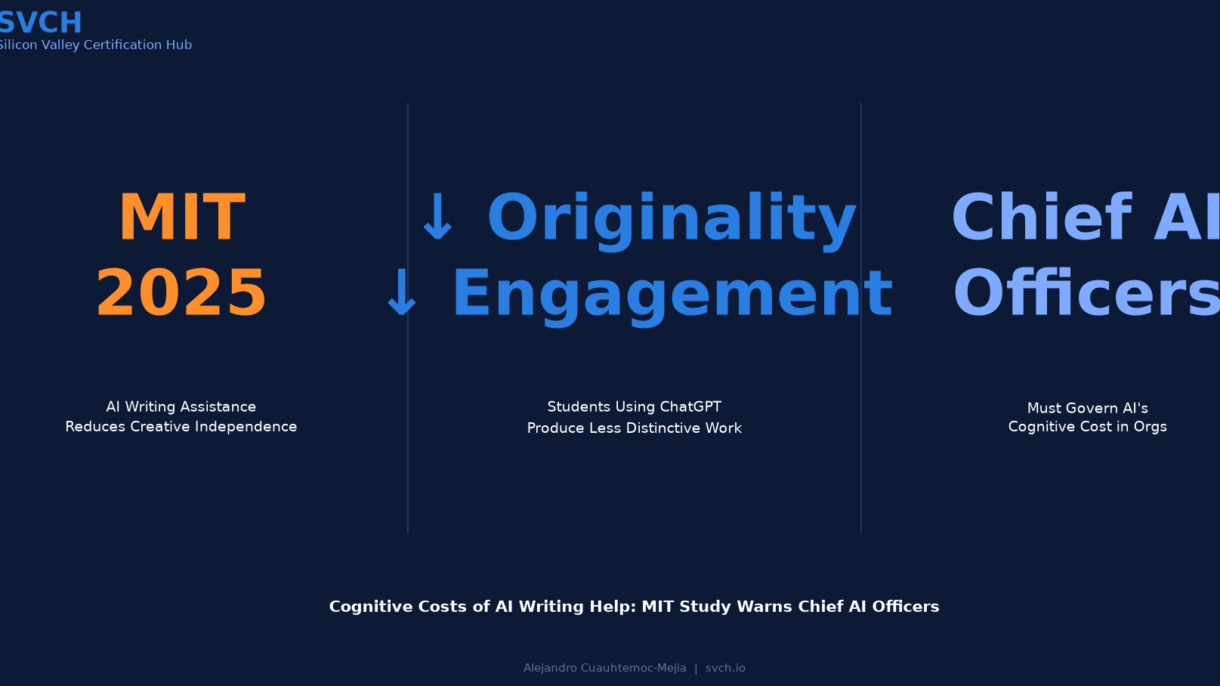
A 2025 MIT Media Lab study found that using ChatGPT for writing measurably lowers memory retention, creativity, and personal ownership of the finished work compared to writing unaided — a pattern researchers call “cognitive debt.” The promise of AI writing assistance is speed and polish. Type a prompt, receive a paragraph, refine and ship. But a new MIT study asks the question that productivity dashboards never measure: what does your organization lose in the exchange?
Researchers at the MIT Media Lab divided participants into three groups — one writing entirely without AI, one writing with full ChatGPT assistance, and one given brain-computer interface support. Students who used ChatGPT wrote essays faster and with fewer surface errors. They also scored significantly lower on creativity assessments, retained far less about the topics they wrote on, and reported a weaker sense of personal ownership over the finished work. The study calls this accumulation of cognitive debt.
For executives running knowledge-work organizations — and for every Chief AI Officer evaluating enterprise AI writing deployments — this is not an education story. It is a workforce capability story. And it arrives at a moment when AI writing tools have become standard infrastructure across legal, marketing, strategy, and finance teams.
Why This Research Matters to Every Chief AI Officer
The enterprise AI adoption conversation has been almost entirely about productivity gains: faster drafts, broader coverage, lower cost-per-output. What it has not measured is the cognitive cost on the human side — the skills that atrophy when writing becomes a delegation task rather than a thinking task.
This MIT study introduces a framework that should be part of every AI readiness evaluation: cognitive debt. The researchers define it as the intellectual deficit that accumulates when AI handles cognitive work that previously built expertise, memory, and judgment. In a writing context, that means the lawyer who no longer constructs arguments from scratch, the strategist who no longer synthesizes research into narrative, the analyst who no longer owns the logic chain behind a recommendation.
The study’s findings are a warning that belongs in boardrooms and in every serious AI Assessment for companies. Not because AI writing tools should be banned, but because organizations deploying them without a cognitive-cost accounting framework are making an invisible trade: short-term output efficiency for long-term knowledge atrophy.
Critical Insight — MIT Media Lab, 2025
AI writing assistance does not just change how people write — it changes what they remember and how much they care.
Students who used ChatGPT showed measurably lower memory retention and significantly weaker ownership of their finished essays compared to students who wrote without assistance. The gap was not marginal. It was systematic, consistent across participants, and present regardless of prior writing ability.
Methodology, Explained Simply
The MIT Media Lab team recruited college-age participants and assigned them to one of three conditions: write an essay without AI, write with full ChatGPT access, or write with EEG-based brain-computer interface support. Participants completed multiple writing sessions on substantive topics across domains — science, social policy, and current events.
After writing, participants were tested on memory retention: how well they could recall the content, arguments, and specific claims from their own essays. They also completed surveys measuring personal ownership — whether they felt the work reflected their thinking, whether they would stand behind the arguments, and how connected they felt to the finished text. A separate panel evaluated the essays for creativity, originality, and divergent reasoning.
The study controlled for prior writing ability, topic familiarity, and time-on-task. The ChatGPT group spent comparable time on each essay but invested less of that time in generative thinking — they spent more time directing, selecting, and editing AI output rather than building arguments from their own cognition.
Results and Practical Insights
The creativity gap is the finding most likely to alarm knowledge-work leaders. The AI-assisted essays were polished but converged on conventional arguments. They were less surprising, less original, and more likely to recycle the most common framings of each topic. This is not a failure of the writers — it is a predictable outcome of LLM architecture. Models trained to predict the most likely next token produce the most likely arguments. Originality is not a default output.
The memory retention finding is more urgent. Students who wrote without AI remembered significantly more about what they had written — the arguments they made, the evidence they cited, the positions they took — when tested in a follow-up session. The ChatGPT group retained materially less. The act of constructing an argument from scratch encodes it into memory in ways that selecting and editing AI output does not. In an organizational context, this is the difference between a strategist who genuinely understands the market analysis they authored and one who can locate the relevant slide deck.
The ownership gap has the most underappreciated organizational consequences. Participants who used ChatGPT were less likely to defend the arguments in their essays, less likely to revise them based on feedback, and reported lower confidence that the work represented their actual views. Scale this across a legal team generating AI-assisted briefs or a product team writing AI-assisted strategy documents, and the implications for accountability, revision, and institutional knowledge are significant.
Key Takeaways for AI Leaders and the Chief AI Officer Role
-
1
Add cognitive-cost accounting to your AI deployment framework
Productivity gains are visible; cognitive debt is not. Any enterprise deployment of AI writing tools should include a mechanism for tracking skill retention and knowledge ownership over time, not just output volume and speed.
-
2
Design AI writing tools as amplifiers, not replacements
The study’s BCI group — which used AI as a feedback and enhancement layer, not a generation layer — showed a different cognitive profile. The design choice of where AI enters the writing process determines whether it builds or erodes human capability.
-
3
Identify which roles cannot afford to outsource cognition
For roles where deep expertise, memory of precedent, and original judgment are competitive advantages — senior legal counsel, lead analysts, strategic advisors — AI writing delegation is a different risk calculation than for roles primarily producing templated or routine content.
-
4
Build organizational memory systems that don’t depend on AI outputs alone
If AI-generated content is not deeply understood or owned by the humans who commissioned it, that content cannot be revised, defended, or built upon. Organizations need human-anchored knowledge systems — not just AI-generated document repositories.
-
5
Make cognitive sustainability a pillar of your AI governance policy
The most forward-looking AI governance frameworks are already moving beyond compliance and toward capability stewardship: ensuring that AI augments human judgment rather than replacing the cognitive work that develops it. Silicon Valley Certification Hub teaches this principle inside the CAIO-CP™ curriculum as a core governance responsibility.
Thanks to the Researchers
- Nataliya Kosmyna — MIT Media Lab, Massachusetts Institute of Technology, Cambridge, MA
- Caitlin Morris — MIT Media Lab, Massachusetts Institute of Technology, Cambridge, MA
- Olivia Hauptman — MIT Media Lab, Massachusetts Institute of Technology, Cambridge, MA
- Ye Yint Aung — MIT Media Lab, Massachusetts Institute of Technology, Cambridge, MA
- Pattie Maes — MIT Media Lab, Massachusetts Institute of Technology, Cambridge, MA
Frequently Asked Questions
What does this mean for a Chief AI Officer?
This study reframes the Chief AI Officer’s governance mandate. It is not sufficient to measure AI’s contribution to output volume; the CAIO must also track its effect on workforce cognition, knowledge retention, and expertise development. Organizations that deploy AI writing tools without a cognitive-sustainability framework may be quietly trading long-term capability for short-term throughput.
What exactly is “cognitive debt” and why does it compound?
Cognitive debt, as defined in this MIT study, is the intellectual deficit that accumulates when AI handles generative thinking tasks that previously built human expertise. Like financial debt, it compounds: the less you write from scratch, the less writing builds your memory, analytical depth, and creative range — and the more dependent on AI assistance you become for future tasks.
Should an AI Assessment for companies include cognitive-impact evaluation?
Yes — and this research makes the case for including it. An AI Assessment for companies that only audits productivity, cost savings, and compliance leaves out a significant dimension: how AI tool deployment is affecting the cognitive capability of the workforce over time. Silicon Valley Certification Hub integrates this dimension into its AI readiness methodology, looking at both efficiency gains and human-capability risk.
Does this finding apply to all knowledge workers or only student writers?
The study used student populations for experimental control, but the cognitive mechanisms — encoding, retrieval, ownership — are not age-specific. Professional writers, analysts, and advisors who use AI writing assistance face the same neurological dynamic: if the generative cognition is outsourced, the memory and ownership benefits of that cognition do not accrue. The organizational stakes are simply higher.
What should executives do now to govern AI writing tools responsibly?
Start by mapping which roles in your organization use AI writing tools for high-cognition tasks — strategy, legal argument, analysis — versus templated or routine output. For high-cognition roles, establish policies that require a first draft without AI assistance before editing with it. Then build periodic skill assessments into the AI governance calendar to detect cognitive debt before it becomes a capability gap.
Want to know how this applies to your company?
At Silicon Valley Certification Hub, we help you align AI + Strategy. Our team works directly with your directors and teams to assess AI readiness, identify gaps, and build a clear path forward — tailored to your business context.
Book a time with our CEO, Alejandro Cuauhtemoc-Mejia
Silicon Valley Certification Hub | 3000 El Camino Real, Building 4, Palo Alto, CA


0 Comments