

SVCH STRATEGIC GUIDE
Four AI governance frameworks. One mental model.
Here is how the EU AI Act, NIST, ISO 42001, and G7 Hiroshima actually fit together.
Most enterprise organizations will need to navigate all four frameworks simultaneously. Knowing how they relate is more efficient than treating each one as a separate compliance project.
The Core Insight
These frameworks are not competing. They are complementary layers of a single governance stack.
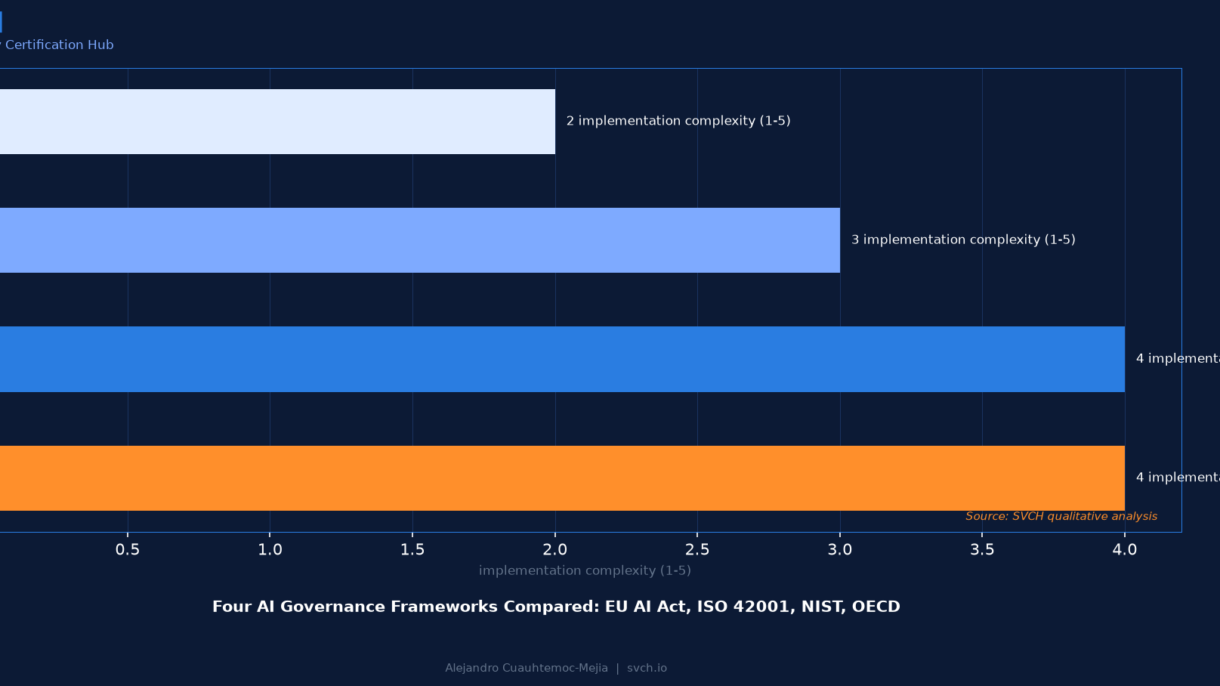
Think of AI governance as a stack: G7 Hiroshima provides the international principles. NIST AI RMF provides the risk management methodology. ISO 42001 provides the certifiable management system structure. And the EU AI Act provides the binding legal requirements. A mature Chief AI Officer builds governance that satisfies all four layers simultaneously, which is more efficient than treating each framework as a separate compliance project.
The Four Frameworks: Side by Side
| Framework | Type | Primary Audience | Binding? | Geographic Scope |
|---|---|---|---|---|
| G7 Hiroshima AI Principles | International policy principles | Governments, large tech companies | No | Global (G7 nations) |
| NIST AI Risk Management Framework | Voluntary risk management standard | US enterprises, federal agencies | No (de facto standard) | United States, global adoption |
| ISO/IEC 42001:2023 | Certifiable management system standard | Organizations deploying AI at scale | No (required by some regulators) | Global |
| EU AI Act | Binding regulation with penalties | Companies operating in or serving EU | Yes (fines up to 3% of global revenue) | European Union + global extraterritorial |
The Four Frameworks in Depth
The international values layer. Eleven AI principles agreed by G7 governments in 2023: transparency, accountability, safety, human oversight, and others. Not binding, but increasingly referenced by regulators globally as the baseline expectation for responsible AI development. Organizations can use G7 alignment as the starting point for communicating AI values to regulators and boards.
The risk methodology layer. A four-function framework (Govern, Map, Measure, Manage) that operationalizes AI risk management into specific practices and outcomes. Voluntary in the United States, but referenced by financial services regulators and healthcare agencies. The NIST AI RMF is the most practically useful framework for building your day-to-day AI risk management processes.
The certifiable management system layer. The first internationally certifiable standard specifically for AI management systems. Organizations can be audited and certified against ISO 42001, producing documented evidence of responsible AI governance that regulators, customers, and partners can verify. Follows the same High Level Structure as ISO 27001 and ISO 9001, enabling integration with existing management systems.
The binding legal layer. Risk-tiered regulation that prohibits certain AI applications (unacceptable risk), creates compliance obligations for high-risk AI systems, and requires documentation, testing, and human oversight for AI affecting employment, credit, education, and critical infrastructure. Extraterritorial reach: applies to any AI system whose outputs are used in the EU, regardless of where the developer is located.
How to Build a Governance Stack That Satisfies All Four
Start with G7 principles to define your AI values baseline
Document your organization’s AI principles aligned to the G7 framework. This is the top of your governance stack, the values that all other controls are designed to protect. It takes days to produce and gives you a board-presentable AI ethics statement.
Use NIST AI RMF to operationalize risk management
Map your AI systems using the NIST four-function framework. For each system, complete the Map function (identify context and risk), Measure function (evaluate risk levels), and Manage function (implement mitigations). NIST gives you the process architecture.
Pursue ISO 42001 certification for the systems where it matters most
Not every AI system requires ISO 42001 certification. Prioritize it for AI systems facing regulatory scrutiny, customer due diligence requirements, or significant fairness and safety risks. ISO 42001 is the governance credential that allows external verification.
Identify your EU AI Act obligations by system
Map every AI system to the EU AI Act risk tiers: prohibited, high-risk, limited risk, minimal risk. For each high-risk system, document the compliance obligations: conformity assessment, technical documentation, human oversight protocols, and registration requirements. Do this before a regulator asks.
Treat the stack as one program, not four
Organizations that run four separate governance programs for four frameworks spend three times the compliance resources of organizations that build one integrated governance system designed to satisfy all four simultaneously. The Chief AI Officer’s job is to architect the unified approach.
Frequently Asked Questions
What does this mean for a Chief AI Officer?
A Chief AI Officer navigating these four frameworks needs to build one governance architecture that satisfies all four layers, not four separate compliance programs. The practical starting point is a documented AI inventory mapped against EU AI Act risk tiers, NIST AI RMF functions, and ISO 42001 clause requirements. That single document becomes the foundation for regulatory response, board reporting, and vendor due diligence.
Which framework should we prioritize first?
If you operate in or serve EU customers, start with EU AI Act compliance because it is binding and carries financial penalties. If you are US-focused with no immediate EU exposure, start with NIST AI RMF because it is the most practical framework for day-to-day risk management. ISO 42001 certification is most valuable when you face customer due diligence or regulatory audit requirements.
Does Silicon Valley Certification Hub certify organizations under these frameworks?
Silicon Valley Certification Hub certifies executives and professionals who need to understand how to lead AI governance under these frameworks. We certify the people who build and manage AI programs, not the programs themselves. ISO 42001 certification for an organization requires an accredited third-party audit. Our programs prepare your Chief AI Officer and governance team to succeed in that audit process.
How does the EU AI Act apply to non-EU companies?
The EU AI Act applies extraterritorially: if your AI system’s outputs are used in the European Union, regardless of wether your company is headquartered outside the EU, you may have compliance obligations. This means any company with EU customers using AI-powered products, services, or decisions should assess their EU AI Act exposure, even if they have no EU operations.
What should executives do this quarter?
Complete an AI system inventory mapped to EU AI Act risk tiers. For any system classified as high-risk, assign a named compliance owner and begin the documentation process for the conformity assessment. This inventory is the foundation of your AI governance stack and the first thing a regulator will request.
Want to know how this applies to your company?
At Silicon Valley Certification Hub, we help you align AI + Strategy. Our team works directly with your directors and teams to assess AI readiness, identify gaps, and build a clear path forward — tailored to your business context.
Book a time with our CEO, Alejandro Cuauhtemoc-Mejia
Silicon Valley Certification Hub | 3000 El Camino Real, Building 4, Palo Alto, CA


0 Comments