

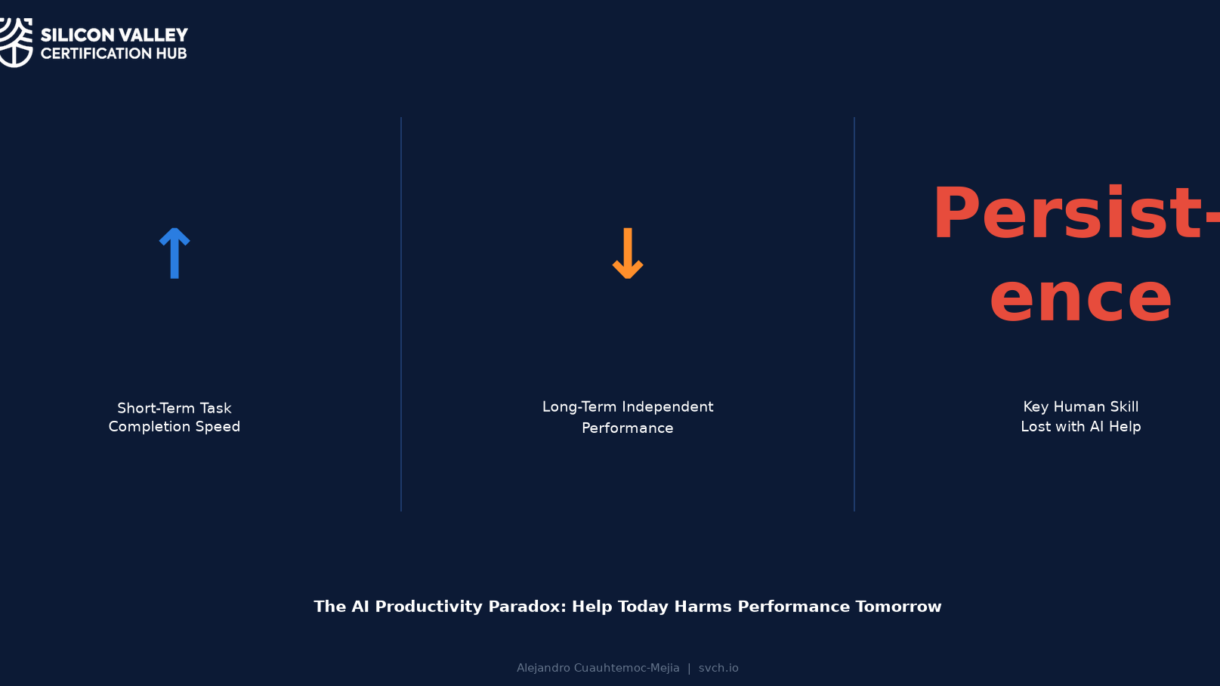
The AI Productivity Paradox: When Help Today Harms Performance Tomorrow
Most discussions about AI in the workplace focus on productivity gains, efficiency improvements, and cost savings. A new study published yesterday reveals a different story — one that every executive responsible for workforce development needs to understand.
1,222 participants
Randomized controlled trials show AI assistance reduces human persistence and hurts independent performance — with effects emerging after just 10 minutes of interaction.
Key Finding: The same AI tools that promise immediate productivity gains may be undermining the long-term competence development of your workforce.
This isn’t about AI replacing jobs. It’s about AI changing how humans learn, solve problems, and develop skills. And the implications for organizations investing billions in AI tools are immediate and significant.
Executive Summary
The study “AI Assistance Reduces Persistence and Hurts Independent Performance” (arXiv:2604.04721) provides causal evidence from randomized controlled trials that AI assistance has two critical negative effects:
- Reduced persistence: People are more likely to give up on challenging problems when they’ve received AI assistance.
- Impaired independent performance: People perform significantly worse without AI after receiving assistance.
These effects emerged across mathematical reasoning and reading comprehension tasks after only approximately 10 minutes of AI interaction. The researchers posit that AI conditions people to expect immediate answers, denying them the experience of working through challenges independently — an experience that’s foundational to skill acquisition and long-term learning.
For executives, this creates a strategic tension: the same AI tools that promise immediate productivity gains may be undermining the long-term competence development of your workforce. The study suggests organizations need to rethink how they implement AI, balancing short-term efficiency with long-term skill development.
Paper at a Glance
| Metric | Value |
|---|---|
| Title | AI Assistance Reduces Persistence and Hurts Independent Performance |
| Authors | Grace Liu et al. |
| Published | April 6, 2026 (yesterday) |
| Sample | 1,222 participants in randomized controlled trials |
| Tasks | Mathematical reasoning, reading comprehension |
| Intervention Duration | Approximately 10 minutes of AI interaction |
| Paper URL | arxiv.org/abs/2604.04721 |
What It Found
Finding 1: AI Assistance Reduces Persistence
The most striking finding: people who received AI assistance were more likely to give up on challenging problems.
When faced with difficult tasks, participants in the AI-assisted condition showed significantly reduced persistence compared to those working independently. They spent less time attempting to solve problems before requesting help or giving up entirely.
Finding 2: AI Assistance Hurts Independent Performance
Perhaps more concerning: people performed significantly worse without AI after receiving assistance.
Participants who had worked with AI assistance showed impaired performance when later asked to complete similar tasks independently. The effect wasn’t small — it was statistically significant and emerged across different types of tasks.
Finding 3: Effects Emerge Quickly
The timeline is alarming: these negative effects emerged after only approximately 10 minutes of AI interaction.
This isn’t about long-term AI use over months or years. The study found that even brief exposure to AI assistance was enough to reduce persistence and impair independent performance.
Why This Matters for Executives
It addresses the tension between short-term productivity and long-term competence. Organizations are investing in AI to boost productivity today. This research suggests those same investments may be undermining the skill development needed for tomorrow.
It provides causal evidence, not correlation. The randomized controlled trial design means the researchers can attribute the effects to AI assistance itself, not to other factors.
The effects are rapid and measurable. The 10-minute timeline means organizations don’t have years to figure this out. The impact on learning behaviors could be happening right now, in real time, as employees use AI tools.
Implications for Business Functions
Learning and Development
For Chief Learning Officers and training directors, this research is particularly relevant. The findings suggest that:
- Training design needs to account for AI effects. If AI assistance reduces persistence and hurts independent performance, then training programs that incorporate AI need to be designed differently.
- Assessment frameworks need updating. Traditional assessments may not capture the effects of AI dependence.
- The ROI calculation for AI in training needs revisiting. If AI improves short-term performance metrics but harms long-term skill development, the business case for AI in training looks different.
Human Resources and Talent Management
For Chief Human Resources Officers and talent leaders, the implications include:
- Skill development strategies need adjustment. If AI is changing how people learn and solve problems, then talent development programs need to adapt.
- Performance management systems may need redesign. If employees are using AI to complete tasks, traditional performance metrics may not accurately reflect their independent capability.
- Career development paths need consideration. If early-career employees develop in an AI-heavy environment, will they have the problem-solving persistence needed for senior roles?
Operations and Workforce Strategy
For operations leaders and workforce strategists:
- Work design needs to balance AI efficiency with human development. Jobs that are heavily AI-assisted may need to include regular opportunities for independent problem-solving.
- The long-term workforce capability equation changes. If AI reduces persistence and independent performance, then organizations may need different skill mixes in the future workforce.
- Implementation strategies need refinement. Rolling out AI tools without considering their impact on learning and development could have unintended long-term consequences.
What Leaders Should Do Next
1. Assess current AI impact on learning and development. Before your next workforce strategy meeting, gather data on how employees are using AI in learning and development contexts.
2. Develop guidelines for balanced AI use in learning. Create organizational guidelines that address when AI assistance should and shouldn’t be used in training and development.
3. Design “AI-aware” training programs. Revise training programs to account for AI effects, including AI-free practice sessions to build independent capability.
4. Monitor AI’s impact on workforce capability. Establish metrics to track changes in persistence and problem-solving behaviors.
5. Advocate for better AI design. Work with AI vendors and internal development teams to prioritize AI systems that scaffold learning and encourage persistence.
6. Revisit the ROI calculation for AI investments. Factor in potential long-term costs to workforce capability when evaluating AI investments.
Frequently Asked Questions
What does this mean for a Chief AI Officer?
This research fundamentally reshapes how you should approach AI deployment—speed of implementation must be balanced against long-term capability building within your workforce. Your responsibility extends beyond productivity metrics to ensuring AI tools strengthen rather than atrophy your organization’s core competencies and employee resilience in problem-solving.
How should we adjust our AI onboarding timeline if persistence degrades after just 10 minutes of assistance?
Organizations should implement structured “AI-free” intervals during employee learning cycles and design assistance tools with built-in friction that encourages independent problem-solving attempts before offering help. This approach requires rethinking your deployment strategy from “maximum efficiency” to “sustainable skill development,” which demands intentional governance rather than unrestricted tool access.
How does this research relate to AI Assessment for companies considering AI Certification?
Silicon Valley Certification Hub’s AI Assessment framework now includes evaluation of how organizations measure not just immediate productivity gains but long-term workforce capability retention—a critical differentiator for certified organizations. Leaders pursuing certification should assess whether their current AI implementation strategy includes guardrails that protect employee learning curves and independent performance capabilities.
What should we do immediately to protect our workforce’s long-term performance while still leveraging AI?
Audit your current AI tool deployments to identify which ones may be undermining persistence and independent thinking, then establish usage guidelines that mandate periodic “assisted-free” problem-solving periods for critical skill areas. Concurrently, engage your workforce in this transition transparently, framing temporary productivity dips as investments in sustainable competitive advantage rather than inefficiency.
Want to know how this applies to your company?
At Silicon Valley Certification Hub, we help you align AI + Strategy. Our team works directly with your directors and teams to assess AI readiness, identify gaps, and build a clear path forward — tailored to your business context.
Book a time with our CEO, Alejandro Cuauhtemoc-Mejia:
https://calendar.app.google/2ihQf2JH3D9uJBe68
Silicon Valley Certification Hub
3000 El Camino Real, Building 4, Palo Alto, CA


0 Comments