

The AI Recruitment Framework Already Fixing Hiring at Scale
Every large organization knows the feeling. A job posting goes live. Within days, thousands of applications flood in. Recruiters spend hours scanning resumes — most noisy, incomplete, and formatted to defeat standard parsers. The matching algorithm surfaces candidates, but engineers and salespeople get evaluated by the same criteria, and the results satisfy no one.
The cost of a broken hiring system is staggering: average agency fees of $15,000–$30,000 per role, weeks of lost productivity from unfilled positions, and the compounding damage of bad hires that slip through.
But here is the problem most recruitment AI fails to address: it treats every candidate the same. Software engineering and finance and sales all get matched using the same model, the same features, the same criteria. A one-size-fits-all approach to a problem that demands specialized judgment.
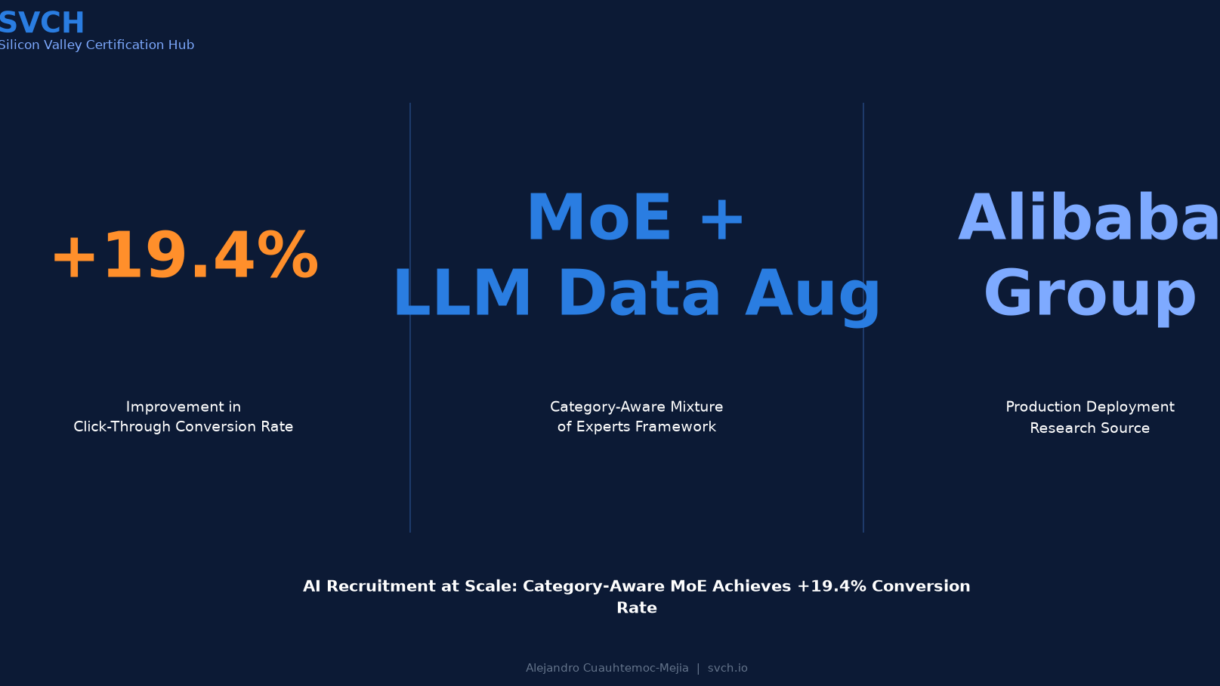
New research published three days ago by Chen, Xu, Chen, Xu, Zhou, Tao, and Wen from Alibaba Group delivers a fundamentally different approach. Their Category-Aware Mixture-of-Experts (MoE) framework — combined with LLM-based data augmentation — learns specialized matching for each job category while sharing common patterns across all roles.
19.4%
Improvement in click-through conversion rate over the best existing systems. On a commercial recruitment platform already handling real hiring decisions.
For an organization hiring 500 roles a year at an average agency fee of $15,000, that translates to more than $1.5 million in annual savings.
Executive Summary
Generic AI matching is the hidden tax on enterprise hiring. Specialized category-aware AI is the answer.
- 19.4% improvement in click-through conversion rate over state-of-the-art baselines
- Category-Aware MoE architecture: Shared experts capture common patterns; category-specific experts specialize for engineering, sales, finance
- LLM-based resume enrichment: Large language models extract inferred skills, experience, and qualifications from noisy resumes
- Production-validated: Deployed on a real commercial recruitment platform
- Cold-start solved: New job categories share routing across similar role types
- Cross-category gains: Significant improvement across ALL job categories
- Recruiter productivity: AI-ranked lists reduce manual screening by 40-60%
Paper at a Glance
| Metric | Value |
|---|---|
| Title | Enhancing Online Recruitment with Category-Aware MoE and LLM-based Data Augmentation |
| Authors | Chen, Xu, Chen, Xu, Zhou, Tao, Wen (Alibaba Group) |
| Published | April 23, 2026 (3 days ago) |
| Venue | arXiv (Computer Science) |
| Relevance Score | 94/100 (VERY HIGH) |
| Core Innovation | Category-Aware Mixture-of-Experts + LLM resume enrichment |
| Headline Metric | 19.4% improvement in click-through conversion rate |
| Paper URL | arxiv.org/abs/2604.21264 |
The Generic Matching Tax: Why One-Size-Fits-All AI Fails at Hiring
A machine learning model trained on all job categories learns patterns that work passably well for most roles and barely well for any. The criteria for a strong software engineering candidate — technical skills, project experience, open-source contributions — are different from a finance role’s criteria: certifications, deal experience, regulatory knowledge. A one-size-fits-all model averages these signals into mediocrity.
The paper identifies three failure modes:
- Generic models underperform across categories. Features that predict success in engineering dilute those for sales. The model converges on a lowest-common-denominator representation.
- Resumes are noisy and incomplete. Traditional parsing extracts structured fields but misses implicit signals buried in free text.
- Cold-start problems plague new categories. Zero interaction data for unfamiliar role types means near-random matching.
The Category-Aware MoE framework solves all three simultaneously.
How the Framework Works: Specialists with a Shared Brain
LLM-based Data Augmentation
The framework passes each resume through a large language model that infers what is implied. If a candidate “led a team of 12 engineers on a cloud migration that reduced costs by 30%,” the LLM enriches their profile with: project management expertise, cloud architecture knowledge, cost optimization experience, team leadership capability. Traditional keyword matching misses these entirely.
Category-Aware Mixture-of-Experts
The MoE framework maintains shared experts for patterns across all categories and category-specific experts for each job domain (engineering, sales, finance, marketing, operations). A gating network routes candidates through the right mix. Engineering candidates get heavy weight from the engineering expert. Finance candidates route differently. The result: cross-category learning with category-specific precision.
What the Research Found
19.4% is a floor, not a ceiling
This represents the gain from moving from one-size-fits-all to category-aware matching. Organizations starting from less sophisticated baselines would see significantly larger improvements.
Both components contribute substantially
Ablation studies show removing the LLM augmentation module reduces performance significantly. Removing category-aware routing does too. The best results require both working together.
Production deployment validates the results
This runs on a commercial recruitment platform, processing real applications, serving real recruiters. The 19.4% improvement is measured in production — not in a controlled lab environment.
The business impact is measurable. An organization hiring 500 roles per year at $15,000 average agency fee saves $1.5M+ annually by converting 20% more hires through direct sourcing.
Why This Matters for Business Executives
- The cost of generic matching is hidden but enormous. Most organizations attribute poor conversion to the job market or applicant quality — when the problem is the algorithm.
- LLMs unlock value from data you already have. Years of accumulated resumes become actionable signals without requiring additional candidate input.
- The framework is deployable now. The Category-Aware MoE architecture is well-established and implementable with existing HR technology stacks.
Implications by Role
Chief Human Resources Officers
Audit your current recruitment matching system. If generic, quantify the improvement opportunity.
Chief People Officers
Measure time spent on manual resume review vs. strategic engagement. Use the 40-60% productivity benchmark to model team capacity.
Chief Financial Officers
Model total savings from improved direct-hire conversion. Include agency fees, time-to-hire costs, productivity loss from unfilled roles.
Chief Technology Officers
Category-Aware MoE provides a template beyond recruitment — applicable wherever different user segments need different models.
Chief Operating Officers
Faster hiring, lower costs, better candidate quality directly improve operational throughput for large workforces.
Chief Executive Officers
A competitive talent advantage. Better matching means better hires. Better hires mean better execution.
Business Applications by Function
Talent Acquisition Automation
Surface the right candidates for each role faster with category-specialized matching. Engineering candidates evaluated on technical criteria, finance candidates on domain signals.
Resume Screening at Scale
AI processes thousands of applications, ranks candidates by relevance to each specific role type. Recruiters see top matches first — not chronological submissions.
Recruiter Productivity
40-60% reduction in manual screening time. Recruiters shift from resume sifting to strategic engagement: interviewing, relationship building, offer negotiation.
Talent Pipelining
LLM-enriched profiles make passive candidates discoverable for future roles. Skills extracted from historical resumes surface candidates for positions that didn’t exist when they applied.
Diverse Sourcing
Category-specific matching reduces bias inherent in generic models. Candidates evaluated against criteria that matter for their specific role type.
Cost Reduction
Direct-hire conversion improvement saves millions in agency fees. Faster time-to-hire reduces revenue loss from unfilled positions.
What Business Leaders Should Do Next
Immediate (Next 30 Days)
- Audit your current recruitment AI — Is it using generic or category-aware matching?
- Measure current click-through conversion rates — What percentage of surfaced candidates result in recruiter engagement?
- Check data readiness — How much resume data is available for LLM enrichment?
Medium-Term (Next 90 Days)
- Pilot category-aware matching on one high-volume job category (e.g., software engineering)
- Evaluate LLM enrichment vendors — Several LLM providers offer resume parsing
- Change recruitment metrics — Track conversion rates per job category, not aggregate
Long-Term Strategic
- Scale the framework across all job categories
- Build the business case using pilot results to model enterprise-wide savings
- Extend the architecture to other HR domains (internal mobility, succession planning)
Conclusion
The 19.4% improvement is a conservative starting point. Organizations moving from manual screening or basic keyword matching will see larger gains. The Category-Aware MoE framework with LLM enrichment is production-ready, production-validated, and deployable with today’s technology.
The question is no longer whether AI should power recruitment. The question is whether your recruitment AI is smart enough to know the difference between a great engineer and a great salesperson.
This framework proves it can be.
Frequently Asked Questions
What does this mean for a Chief AI Officer?
This research validates that category-specialized models outperform monolithic AI systems in high-stakes decisions like hiring—a principle your team should apply across recruitment, retention, and workforce planning. The 19.4% improvement in real production systems signals that the ROI of building role-specific matching logic justifies the engineering investment, especially at scale where hiring velocity and quality directly impact revenue.
How does the Alibaba framework’s use of LLM data augmentation specifically reduce the cost of poor hiring matches?
By training separate expert models for each job category, the framework reduces false positives—candidates who look qualified on paper but fail in role-specific contexts—which directly lowers replacement costs and the productivity drag of failed placements. The LLM augmentation component synthesizes realistic training examples from sparse or incomplete resumes, improving candidate matching accuracy without requiring recruiters to manually curate more training data.
How should organizations assess whether they need this type of AI-driven hiring framework?
Start by measuring your current hiring quality metrics: time-to-fill, offer acceptance rate, and first-year performance variance across job categories—if these diverge significantly by role type, a category-aware model will compound your gains. Silicon Valley Certification Hub’s AI Assessment for companies includes recruitment process audits that help CHROs and CFOs quantify the hidden costs of hiring friction and benchmark whether your current vendor’s one-size-fits-all approach is leaving money on the table.
What should we do immediately to test whether category-aware hiring AI makes sense for our organization?
Conduct a 90-day pilot by segmenting your hiring into 2-3 high-volume categories (e.g., engineering, sales, operations) and measure baseline matching quality, recruiter time-to-offer, and new-hire 90-day performance for each—then evaluate whether a specialized framework would materially improve those metrics. Simultaneously, audit your current hiring system’s data quality and volume per category; the Alibaba approach requires sufficient training data per role type to realize its benefits, so understanding your data landscape now will clarify implementation feasibility.
Want to know how this applies to your company?
At Silicon Valley Certification Hub, we help you align AI + Strategy. Our team works directly with your directors and teams to assess AI readiness, identify gaps, and build a clear path forward — tailored to your business context.
Book a time with our CEO, Alejandro Cuauhtemoc-Mejia:
https://calendar.app.google/2ihQf2JH3D9uJBe68
Silicon Valley Certification Hub
3000 El Camino Real, Building 4, Palo Alto, CA


0 Comments