

SVCH STRATEGIC GUIDE
Most AI investments fail. Not because the technology is wrong.
Because the organization was never ready for it.
An AI Readiness Assessment for companies is the structured diagnostic that finds the gaps before they cost you a failed rollout.
An AI readiness assessment is a structured diagnostic that measures an organization’s current capability to adopt, scale, and govern artificial intelligence effectively. It answers the question every board and executive team is asking: Are we actually ready to deploy AI at scale, or are we about to spend significant capital on initiatives that will stall in execution?
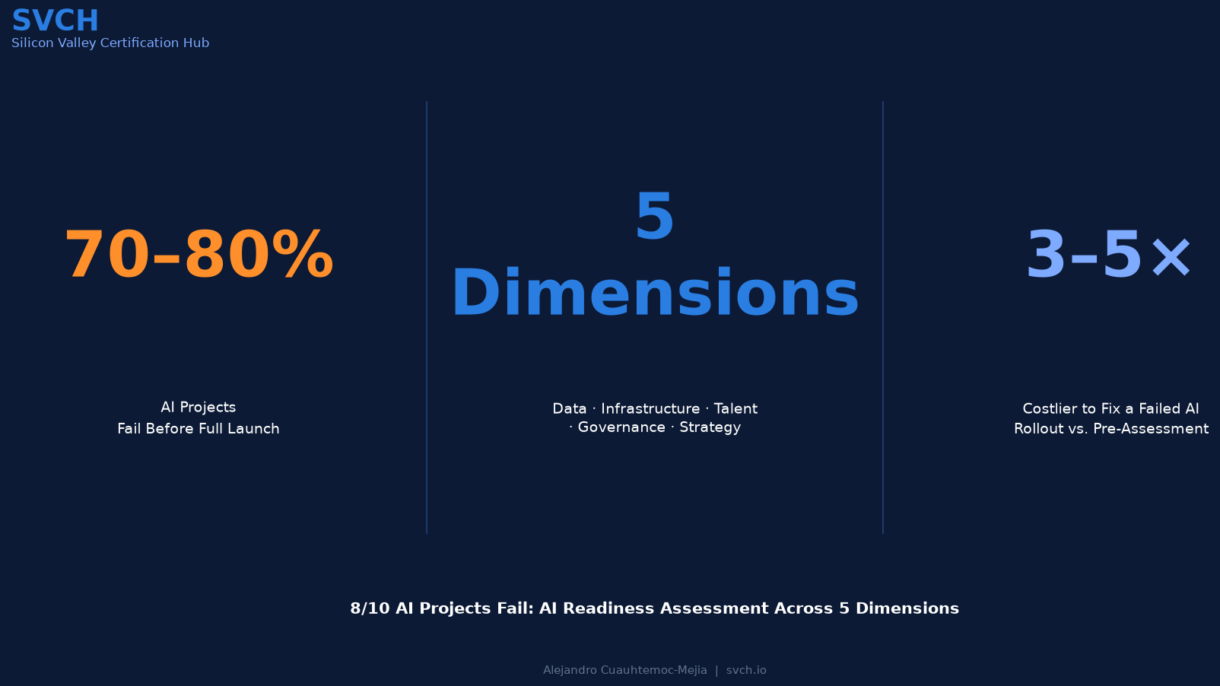
Research consistently shows that 70 to 80 percent of enterprise AI projects fail to reach production or fail to deliver expected ROI. The primary causes are not technical. They are readiness gaps: poor data quality, inadequate infrastructure, insufficient AI talent, absent governance frameworks, and AI strategies disconnected from business priorities. An AI readiness assessment identifies these gaps before they become expensive failures.
The Brutal Truth
Most AI failures are readiness failures, not technology failures
The models work. The problem is that organizations deploy them into environments where the data is messy, the infrastructure is fragile, the talent is thin, and governance hasn’t been defined. Fixing a failed AI rollout costs three to five times more than building the readiness foundation first. The assessment is not a luxury, it is insurance.
The Five Dimensions of AI Readiness
Quality, availability, and governance. Does your organization have the clean, labeled, accessible data that AI models require? Are data pipelines reliable and well-documented? Is data governance in place? Poor data quality is the most common root cause of AI project failure, appearing in more than 60% of post-mortems.
Compute, cloud architecture, and MLOps tooling. Can your infrastructure support AI workloads at the scale you are planning? Do you have MLOps practices for model deployment, monitoring, and retraining? Infrastructure gaps become bottlenecks at exactly the moment you are trying to scale a successful pilot.
AI expertise, literacy, and organizational change readiness. Does your organization have people who can build, evaluate, and govern AI systems? Beyond technical talent, do business leaders have enough AI literacy to make good decisions about AI investments and deployment? Talent gaps are the hardest to close quickly.
Policies, accountability, and risk management. Do you have AI governance policies, clear ownership of AI decisions, and defined processes for risk management? Absent governance is what turns a successful AI pilot into a regulatory, reputational, or ethical incident at scale.
Business alignment and executive commitment. Is your AI strategy connected to specific business outcomes with defined success metrics? Does leadership have a shared understanding of where AI creates value versus where it creates risk? Strategy misalignment is the silent killer of AI programs that have everything else right.
What the Assessment Produces
A maturity score across all five dimensions
Each dimension is benchmarked against industry standards and your organization’s specific context. The score is not a grade, it is a map showing where you are ready to accelerate and where you need to build before investing further.
A prioritized gap closure roadmap
Not every gap is equally urgent. The assessment identifies which gaps will most directly block your highest-priority AI initiatives and sequences remediation in order of business impact.
An executive-ready business case framework
The output gives your Chief AI Officer the evidence base needed to present AI investment priorities to the board, including the cost of inaction alongside the cost of investment.
A governance readiness baseline
Before any AI system goes to production, you need documented accountability structures. The assessment identifies the governance gaps that create regulatory and reputational risk before they surface in a deployment.
A vendor evaluation framework
With a clear readiness profile, your organization can evaluate AI vendors against your specific gaps rather than falling for generic demonstrations that don’t address your actual constraints.
Who Should Initiate an AI Readiness Assessment
Use the assessment to build the empirical foundation for your AI roadmap. Alot of CAIOs inherit AI programs without a clear baseline. The readiness assessment gives you the data to rationalize investments and set realistic board expectations.
Use the assessment to evaluate whether proposed AI investments are credible. A board that approves AI budgets without a readiness baseline is approving investments without risk context. The assessment closes that governance gap.
Use the assessment to identify infrastructure and data gaps before they become execution blockers. The infrastructure and data dimensions of the assessment translate directly into your technology roadmap.
Frequently Asked Questions
What does this mean for a Chief AI Officer?
A Chief AI Officer who runs an AI Readiness Assessment before approving new AI investments has a defensible, evidence-based process for prioritizing the roadmap. Without a baseline, AI budget decisions are based on competitive pressure and vendor pitches rather than organizational capability. The assessment transforms AI governance from reactive to proactive.
How long does an AI Readiness Assessment take?
A structured assessment of all five dimensions typically takes two to four weeks for a mid-sized enterprise, depending on the number of business units and the complexity of the data and infrastructure landscape. Larger organizations or those with significant regulatory complexity may require six to eight weeks for a thorough baseline.
How does Silicon Valley Certification Hub approach AI Assessment for companies?
The AI Assessment for companies at Silicon Valley Certification Hub is designed for executive teams and boards who need a clear readiness picture before making AI investment decisions. We assess all five dimensions, produce a maturity score, and deliver a prioritized roadmap that connects readiness gaps to specific business outcomes, not generic AI best practices.
What happens after the assessment?
The assessment is a starting point, not a destination. The prioritized gap closure roadmap becomes the first-year AI governance agenda. Organizations that complete the assessment and act on the roadmap systematically reduce their AI project failure rate and accelerate the time to value on new AI initiatives.
What should executives do this quarter?
If you do not have a current AI readiness baseline, schedule the assessment before approving any new AI investments this budget cycle. The cost of the assessment is a fraction of the cost of a failed AI rollout, and the roadmap it produces makes every subsequent AI investment decision more defensible.
Want to know how this applies to your company?
At Silicon Valley Certification Hub, we help you align AI + Strategy. Our team works directly with your directors and teams to assess AI readiness, identify gaps, and build a clear path forward — tailored to your business context.
Book a time with our CEO, Alejandro Cuauhtemoc-Mejia
Silicon Valley Certification Hub | 3000 El Camino Real, Building 4, Palo Alto, CA


0 Comments