

Google AI Overviews: 1 in 9 ‘Facts’ Are Unsupported
Here is a number that should stop every communications executive cold: 64.7%.
That is the percentage of question-form Google searches that now return an AI-generated answer at the top of the results page — not a list of links, but a synthesized paragraph delivered as authoritative fact. Google AI Overviews reach over 2 billion monthly users. For roughly two-thirds of the questions people ask, the first thing they see is text written by a machine.
Now here is the number that should keep you up at night: 11.0%.
That is the percentage of claims in those AI-generated answers that are not supported by the sources Google cites. In plain English: one in nine AI-generated facts is made up or unsupported by the evidence Google links to.
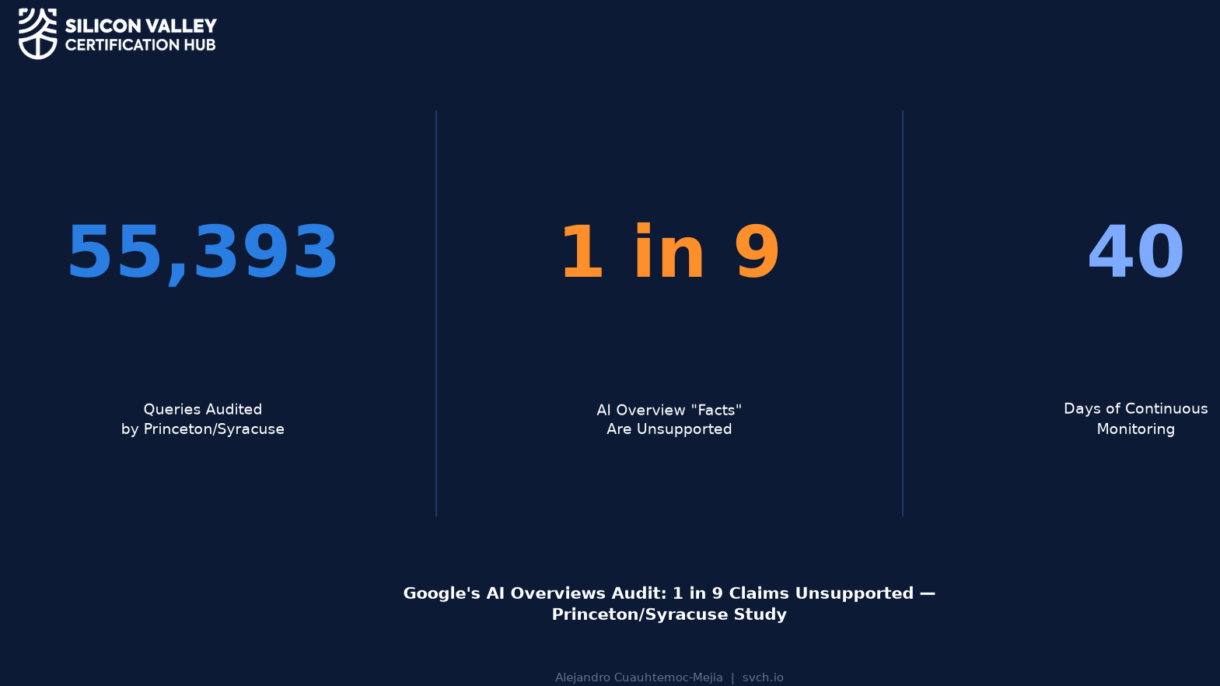
A research team from Princeton and Syracuse conducted the first large-scale, independent audit of Google AI Overviews — 55,393 trending queries over 40 days across 19 topical categories. They analyzed 98,020 individual claims extracted from the AI-generated responses. Their findings paint a picture of an information ecosystem undergoing the fastest transformation since the invention of the search engine itself.
For anyone responsible for a brand’s reputation — CCO, CMO, head of digital, publisher — this paper is the most important thing you will read this year.
AI Overview activation rate for question-form queries
55,393 queries • 40 days • 19 categories • 98,020 claims analyzed
Executive Summary
The study: 55,393 trending queries issued to Google Search over 40 days (March 13 – April 21, 2026), covering 19 topical categories. Researchers extracted all AI Overview responses and decomposed them into 98,020 atomic claims, verifying each against its cited source.
64.7% for questions
AI Overviews appear for 13.7% of all queries — but 64.7% of question-form queries. Politically sensitive topics see significantly lower activation.
30% invisible in search
AIO-cited domains are more credible than organic results, but 30% do not appear in Google’s regular search results at all. Distinct selection mechanism from PageRank.
11.0% unsupported claims
4.1% directly contradict their source. 7.0% make claims not present in the cited source at all. Dominant failure mode: fabrication, not factual error.
14.7% click suppression
Over half of AIO-cited pages carry display ads. Users don’t click through. Publishers get zero revenue. Google’s sponsored ads keep running.
Every brand narrative, every PR campaign, every content marketing strategy now flows through an algorithm that fabricates claims 11% of the time and selects sources through a hidden mechanism. Managing brand reputation requires a new discipline: AI search visibility monitoring.
Paper at a Glance
| Metric | Value |
|---|---|
| Title | Measuring Google AI Overviews: Activation, Source Quality, Claim Fidelity, and Publisher Impact |
| Authors | Researchers from Princeton University, Syracuse University, and collaborating institutions |
| Published | May 13, 2026 |
| Categories | cs.CY (Computers and Society), cs.AI |
| Relevance Score | 92/100 — First independent large-scale audit of the single largest generative AI deployment in the world |
| Paper URL | arxiv.org/abs/2605.14021 |
What the Paper Found
Finding 1: AI Overviews Are Everywhere for Questions — But Disappear for Sensitive Topics
Overall AI Overview activation: 13.7% of all queries. But for questions specifically, activation jumps to 64.7%. For politically sensitive topics — healthcare, energy, finance, policy — activation drops sharply, suggesting Google applies content filters where risk is highest.
So what: If your brand operates in a sensitive category, Google’s AI may be less active — but it is most active for the broad, accessible queries consumers ask most frequently about your products, services, and reputation.
Finding 2: The AI Picks Sources Through a Hidden Mechanism — 30% Invisible in Regular Search
AIO-cited domains are, on average, more credible than organic first-page results. But 30% do not appear in Google’s standard search results at all. The AI selects sources through a mechanism independent of PageRank.
Your company could be invisible in both regular search and AI Overviews, with the AI citing third-party sources about your brand. Or a source your PR team has never seen could be cited as authoritative about your company while your own website is ignored.
So what: Traditional SEO does not translate to AI Overview visibility. A new discipline — AIO source monitoring — is needed to track which sources Google’s AI cites about your brand.
Finding 3: 11% of AI-Generated Claims Are Unsupported — Fabrication Is the Dominant Failure Mode
Of 98,020 claims analyzed:
- 85.0% are supported by the cited source
- 7.0% are “not addressed” — the cited source does not contain the claim at all
- 4.1% are directly contradicted by the cited source
- 3.9% unverifiable (page disappeared, changed, or behind paywall)
The most important insight: the dominant failure mode is fabrication, not factual error. The AI attributes a claim to a source that never stated it. A user searches for your company, the AI fabricates a claim about your product, and cites a source that never said it.
So what: Reputation management now requires monitoring what AI systems say about your brand, not just what human journalists write. The 1-in-9 failure rate means every brand in every AI Overview is at risk.
Finding 4: Publishers Lose Twice — No Traffic, No Revenue, While Google Keeps Selling Ads
Over half of AIO-cited pages carry display advertising. When users are satisfied by the AI answer, they do not click through. Publishers get zero traffic, zero ad impressions, zero revenue from content the AI summarized.
Organic referral traffic from Google Search is already down 10% year over year. AI Overviews are estimated to suppress a further 14.7% of publisher clicks (36.1% for high-traffic pages). Meanwhile, Google’s sponsored ads continue appearing on the same page.
So what: If you run a media or publishing business, the economics are deteriorating rapidly. Google summarizes your content, your ad inventory is cannibalized, and Google captures the full value of the interaction.
AI-generated claims are fabricated or unsupported by cited sources
7.0% not addressed in source at all • 4.1% directly contradicted by source
Exhibit: The Rise of AI Overviews
The paper’s activation chart spans 40 days — March 13 to April 21, 2026. The activation rate fluctuates day to day but trends in a clear direction: upward. At 64.7% for question-form queries, AI Overviews have crossed a threshold from novelty to norm.
For a communications executive, this is the evidence that a strategic inflection point has passed. The deployment is mature. The penetration is broad. The system is already shaping what 2 billion people read, know, and believe about the world — including your brand.
Why This Matters for Executives
Chief Communications Officers — Your job has a new dimension: monitoring what an AI system says about your brand. The 11% unsupported claim rate means users asking about your company will see AI-generated responses containing fabricated statements. Action: Commission an AI search audit for your brand. Issue the most common consumer queries about your company and document AI responses. Establish monthly AIO monitoring.
Chief Marketing Officers & Heads of Digital — Your SEO strategy does not translate to AI Overview visibility. Action: Add AI Overview visibility to your digital marketing dashboard. Track which searches trigger AIOs about your brand. Optimize content structure for AI extraction — clear factual statements with transparent sourcing.
Publishers & Media Executives — The 10% year-over-year decline in Google organic referral traffic is not a blip — it is the new baseline. Action: Diversify traffic sources aggressively. Invest in direct audience channels — email, podcasts, events, subscriptions. Google is no longer a reliable distribution partner.
General Counsel & Compliance Officers — The 4.1% contradiction rate and 7.0% fabrication rate create liability exposure. In regulated industries, AI-generated claims about products, risks, or efficacy could violate regulatory requirements. Action: Map regulatory requirements to this paper’s findings. Consider engaging with policymakers on AI search regulation.
CEOs — Every customer-facing company is affected. Every brand narrative is now filtered through an algorithm with a 1-in-9 fabrication rate. Action: Ask your CCO and CMO for a Google AI Overview risk assessment within 60 days. Demand: audit of AI-generated claims about your brand, source selection analysis, publisher traffic impact, and a monitoring and response plan.
How This Fits the Series
| Date | Category | Paper Topic |
|---|---|---|
| May 16 | Customer Service & CX Automation | Agentic AI Field Experiment on Taobao (Alibaba) |
| May 17 | PR & Communications | Google AI Overviews Audit (This Paper) |
New business function: PR & Communications (AI Search Impact on Brand). The 58th business function covered in the series — first addressing the intersection of AI search and corporate reputation.
Conclusion
Google AI Overviews are the fastest transformation of the information ecosystem since the search engine itself. With 64.7% question-form activation, an 11% unsupported claim rate, an opaque source selection mechanism where 30% of cited domains are invisible in regular search, and publisher economics being structurally eroded — this is the defining communications challenge of the AI era.
The time for preparing for AI Overviews is over. The time for monitoring and responding is now.
“These findings document a rapid transformation of the online information ecosystem whose consequences for epistemic security remain poorly understood.”
— arXiv:2605.14021, Princeton University & Syracuse University
Frequently Asked Questions
What does this mean for a Chief AI Officer?
You are now accountable for a system that reaches 2 billion users monthly while operating at an 11% hallucination rate—a gap between scale and accuracy that creates material legal, reputational, and competitive risk. The Princeton-Syracuse audit proves this isn’t a theoretical concern but a structural flaw in how AI synthesizes information at scale, making governance and validation your highest-priority mandate.
How are AI Overviews suppressing publisher traffic, and what’s the financial impact?
The research found that 30% of sources cited in AI answers are invisible in regular search results, and AI Overviews suppress clicks to publishers by 14.7%—a structural economics problem that erodes the content supply chain Google depends on. For publishers and brands, this means declining discoverability and traffic even when your content is technically cited, forcing a strategic reassessment of search-based marketing ROI.
How should companies evaluate their exposure to AI-generated misinformation risks?
An AI Assessment for companies should now include third-party audits of how your brand, products, and claims appear in AI-generated summaries across major platforms—similar to how you’d audit financial statements. Silicon Valley Certification Hub offers frameworks to benchmark your brand’s presence and accuracy in AI outputs, helping you understand where your reputation is most vulnerable and develop mitigation strategies.
What should executives do immediately to protect brand reputation?
Conduct an audit of your top 100 branded and product-related queries to see how AI Overviews represent your company, then establish a monitoring process to catch factual errors before they reach 2 billion users. In parallel, work with your legal and comms teams to document cases where unsupported claims cause measurable harm, creating evidence for future regulatory or competitive actions.
Want to know how this applies to your company?
At Silicon Valley Certification Hub, we help you align AI + Strategy. Our team works directly with your directors and teams to assess AI readiness, identify gaps, and build a clear path forward — tailored to your business context.
Book a time with our CEO, Alejandro Cuauhtemoc-Mejia:
https://calendar.app.google/2ihQf2JH3D9uJBe68
Silicon Valley Certification Hub
3000 El Camino Real, Building 4, Palo Alto, CA


0 Comments