


Paper review: “Can AI and AI-Hybrids Detect Persuasion Skills? Salesforce Hiring with Conversational Video Interviews” from Yale University, University of Wisconsin-Madison & University of Texas at Dallas
Authors
- Ishita Chakraborty University of Wisconsin-Madison
- Khai C. – The University of Texas at Dallas
- Dr. Howard Dover – Naveen Jindal School of Management, UT Dallas
- K Sudhir – Yale School of Management
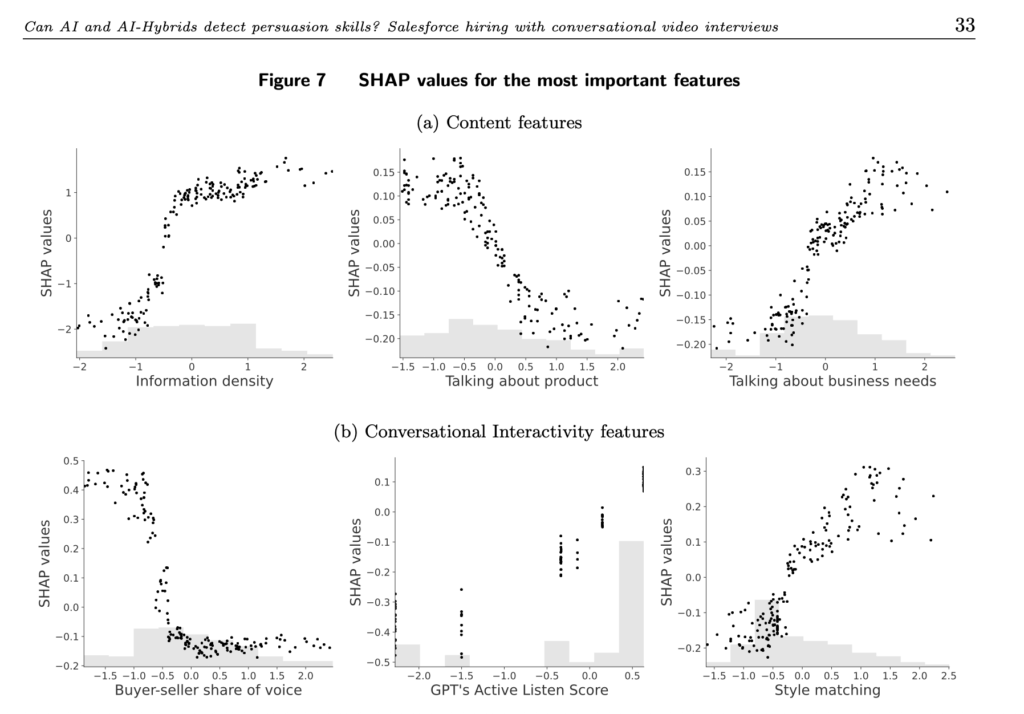
The paper “Can AI and AI-Hybrids Detect Persuasion Skills? Salesforce Hiring with Conversational Video Interviews” explores whether AI can evaluate soft skills like persuasion and adaptability during entry-level sales interviews. These qualities are often crucial in B2B sales but hard to measure through resumes or standardized tests.

Methodology
- Data Source: 195 role-play sales interviews from the National Collegiate Sales Competition.
- Inputs: Multi-modal data (text, voice, body language).
- Hybrid Approach: Bayesian model combining AI predictions with one human evaluator.
Key Findings & Takeaways
- AI alone predicted sales potential with an AUC of ~74%—improving workforce quality by 40% compared to random hiring.
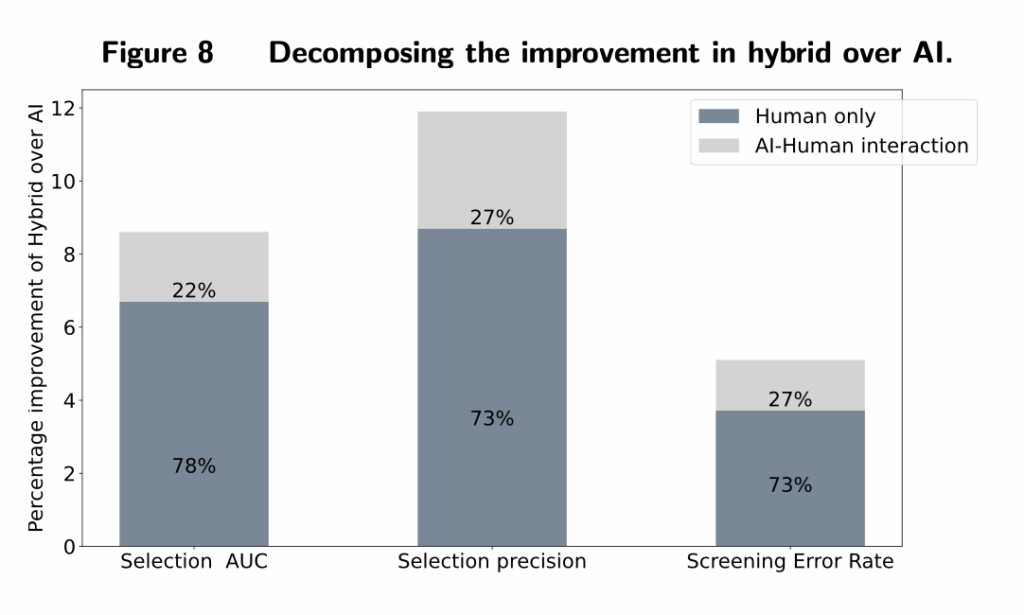
- AI-Human hybrids achieved even better results: with just one human evaluator, workforce quality improved by 67%.
- The first 7 minutes of an interview contained most of the predictive value.
So What?
For executives and business leaders, this research provides a clear preview of how AI is set to reshape both talent strategy and sales enablement. What once felt like a futuristic idea—AI evaluating persuasion or adaptability—is now backed by rigorous academic evidence. The implications extend well beyond recruitment.
- Recruitment: Traditional hiring relies heavily on resumes and standardized interviews, both of which often fail to capture soft skills like persuasion, adaptability, or empathy. This study shows that AI-human hybrid systems can lower hiring costs while significantly increasing the quality of new hires. By blending AI’s ability to process multi-modal data with human intuition, companies can reduce bias, improve consistency, and make smarter choices about who joins their teams.
- Sales Training: The research demonstrates that AI can break down persuasion into measurable signals—such as conversational interactivity, body language, and real-time adaptation. That means companies can use AI not just to hire sales talent, but also to coach and develop it. Managers could receive dashboards highlighting which reps struggle with active listening, which overuse certain gestures, or who needs to adjust their conversational style. This opens the door to personalized, scalable, and cost-efficient sales enablement.
- Broader Implications: While the study focuses on entry-level B2B sales, the methodology is transferable to any role where persuasion, communication, and adaptability matter. Think of consulting, customer service, negotiations, or even executive leadership. Imagine leadership development programs that use AI to assess and coach rising managers in real-time, helping organizations build stronger pipelines of leaders who are not only technically competent but also persuasive and adaptable.
Frequently Asked Questions
What does this mean for a Chief AI Officer?
This research validates that AI can reliably measure soft skills traditionally evaluated through subjective human judgment, reducing hiring bias and improving sales team quality by 40%. As a CAO, you now have evidence-based justification to invest in conversational AI systems for talent acquisition, positioning your company to compete for top sales talent while maintaining quality standards that hybrid approaches (AI plus one evaluator) can achieve at 67% improvement over random selection.
Why does the first 7 minutes of an interview contain most of the predictive value for assessing persuasion skills?
Early interactions reveal how candidates establish rapport, respond to unexpected questions, and adapt their messaging—core persuasion competencies that don’t develop further in longer conversations. This finding allows you to compress interview cycles and reduce time-to-hire while maintaining predictive accuracy, a significant operational efficiency gain for high-volume sales hiring.
How does this research compare to traditional AI Assessment for companies seeking hiring optimization?
Unlike standard assessments that measure cognitive ability or personality traits, this hybrid approach specifically evaluates persuasion and adaptability through real conversational interaction, making it more predictive for sales roles than generic talent platforms. Organizations working with resources like Silicon Valley Certification Hub can now benchmark their hiring practices against this Yale-backed research to ensure they’re using AI-human collaboration effectively rather than relying on AI alone.
What should executives do next to implement these insights into their sales hiring strategy?
Begin piloting conversational video interview tools that capture multi-modal data (speech, tone, body language) and establish a lightweight human-in-the-loop process—the research shows that even one experienced evaluator dramatically improves outcomes. Simultaneously, audit your current hiring funnel to identify where bias may be inflating or deflating candidate assessments, then set a quality improvement target against the 67% baseline this study demonstrates is achievable.
Want to know how this applies to your company?
At Silicon Valley Certification Hub, we help you align AI + Strategy. Our team works directly with your directors and teams to assess AI readiness, identify gaps, and build a clear path forward — tailored to your business context.
Book a time with our CEO, Alejandro Cuauhtemoc-Mejia:
https://calendar.app.google/2ihQf2JH3D9uJBe68
Silicon Valley Certification Hub
3000 El Camino Real, Building 4, Palo Alto, CA


0 Comments