

SVCH EXECUTIVE GUIDE
Three C-suite roles are fighting over AI ownership.
Only one of them should win. Here is which one, and why.
Competing mandates between CAIO, CTO, and CIO stall AI initiatives, create governance gaps, and generate the board-level confusion that delays AI investment approvals.
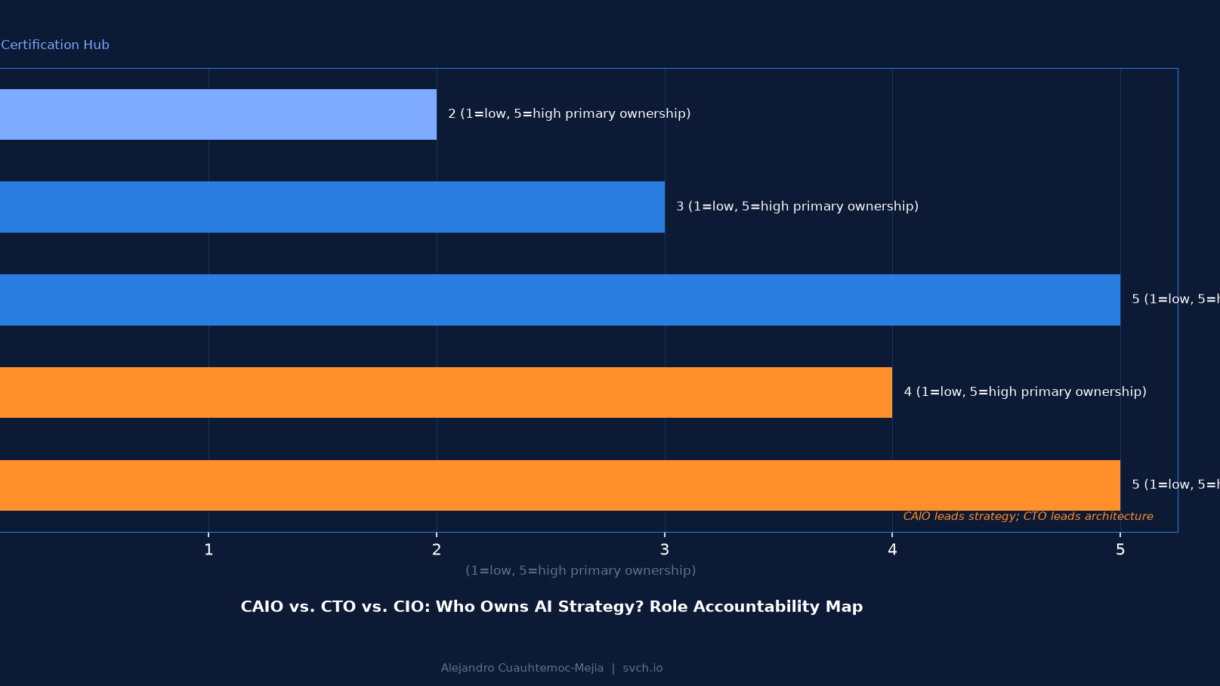
As AI reshapes every business function, three C-suite roles increasingly overlap in responsibility. The CAIO owns AI strategy and governance. The CTO owns technology architecture and engineering. The CIO owns data infrastructure and enterprise systems. When all three are in the room for an AI decision with no clear owner, decisions stall and no one is accountable for outcomes.
Getting this wrong is expensive. Competing mandates stall AI initiatives, create governance gaps, and produce the kind of board-level confusion that delays AI investment approvals by quarters. This guide draws a clear boundary between the three roles and offers a decision framework for executives navigating the question.
The Core Principle
AI strategy needs a named, empowered owner. Not a committee.
The most common breakdown occurs in AI governance: the CTO sees AI security as an engineering problem; the CIO sees it as a data governance problem; the CAIO sees it as an enterprise risk and ethics problem. Without a single owner, all three problems get partial attention and no problem gets resolved. The answer is not better collaboration. It is clearer accountability.
The Three Roles: Where They Differ
| Role | Primary Mandate | Owns AI Strategy? | Core Background |
|---|---|---|---|
| Chief AI Officer (CAIO) | AI strategy, governance, adoption, ethics, ROI | Full ownership | AI/ML combined with business strategy |
| Chief Technology Officer (CTO) | Product technology, engineering, R&D, infrastructure | Partial — builds the platform AI runs on | Engineering and product development |
| Chief Information Officer (CIO) | IT systems, data infrastructure, enterprise platforms | Partial — manages data that feeds AI models | IT operations and enterprise architecture |
Where the Roles Overlap and Where They Diverge
The CTO builds and maintains the technical platforms that AI runs on: model serving infrastructure, MLOps tooling, API architecture. The CTO answers: can we build this, and can it scale? The CTO does not decide which AI use cases to pursue or how to govern models in production.
The CIO manages the data systems and enterprise applications that feed AI models: data warehouses, ERP integrations, data quality pipelines. The CIO answers: do we have the data, and is it trustworthy? The CIO does not set AI strategy or determine acceptable risk thresholds for model deployment.
The CAIO decides which AI use cases to pursue, how to govern deployed models, and how to measure business impact. The CAIO answers: should we deploy this, does it create value, and how do we ensure it works without causing harm? The CAIO owns end-to-end accountability for AI outcomes.
AI security sits at the intersection of all three roles, which is precisely why it often falls through the cracks. The CAIO, CTO, and CIO must have explicit, documented agreements about who owns each category of AI risk: model robustness (CTO), data integrity (CIO), deployment governance and ethics (CAIO).
The Decision Framework: Who Should Own AI Strategy?
If AI is a strategic differentiator for your business, you need a CAIO
When AI is core to your competitive positioning, product roadmap, or regulatory obligations, the CAIO role is not optional. A CTO or CIO with AI responsibilities will deprioritize AI governance when engineering or data infrastructure crises compete for attention. AI strategy needs dedicated executive ownership.
If AI is an operational efficiency tool, the CIO may be sufficient in the short term
Organizations using AI primarily for process automation within existing IT workflows, document processing, basic chatbots, internal search, can often assign AI oversight to the CIO as an expanded mandate. This is a transitional state, not a permanent structure.
Never assign AI strategy to the CTO unless AI is purely a product engineering function
The CTO is the right owner for AI that is embedded directly in product features, not for enterprise-wide AI governance. Assigning cross-functional AI strategy to the CTO creates a structural conflict between shipping product and managing organizational AI risk.
Document the boundaries explicitly at the board level
The most effective AI leadership structures have written RACI matrices defining which decisions require CAIO approval, which require CTO input, and which the CIO executes. Ambiguity at the C-suite level becomes dysfunction at the project level.
How Leading Organizations Structure AI Accountability
| Structure | When It Works | Risk |
|---|---|---|
| Dedicated CAIO reporting to CEO | Large enterprise with strategic AI bets, regulatory exposure, or board-level AI accountability requirement | CAIO isolated from technology teams without strong CTO/CIO collaboration protocols |
| AI Council: CAIO + CTO + CIO | Mid-market organizations building AI governance without a full CAIO function | Council structure without decision rights becomes a discussion forum, not a governance body |
| AI lead under CTO | Early-stage AI adoption, AI primarily in product features | Governance gaps emerge when AI moves from product to enterprise operations |
| AI lead under CIO | AI primarily in data-intensive back-office functions | Misses the strategic and ethics dimensions that define mature AI governance |
Frequently Asked Questions
What does this mean for a Chief AI Officer?
A Chief AI Officer in this organizational dynamic must proactively define the boundaries of their role in writing, not just in practice. That means a documented RACI with the CTO and CIO, explicit board-level accountability for AI outcomes, and a recurring governance review that keeps all three roles aligned without creating committee paralysis.
Our company has a CTO who is also managing AI. Is that a problem?
It depends on the scope. If AI is primarily in product features and the organization doesn’t have significant regulatory exposure or cross-functional AI deployments, a CTO-led AI function can work in the short term. The moment AI governance, ethics review, or board-level AI accountability becomes necessary, the CTO role is structurally compromised by competing priorities.
How does Silicon Valley Certification Hub help companies structure AI leadership?
At Silicon Valley Certification Hub, the Chief AI Officer Certification Program prepares executives to build and lead the AI accountability structures described in this guide. The program covers AI strategy, governance frameworks, risk management, and the organizational design decisions that determine wether AI initiatives succeed or stall.
What is the most common mistake companies make in AI leadership structure?
Assigning AI strategy to whoever is most enthusiastic about AI rather than whoever has the right mandate, authority, and accountability structure. Enthusiasm is not a governance framework. The most common failure mode is an AI program that moves fast in the pilot phase and then stalls because no one defined who owns production deployment, model monitoring, or incident response.
What should companies do this quarter?
Start with an AI Assessment for companies to map every AI initiative currently underway to a named executive owner. For any initiative without a clear owner, assign one and document their decision authority. If three or more initiatives lack clear ownership, the organization likely needs to define or hire the CAIO function before the next planning cycle.
Want to know how this applies to your company?
At Silicon Valley Certification Hub, we help you align AI + Strategy. Our team works directly with your directors and teams to assess AI readiness, identify gaps, and build a clear path forward — tailored to your business context.
Book a time with our CEO, Alejandro Cuauhtemoc-Mejia
Silicon Valley Certification Hub | 3000 El Camino Real, Building 4, Palo Alto, CA


0 Comments