

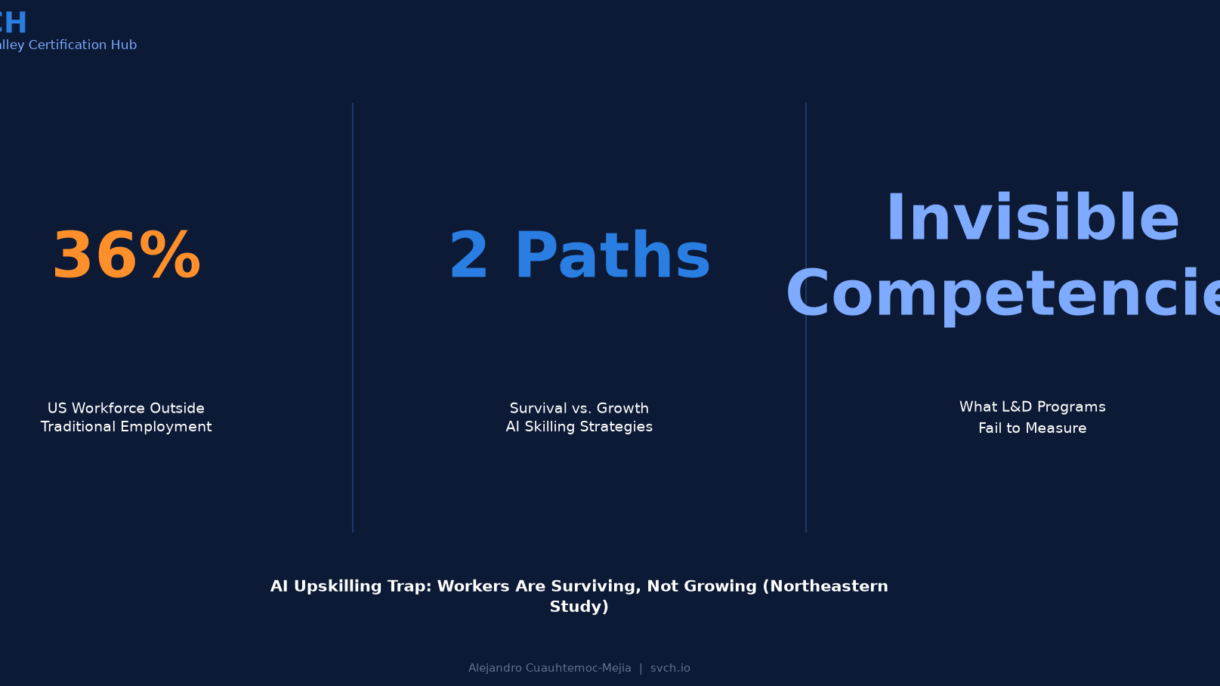
The AI Upskilling Trap: Why Workers Are Just Trying to Survive
There is a structural gap between how organizations think AI skilling works and how it actually works.
Most corporate learning and development programs assume a model that looks like this: an employee takes a course, earns a certification, and advances along a career path. The motivator is growth. The outcome is credentialed.
That model is built for a workforce that increasingly does not exist.
New research from Northeastern University studied how freelance knowledge workers — the fastest-growing segment of the global labor market — actually learn AI skills. The findings reveal two structural problems that every organization building an AI-skilling strategy needs to understand.
First, AI has turned learning from a growth exercise into a survival race. Workers upskill to avoid being eliminated, not to advance. It is a race that never ends, because AI is simultaneously driving market demand shifts and providing the tool to meet them — a self-fueling cycle of precarity.
Second, workers acquire real, valuable skills through daily AI use. But they cannot prove they have them. No certificate exists for advanced prompt engineering. No credential validates AI-mediated data analysis. On a resume, that expertise does not exist.
The authors call this the invisible competencies problem. And it means your talent acquisition pipeline is likely missing qualified people.
Executive Summary
This paper presents a mixed-methods study combining a survey and semi-structured interviews with freelance knowledge workers, grounded in self-directed learning theory, examining how generative AI tools are reshaping how contingent workers learn new skills.
Three breakthrough findings:
- Learning as survival, not growth. Freelancers upskill for immediate market viability — to stay afloat, not to advance. AI has made continuous learning a precondition of employment, not a path to advantage.
- AI as supplementary, not primary. Freelancers use AI to structure learning, but do not treat it as their main resource due to three barriers: inconsistency, lack of contextual relevance, and verification overhead.
- Invisible competencies. Workers acquire meaningful skills through AI but cannot signal or validate them. Traditional credentials do not capture AI-acquired competencies.
For the executive reader: Your L&D strategy assumes a full-time employee model with structured training and career pathways. But 36% of the US workforce operates outside that model. And even your employees are learning AI skills in ways your training programs do not track.
Paper at a Glance
| Metric | Value |
|---|---|
| Title | Upskilling with Generative AI: Practices and Challenges for Freelance Knowledge Workers |
| Authors | Kashif Imteyaz, Isabel Lopez, Nakul Rajpal, Hunjun Shin, Saiph Savage |
| Host Institution | Northeastern University / Khoury College of Computer Sciences |
| Published | April 29, 2026 |
| Methodology | Mixed-methods: survey + semi-structured interviews |
| Relevance Score | 88/100 |
| Focus Domain | Workforce development, talent strategy, AI skilling |
| Paper URL | arxiv.org/abs/2604.27231 |
Shift One: From Learning as Growth to Learning as Survival
The traditional model of professional development assumes a trajectory. You learn a skill. You practice it. You advance. Your employer benefits from your growth, and you benefit from the opportunity.
That model assumes something increasingly false: that the skill you learn today will be relevant long enough to provide a return on the learning investment.
AI has compressed skill-relevance timelines dramatically. A worker who learns prompt engineering in January may find by March that the tool has updated and the approach has shifted. The learning never stops — and because of AI itself, it never can.
— Freelance knowledge worker, from the study
This is learning as survival. It is not limited to freelancers. As organizations flatten hierarchies and shift toward skills-based models, full-time employees increasingly face the same pressure — but without the organizational support structures.
So what for the executive: Any workforce development strategy that assumes growth as the primary motivator will miss the actual experience of workers. Survival-motivated workers need faster feedback loops, just-in-time resources, and recognition that learning itself is a cost they are bearing, not a benefit they are receiving.
Shift Two: The Invisible Competencies Problem
A freelance data analyst uses generative AI every day. Through that use, she learns sophisticated techniques: chain-of-thought prompting, multi-step reasoning decomposition, AI-mediated data cleaning and visualization. She becomes genuinely skilled through daily practice.
But she cannot prove it.
No certification body offers a credential for “advanced AI-prompted data analysis.” On her resume, the skill she uses most — the one her clients value most — has no formal representation.
The invisible competencies problem: A structural mismatch between how skills are acquired (through daily AI interaction) and how skills are recognized (through formal credentials). Qualified candidates are systematically filtered out because their most relevant skills do not appear on paper.
So what for the executive: If your organization uses credential-based screening — degree requirements, certifications, formal training completion — you are likely filtering out workers with the exact AI skills you need. The invisible competencies problem is not a worker problem. It is a hiring system problem.
The Three Barriers to AI-Mediated Learning
Together, these three barriers explain why freelancers rely on AI for structured learning and exploratory skill acquisition — but do not treat it as their primary learning resource. The tool that promises frictionless learning imposes its own friction.
What Organizations Should Do Differently
Redesign L&D for the workforce you actually have, not the one you assume. If 36% of your workforce is contingent, design learning pathways that meet survival-motivated learners where they are: faster, more targeted, continuously updated, explicitly tied to immediate market value.
Build credentialing for the AI era. The invisible competencies problem is a market opportunity. The first organization that can verify and certify AI-acquired skills will have a structural advantage in talent acquisition.
Evaluate AI learning tools on verification, not marketing. Does the tool verify its own outputs? Can workers trust what it teaches? Does it understand domain context? Tools that score low impose a hidden verification tax.
Move from credential-based screening to competency-based evaluation. If traditional credentials do not capture AI-acquired skills, then credential-based screening is systematically filtering out talent. Shift to practical assessments and work samples.
Treat contingent worker development as strategic. Organizations that invest in freelancer skill development will have access to a more capable, more reliable talent pool. Those that do not will inherit the verification overhead and skill gaps.
What Business Leaders Should Do This Week
- Audit your L&D programs for contingent worker accessibility. Are freelancers and contractors excluded from structured learning pathways?
- Pilot a competency-based hiring process for one role type. Replace credential-based screening with practical skills assessment.
- Evaluate your AI learning tools against the three barriers. Does the tool verify outputs? Understand domain context? Reduce verification overhead?
- Identify invisible competencies in your organization. Survey workers about AI skills they use daily but cannot credential.
- Start tracking learning velocity. How quickly can workers acquire and apply a new AI skill? That may be your most important workforce metric.
Conclusion
The “train your employees” model of AI skilling is incomplete. It assumes a workforce of full-time employees with growth as a primary motivator and credentials that effectively signal competence. None of these assumptions hold for 36% of the workforce — and they are weakening for the rest.
The learning-as-survival finding reveals that AI has fundamentally changed the economics of skill acquisition. Continuous learning is no longer a differentiator. It is a precondition.
The invisible competencies finding reveals that our systems for recognizing skill have not kept pace with how skills are actually acquired.
The organizations that lead in the AI era will not necessarily have the most training programs. They will have the most accurate picture of what their people actually know — and the most flexible systems for recognizing it.
Frequently Asked Questions
What does this mean for a Chief AI Officer?
CAOs must rethink upskilling as survival infrastructure, not career progression. Traditional certification models fail freelancers and contingent workers who learn through necessity. Your skilling strategy needs to validate undocumented AI competencies acquired during actual work, creating credibility pathways that reflect how modern workers actually gain expertise.
How should organizations respond to workers learning AI skills out of survival rather than growth motivation?
Recognize this shift reflects market reality, not employee deficiency. Reframe L&D as stabilization rather than advancement. Create skill recognition systems that capture tacit knowledge gained through daily AI use. This transforms precarity into productive capability documentation, reducing organizational risk while acknowledging worker agency.
Why are traditional AI Assessment for companies failing to capture the skills that actually exist in the workforce?
Conventional assessments measure formal training completion, not applied competency. Workers develop sophisticated AI skills through real-world problem-solving but lack credentials to prove it. Organizations need assessment approaches grounded in portfolio evidence and demonstrated capability rather than course completion, closing the credibility gap entirely.
What immediate action should executives take to align their talent strategy with these findings?
Audit your current L&D assumptions and replace growth-focused models with survival-aware frameworks. Implement skill recognition systems that validate undocumented competencies. Partner with assessment providers who evaluate applied AI knowledge rather than certification status, creating transparent pathways for workers to prove what they actually know.
Want to know how this applies to your company?
At Silicon Valley Certification Hub, we help you align AI + Strategy. Our team works directly with your directors and teams to assess AI readiness, identify gaps, and build a clear path forward — tailored to your business context.
Book a time with our CEO, Alejandro Cuauhtemoc-Mejia:
https://calendar.app.google/2ihQf2JH3D9uJBe68
Silicon Valley Certification Hub
3000 El Camino Real, Building 4, Palo Alto, CA


0 Comments