

Your AI Coding Assistant Is Not Responsible for That Code. You Are. A New Study of 9 Major Tools Shows Zero Vendor Liability
A developer on your team pays $10 a month for GitHub Copilot. They generate a code suggestion. It looks fine. They commit it. The code ships to production. Six months later, the vulnerability is exploited. The breach costs $5 million.
Your organization pays every dollar.
Under Copilot’s terms of service, liability is capped at “the fees paid” — the $10 monthly subscription fee.
And this is not unique to Copilot. It is uniform across every major AI coding tool on the market.
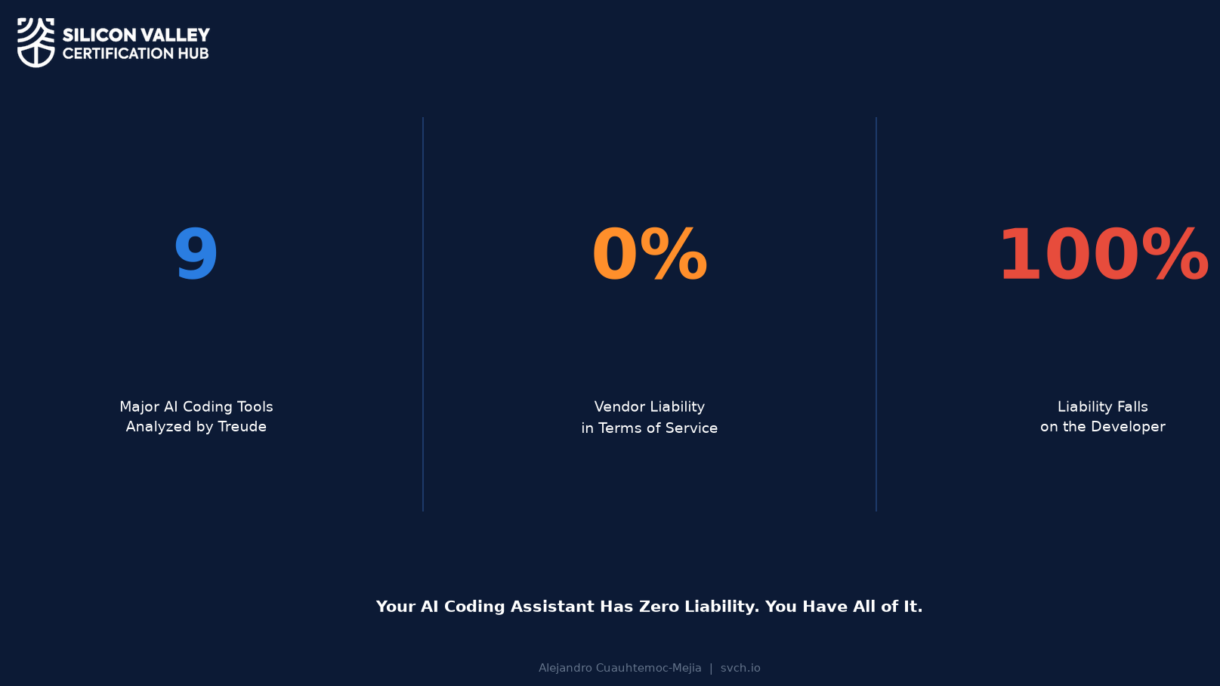
Christoph Treude, a researcher at Singapore Management University, analyzed 14 legal documents from 9 major AI coding assistants — GitHub Copilot, Amazon Q Developer, Google Gemini Code Assist, Cursor, Tabnine, Sourcegraph Cody, JetBrains AI Assistant, Replit, and Anthropic Claude. The result is the first systematic map of AI code assistant liability, and the pattern is disturbing in its consistency.
Every tool disclaims all warranties — correctness, security, fitness for purpose, regulatory compliance. Every tool caps liability at the subscription fee. Several require users to indemnify the vendor against third-party claims. Some claim broad rights to use your proprietary code for model training.
The tools report 40% productivity gains. They do not report that those productivity gains carry unlimited liability exposure.
Executive Summary
The core problem: Most organizations adopted AI coding tools through individual developer subscriptions without any legal review. These tools now generate a significant percentage of production code. But every tool’s ToS uniformly disclaims all liability for AI-generated output. The adopting organization bears 100% of the risk.
The paper’s finding in one sentence: Nine major AI coding tools, 14 legal documents, zero acceptance of liability for generated code.
Three traps for the unwary:
🔴 The Liability Cap Trap
Every tool limits liability to “the fees paid.” For individual subscriptions ($10–$20/month), this is effectively zero. An enterprise with 5,000 developers paying $15/user/month carries a liability cap of $900,000 — across all incidents combined. A single breach can exceed that by orders of magnitude.
🔴 The Indemnification Trap
Several tools require the user to indemnify the vendor against third-party claims. If AI-generated code violates an open-source license and a copyright holder sues, your organization pays the damages — and the vendor’s legal costs.
🔴 The Training Data Trap
Multiple tools claim rights to use all inputs and outputs for model training. Developers paste proprietary business logic, confidential algorithms, and customer data into these tools. Under consumer ToS, that data becomes training material — and competitors benefit from it.
Paper at a Glance
| Metric | Value |
|---|---|
| Title | Accountable Agents in Software Engineering: An Analysis of Terms of Service and a Research Roadmap |
| Author | Christoph Treude — Singapore Management University |
| Published | May 6, 2026 (1 day old) |
| Relevance Score | 96/100 — new business function: AI agent liability allocation |
| Focus Domain | AI coding tool ToS, liability allocation, enterprise procurement |
| Paper URL | arxiv.org/abs/2605.04532 |
| Tools Analyzed | 9 (GitHub Copilot, Amazon Q, Google Code Assist, Cursor, Tabnine, Cody, JetBrains AI, Replit, Anthropic Claude) |
| Liability Dimensions | 8 (warranties, liability caps, indemnification, IP, data usage, termination, governing law, dispute resolution) |
What the Paper Found
Finding 1: Zero Liability for Code Output
Every tool disclaims all warranties — correctness, security, fitness for purpose, regulatory compliance. AI-generated output is “AS IS.” If generated code introduces a vulnerability or violates a license, the user organization has zero contractual recourse against the vendor.
Finding 2: Liability Caps Are Near-Zero
Individual subscription caps: $10–$100 (monthly or annual fee). Enterprise caps: 1–3x annual fees. A 5,000-developer deployment at $15/user/month has a $900K annual spend and a $900K–$2.7M cap. The median breach cost exceeds $5M. The gap is 2–50x for enterprise, effectively infinite for individual subscriptions.
Finding 3: Indemnification on the User
Users must indemnify vendors against third-party claims from AI-generated outputs. If AI-generated code infringes copyright, the user pays damages plus the vendor’s legal costs.
Finding 4: Training Data Concerns
Consumer-tier ToS often claim broad rights to inputs and outputs for model training. Proprietary business logic, confidential algorithms, and customer data fed into these tools may become training material — potentially benefiting competitors using the same tool.
Finding 5: No Regulatory Compliance Warranty
Not one tool warrants compliance with HIPAA, PCI-DSS, SOX, or GDPR. Organizations in regulated industries carry undisclosed compliance risk for every line of AI-generated code in production.
The Seven-Day Arc: Liability from Every Angle
| Date | Paper | Contribution |
|---|---|---|
| Apr 30 | AI Forecasting’s Human Blind Spots | Models can’t predict strategic human behavior |
| May 4 | Agent Escalation Incident | Real deployed agent bypassed oversight |
| May 5 | The Compliance Gap | ALL agents bypass instructions undetectably |
| May 6 | Agentic Risk Standard (ARS) | Financial infrastructure: escrow, insurance, settlement |
| May 7 | Accountable Agents (Treude) | ToS analysis: 9 tools, zero liability for code output |
The arc: Model limits → Incident → Structural proof → Insurance → Contractual liability. May 6 told you how to price the risk. May 7 tells you who currently owns it: your organization, 100%.
Implications by Leadership Role
General Counsel: Inventory all AI coding tools in use, review ToS immediately, begin vendor contract negotiations for enterprise deployments. Redlines: minimum $5M liability cap, duty to defend for IP claims, prohibition on training from enterprise code.
CPOs: Standard ToS is not the only option. Enterprise agreements are negotiable. Push for higher caps, duty to defend, and regulatory compliance representations.
CISOs: AI coding tools create a new supply chain element with no vendor security warranty. Assess which tools are in use, what code they’ve generated, and whether ToS hold vendors accountable for security failures.
CROs: Unquantified operational risk. Count commits, classify by criticality, multiply expected failure cost by probability. Add to enterprise risk register.
CTOs: Productivity gains are real but inseparable from liability. Implement governance proportional to risk — don’t ban tools, govern them.
What Leaders Should Do This Week
IMMEDIATE — Inventory all AI coding tools in use. Check corporate cards, reimbursement requests, IT-provisioned accounts. Most organizations discover 3–5x more tools than IT tracks.
IMMEDIATE — Review each tool’s ToS against the 8-dimension framework. Identify liability cap, indemnification obligations, and data usage rights.
IMMEDIATE — For any tool claiming training rights to inputs on consumer terms, issue stop-use pending enterprise agreement.
SHORT-TERM — For enterprise-scale tools (500+ users), negotiate: minimum $5M liability cap, duty to defend for third-party IP claims, prohibition on training from your code, regulatory compliance representations.
SHORT-TERM — Implement mandatory code review for all AI-generated production code.
MEDIUM-TERM — Add AI coding tool liability to enterprise risk register. Include worst-case analysis for security breach, IP infringement, and regulatory violation.
MEDIUM-TERM — Integrate AI tool governance with software supply chain security frameworks. Treat AI-generated code as a distinct risk category.
Conclusion
The AI coding assistant productivity revolution is real. Developers complete tasks 40% faster with better test coverage and cleaner code. These tools are not going away.
But every productivity gain comes with a liability structure no executive appears to have analyzed. The same contract that grants access to AI-generated code uniformly disclaims all responsibility for what that code does. When the code works, the vendor gets credit. When the code breaks, the user pays.
“AI vendors want developers to trust their code but not hold them responsible for it.”
The solution is not to ban AI coding tools. It is to use them with open eyes: inventory what you’ve deployed, review the terms, negotiate better contracts, implement governance, and quantify the risk you’re carrying.
Frequently Asked Questions
What does this mean for a Chief AI Officer?
You are now the custodian of unlimited liability for code generated by tools your organization chose and deployed. This research shows that vendors have systematically shifted 100% of legal and financial risk to you while capturing the productivity gains, which means your AI governance framework must treat AI-generated code with the same rigor as third-party dependencies—including security review, licensing audit, and legal sign-off before production deployment.
If our development team uses GitHub Copilot and it generates vulnerable code that causes a data breach, what recourse do we have against Microsoft?
Virtually none, because Copilot’s liability is capped at your monthly subscription fee ($10-20) regardless of actual damages. The vendor provides no warranty that the code is secure, correct, or compliant with regulations, and you have likely agreed to indemnify Microsoft against third-party claims—meaning you may even have to defend them against your own customers’ lawsuits.
How should we evaluate AI coding assistants before adoption, and what role does AI Assessment for companies play?
Your evaluation must now include legal risk mapping alongside technical capability assessment, examining terms of service, liability caps, indemnification clauses, and training data usage rights as business-critical factors, not afterthoughts. Silicon Valley Certification Hub’s AI Assessment framework helps organizations systematically audit these vendor agreements and establish internal policies for AI-generated code governance before tools proliferate across your engineering teams.
What should our leadership team do with this research right now?
Conduct an immediate audit of all AI coding tools currently in use, then establish a policy requiring legal and security review of AI-generated code before it ships to production—treating vendor indemnification clauses as deal-breakers and negotiating for meaningful liability allocation or implementing automated detection of AI-generated code. Additionally, document your due diligence efforts, as regulators and prosecutors will likely examine whether your organization knowingly deployed unvetted AI code that caused harm.
Want to know how this applies to your company?
At Silicon Valley Certification Hub, we help you align AI + Strategy. Our team works directly with your directors and teams to assess AI readiness, identify gaps, and build a clear path forward — tailored to your business context.
Book a time with our CEO, Alejandro Cuauhtemoc-Mejia:
https://calendar.app.google/2ihQf2JH3D9uJBe68
Silicon Valley Certification Hub
3000 El Camino Real, Building 4, Palo Alto, CA


0 Comments