

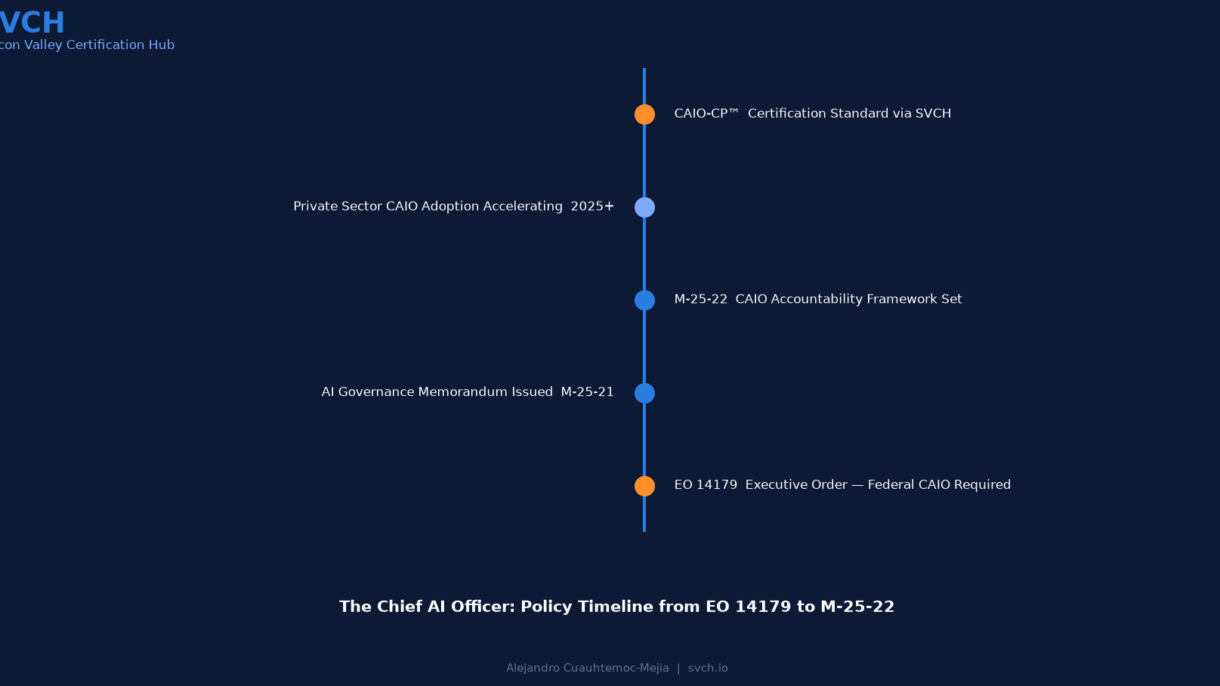
The recent issuance of Executive Order 14179, along with Memorandums M-25-21 and M-25-22 by the United States government, clearly establishes a fundamental premise: Artificial Intelligence (AI) is no longer optional—it is a strategic necessity for all organizations, both public and private.
This Executive Order aims to ensure that the United States maintains a global competitive advantage through responsible, secure, and efficient implementation of AI. In this context, the Chief AI Officer (CAIO) emerges as an essential actor to ensure alignment between technology, ethics, security, and the strategic goals of institutions.
Executive Order 14179: A New Roadmap
Executive Order 14179 specifically instructs federal agencies to proactively adopt and manage AI-based solutions, emphasizing key aspects such as national security, privacy, innovation, and civil rights protections. This highlights the urgent need for organizations to rapidly adapt, generating a growing demand for specialized AI leadership.
On the other hand, Memorandum M-25-21 outlines governance requirements and clear standards for managing risks, ethics, and transparency related to the implementation of intelligent systems. Complementing this, Memorandum M-25-22 strengthens these guidelines by further clarifying organizational responsibilities, specific mechanisms to assess ethical and regulatory compliance, and best practices for data protection and privacy in AI-based solutions. These documents not only underscore the strategic relevance of AI, but also establish a solid governance framework that must be led by a specific figure: the CAIO.
Why Is a Chief AI Officer Strategic?
The CAIO plays a crucial role across several strategic dimensions:
- Governance and Ethics: Ensures AI implementation complies with regulatory and ethical frameworks as required by Memorandums M-25-21 and M-25-22. Manages risks, prevents algorithmic bias, and guarantees transparency and explainability of automated decisions working together with the CAIERO (Chief AI Ethics and Responsibility Officer).
- Competitive Innovation: Drives the adoption of emerging technologies to transform internal processes and business models, maintaining global competitiveness.
- Security and Privacy: Establishes robust protocols to protect sensitive data, ensuring compliance with the executive order in terms of national security and cybersecurity, working together with the COO (Chief Compliance Officer)
- Leadership and Organizational Change: Promotes an AI-driven culture and continuous learning within the organization, preparing human talent to harness the benefits of intelligent automation and advanced analytics.
Conclusion: An Urgent Need, Clear Leadership
The message of Executive Order 14179 and Memorandums M-25-21 and M-25-22 is unequivocal: the future of organizations depends on their ability to strategically manage artificial intelligence. The Chief AI Officer is not just a new corporate figure—it is a key leadership role that ensures organizations leverage AI in an ethical, secure, strategic, and competitive way.
Ultimately, having a CAIO is no longer a luxury or secondary option—it is a strategic responsibility that is essential for any organization aiming to excel in the digital era driven by artificial intelligence.
Frequently Asked Questions
What does this mean for a Chief AI Officer?
The Chief AI Officer has moved from a nice-to-have role to a business-critical position responsible for ensuring your organization meets federal compliance requirements while maintaining competitive advantage through responsible AI deployment. This executive now owns the intersection of technology strategy, ethical governance, security, and organizational alignment—making them as essential to your C-suite as your CFO or Chief Information Security Officer.
How should organizations balance rapid AI adoption with the compliance requirements outlined in these executive orders?
Rather than viewing compliance as a constraint on innovation, leading organizations are embedding governance and ethics into their AI implementation roadmap from day one, reducing costly rework and regulatory risk. A strategic CAIO will establish clear risk assessment frameworks and transparency mechanisms upfront, enabling faster deployment of AI solutions while maintaining the trust and oversight that regulators and stakeholders demand.
How can we determine if our organization is truly ready for AI transformation?
An AI Assessment for companies—like those offered through resources at Silicon Valley Certification Hub—provides an objective evaluation of your current governance, technical maturity, compliance posture, and leadership readiness to implement AI responsibly. This baseline assessment helps executives prioritize investments and identify gaps before deploying AI systems that could create regulatory or reputational risk.
What should our executive team do immediately to prepare for this AI-first era?
Start by evaluating whether you have clear AI governance structures and a designated leader accountable for aligning AI strategy with federal requirements and business objectives. If not, establishing a Chief AI Officer role and conducting a comprehensive AI readiness assessment should be your first moves—these foundational steps will position you to capitalize on AI opportunities while protecting your organization from compliance and security risks.
Want to know how this applies to your company?
At Silicon Valley Certification Hub, we help you align AI + Strategy. Our team works directly with your directors and teams to assess AI readiness, identify gaps, and build a clear path forward — tailored to your business context.
Book a time with our CEO, Alejandro Cuauhtemoc-Mejia:
https://calendar.app.google/2ihQf2JH3D9uJBe68
Silicon Valley Certification Hub
3000 El Camino Real, Building 4, Palo Alto, CA


0 Comments