

M&A Screening • Corporate Development • Complexity Science Hub Vienna
The AI-Built M&A Screening Engine That Costs Nothing
Every firm in the global semiconductor production network now has a centrality score. That score tells you which companies are structurally important — regardless of their revenue. And it comes from public web data. Cost: $0.
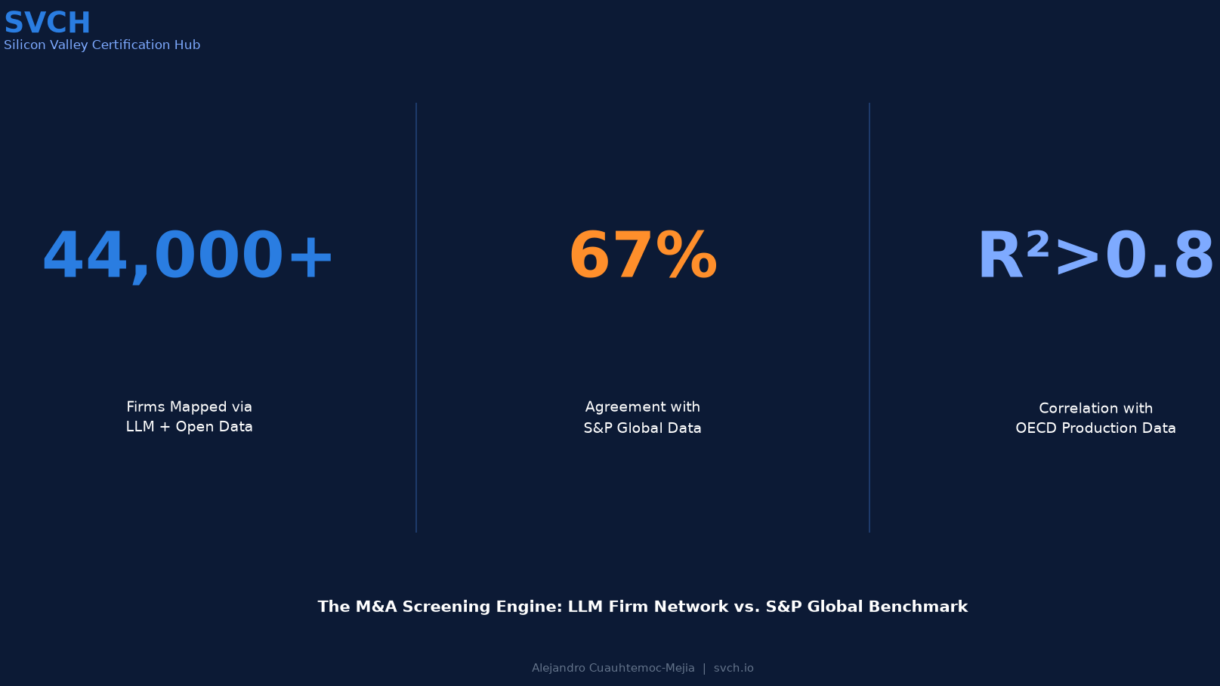
A research team from the Complexity Science Hub Vienna, the Medical University of Vienna, and the Austrian Institute of Economic Research reconstructed the global semiconductor production network using LLMs to crawl publicly archived web pages. The result is a dataset of 44,000 firms with 2.1 million unique supply chain, partnership, ownership, and credit relationships across 64 countries and 25 years.
For M&A and corporate development leaders, this is not just a research methodology paper. It is a working deal screening engine that proprietary databases cannot match.
Why This Paper Matters
M&A screening today filters by revenue, growth, geography, and technology category. These are surface-level metrics. They tell you what a firm does and how much money it makes. They do not tell you how structurally important that firm is in its industry.
The Complexity Science Hub network fills this gap. Every firm gets a betweenness centrality score — a measure of how many shortest paths between other firms pass through it. A firm with moderate revenue but high centrality sits at structural crossroads that many other firms depend on. Traditional screening misses these targets entirely.
The paper validated its approach against S&P Global data (67% agreement — higher than typical inter-database agreement) and OECD data (R² > 0.8). It captures relationships that premium databases miss. And it costs nothing in data acquisition.
Methodology, Explained Simply
The researchers used a straightforward pipeline: collect archived web pages from 1,145 cities across 64 countries; extract mentions of firm-to-firm relationships using large language models; classify those relationships into types (supply, partnership, ownership, credit); and build a dynamic network that evolves year by year.
The innovation is not in the model. It is in the recognition that public web data — press releases, corporate websites, news archives — already contains the information that proprietary databases charge $500,000 to $5 million annually for. LLMs simply extract it at scale.
The resulting network covers 114,605 firms initially, filtered to 44,000+ with meaningful inter-firm connections. The temporal dimension — 25 years of relationship data — is something no quarterly-snapshot proprietary database can offer.
Results and Practical Insights
Four M&A Applications from the Same Data Pipeline
Target Screening by Centrality. Filter all 44,000 firms by betweenness centrality. Firms with high centrality but moderate revenue are targets that traditional screening methods miss. The centrality trajectory adds another dimension: firms whose centrality is rising faster than their revenue are becoming more strategically important.
Integration Risk Assessment. Before signing an LOI, compute network overlap (Jaccard similarity) between acquirer and target supplier networks. High similarity means consolidation opportunity. Low similarity means integration complexity. Mid-range similarity means complementary networks — the optimal acquisition profile.
Portfolio Concentration Monitoring. Two portfolio companies that appear unrelated may share a Tier 2 or Tier 3 supplier. A disruption at that supplier affects both simultaneously. The LLM network reveals these invisible dependencies.
Divestiture Identification. Portfolio companies in the bottom centrality quartile with declining trajectories are divestiture candidates. The top quartile are strategic assets to retain and invest in.
Key Takeaways for M&A and Corporate Development Leaders
- Centrality is your fifth screening metric. Add betweenness centrality to revenue, growth, geography, and category. The firms that score high on both traditional metrics and centrality are validated priorities. The firms that score high on centrality alone are hidden gems.
- Network overlap predicts integration success. Supplier network similarity correlates with integration complexity. Run the analysis before the LOI, not during due diligence.
- Portfolio concentration risk is invisible without network analysis. Shared Tier 2 and Tier 3 dependencies are not captured by any current risk register. The network makes them visible.
- The cost advantage is permanent. Public web data + LLMs now replaces $500K–$5M in annual proprietary database spend. The information monopoly has been broken.
- Temporal trajectory reveals winners and losers. Centrality rising faster than revenue signals increasing strategic importance. Declining centrality signals a firm to pass on — or divest.
Thanks to All Authors
This article is based on the research of Seyda Köse (Complexity Science Hub Vienna), Christian Diem (Complexity Science Hub Vienna), Elma Dervic (Medical University of Vienna), Klaus Friesenbichler (Austrian Institute of Economic Research), Georg Heiler (Complexity Science Hub Vienna), Andreas Koller (Complexity Science Hub Vienna), and Peter Klimek (Complexity Science Hub Vienna & Medical University of Vienna).
Frequently Asked Questions
What does this mean for a Chief AI Officer?
You now have a defensible, zero-cost alternative to proprietary M&A databases by deploying language models against public web archives to reconstruct supplier networks at scale. This shifts your competitive advantage from paying vendors for data to building institutional capability in network reconstruction and centrality analysis, which your corporate development team can iterate on continuously as web data updates.
How can we use centrality scores to identify acquisition targets our competitors are missing?
A firm with 10% of a sector leader’s revenue but high betweenness centrality controls critical supply chain chokepoints that rival acquirers overlook when filtering by revenue alone. By mapping these structural gatekeepers, you can identify smaller targets whose integration unlocks far greater operational leverage than traditional screening would suggest.
How does this approach compare to traditional AI Assessment for companies that Silicon Valley Certification Hub offers?
Traditional AI assessments evaluate a single company’s capabilities and readiness; this network-based screening reveals how a target firm sits within its ecosystem dependencies and which other firms it influences. Silicon Valley Certification Hub’s certification framework becomes more valuable when paired with network centrality data—you’re not just certifying a company’s AI maturity, you’re understanding its structural importance to deal outcomes.
What should our corporate development team do with this research today?
Audit your last five M&A targets by calculating their betweenness centrality scores using this Vienna team’s methodology on public data to see how many deals focused on high-revenue targets that lacked structural importance. Then, build a standing process where every new target gets scored for both revenue and centrality before screening committees, and allocate a small pilot budget to map your sector’s full network to identify the 5-10 highest-leverage acquisition candidates you’re currently missing.
Want to know how this applies to your company?
At Silicon Valley Certification Hub, we help you align AI + Strategy. Our team works directly with your directors and teams to assess AI readiness, identify gaps, and build a clear path forward — tailored to your business context.
Book a time with our CEO, Alejandro Cuauhtemoc-Mejia:
https://calendar.app.google/2ihQf2JH3D9uJBe68
Silicon Valley Certification Hub
3000 El Camino Real, Building 4, Palo Alto, CA


0 Comments