

Stop Building AI Pipelines. Start Building AI Companies.
Every enterprise that scales AI faces the same wall. Individual agents perform well on narrow tasks. But string them together for complex workflows, and the system becomes brittle. Pipelines are pre-configured. Teams are fixed at compile time. When the business problem changes, you don’t reconfigure — you rebuild.
It is like running a company where every project team is hard-coded before the year starts. No hiring. No reorganization. No continuous improvement. The org chart is frozen.
This is exactly wrong.
New research published three days ago by Yu, Fu, He, Huang, Lee, Fang, Luo, and Wang from University College London introduces a framework called OneManCompany (OMC) that treats multi-agent AI the way real companies treat their workforces.
The core idea is simple and profound: the missing layer in enterprise AI is not better individual agents. It is organizational design.
OMC introduces three concepts that map directly to how human organizations function:
- A Talent Market where AI agents are recruited on-demand for specific skills
- Typed Organizational Interfaces that define clear role charters and coordination protocols
- An Explore-Execute-Review (E²R) loop driving planning, execution, and systematic improvement
84.67%
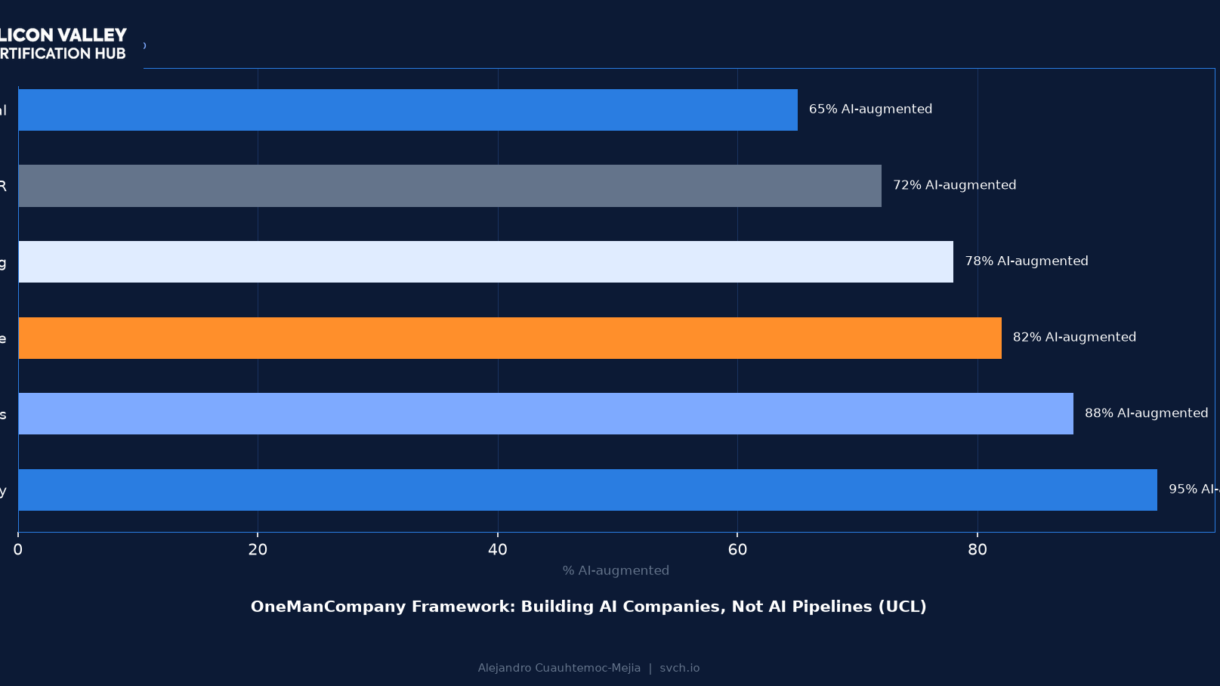
Success rate on PRDBench — 15.48 percentage points above state-of-the-art. A 23% reduction in task failure across PR, business analysis, software development, and customer support.
The implication: the next leap in enterprise AI will not come from better models. It will come from better organizations.
Executive Summary
Current multi-agent AI is a collection of point solutions. OneManCompany transforms them into a scalable, governable, self-improving workforce.
- 84.67% success rate on PRDBench — 15.48pp above SOTA (23% fewer task failures)
- Talent Market: On-demand recruitment of specialized AI agents during execution
- Typed Organizational Interfaces: Role charters abstracting over AI backends — no vendor lock-in
- Explore-Execute-Review Loop: Unified governance with formal termination and deadlock freedom guarantees
- Cross-domain: PR, business analysis, software development, customer support
- Self-improving: Outcomes drive systematic review and refinement
- Portable Talents: Skills, tools, and configs packaged into portable agent identities
Paper at a Glance
| Metric | Value |
|---|---|
| Title | From Skills to Talent: Organising Heterogeneous Agents as a Real-World Company |
| Authors | Yu, Fu, He, Huang, Lee, Fang, Luo, Wang (University College London) |
| Published | April 24, 2026 (3 days ago) |
| Venue | arXiv (Computer Science) |
| Relevance Score | 95/100 (VERY HIGH) |
| Core Innovation | Principled organizational layer for multi-agent systems |
| Headline Metric | 84.67% success rate on PRDBench (+15.48pp over SOTA) |
| Paper URL | arxiv.org/abs/2604.22446 |
The Missing Organizational Layer
The problem with current multi-agent AI is not a shortage of capability. Individual agents code, write, analyze, and plan impressively well. The problem is structural.
Today’s multi-agent systems are static pipelines. A fixed set of agents, with fixed roles, connected by fixed coordination logic. When the task changes, the pipeline is either inadequate or must be rebuilt. When a better model comes along, switching requires re-engineering the entire coordination layer.
In human companies, we solve this through structure. We define roles. We write job descriptions. We create departments with clear charters. We hire specialists as needed. We review outcomes and refine processes.
OMC brings this same organizational principle to AI agents.
How the Framework Works
The Talent Market
Instead of pre-coding which agents participate in workflows, OMC maintains a marketplace of available Talents — each packaged with skills, tools, and configuration. When the system encounters a task requiring capabilities the current team lacks, it recruits needed Talents on the fly.
A software development project recruits a code-generation specialist, a code-review specialist, and a testing specialist. A PR campaign recruits a content writer, a media relations agent, and a metrics analyst. The same organization handles both, with different Talent compositions for each challenge.
This mirrors exactly how consulting firms staff projects.
Typed Organizational Interfaces
Talents have defined roles, responsibilities, and coordination protocols — formalized through typed interfaces. A “Code Reviewer” Talent’s interface defines what inputs it accepts, what outputs it produces, and how it coordinates with “Developer” and “Tester” Talents.
These interfaces abstract over the underlying AI backend. A Code Reviewer on OpenAI communicates with a Tester on Claude, which communicates with a Developer on an open-source model. Vendor independence by design.
Explore-Execute-Review Loop
The E²R tree search is OMC’s governance mechanism — mapping directly to the Plan-Do-Check-Act (PDCA) cycle familiar from quality management.
- Explore: Decomposes tasks top-down into accountable units
- Execute: Runs units in parallel across recruited Talents
- Review: Aggregates outcomes bottom-up, driving systematic refinement
The loop has formal guarantees on termination and deadlock freedom. For mission-critical deployments, these guarantees matter.
What the Research Found
The finding that matters most
The 15.48pp improvement is significant. But the more important finding: OMC succeeds across four completely different domains with the same organizational structure. This generalizes.
The Talent Market is the source of resilience
When the system encounters a capability gap, it fills it on-demand rather than failing. The ability to recruit during execution — not rely on a fixed pre-configured team — is the primary driver of performance.
Formal guarantees matter for production
Termination and deadlock freedom proofs mean the system always finishes and never gets stuck. For business-critical workflows, this provides the reliability basis that point solutions lack.
Cross-domain performance is not a trade-off. Most specialized systems outperform general frameworks in their specific domain but fail elsewhere. OMC achieves top-tier performance across all four domains tested — PR, business analysis, software development, and customer support.
Why This Matters for Business Executives
- The ceiling on enterprise AI is organizational, not technological. The next leap requires thinking about AI as a workforce, not a collection of point solutions.
- The Talent Market eliminates the custom-engineering bottleneck. Compose AI teams on-demand without writing new code. Dramatically reduces time from business problem to AI solution.
- Vendor independence is built in. Switch providers, run hybrid backends, adopt new models without restructuring the AI organization.
Implications by Role
Chief Technology Officers
The architectural blueprint for moving from point solutions to scalable AI workforces. Audit deployments against OMC’s principles.
Chief Operating Officers
The E²R loop maps to PDCA quality management. Your existing process improvement discipline now applies to AI operations.
Enterprise Architects
Typed interfaces decouple organization from implementation. Switch providers without rebuilding coordination layers.
Chief Strategy Officers
The Talent Market transforms AI from point solutions into a reusable organizational asset. Build an internal marketplace.
Chief Product Officers
Serve diverse customer needs from shared AI infrastructure. Compose different Talent teams for different user segments.
Chief AI Officers
The missing organizational layer for enterprise AI. OMC provides the governance and coordination framework you’ve been lacking.
Business Applications by Function
AI Workforce Management
Replace static pipelines with self-organizing teams that recruit specialists on-demand from the Talent Market.
Enterprise AI Governance
Typed interfaces provide clear role definitions, accountability boundaries, and coordination protocols. Every AI agent knows its job.
Business Process Automation
The E²R loop mirrors PDCA quality management with formal guarantees on completion and deadlock freedom.
Cross-Departmental AI
One framework serves PR, business analysis, software development, and customer support. No more building separate systems per department.
Vendor Management
Best-of-breed composition across AI providers. Switch models, try new providers, or run hybrid backends without disrupting operations.
Continuous Improvement
Systematic review and refinement means AI operations improve over time. What works is reinforced. What fails is analyzed and corrected.
What Business Leaders Should Do Next
Immediate (Next 30 Days)
- Audit current AI agent deployments — Are they static pipelines or do they have organizational structure?
- Map the metaphor to your context — What would your AI workforce org chart look like?
- Assess Talent Market readiness — What AI capabilities can be packaged as portable Talents?
Medium-Term (Next 90 Days)
- Identify two domains for a pilot — Choose domains with different capability requirements
- Evaluate orchestration platforms — Which support typed interfaces and governed execution?
- Run a small-scale E²R pilot — One business process, clear role definitions, measure outcomes
Long-Term Strategic
- Invest in AI organizational design capability — This is a new enterprise skill
- Build an internal Talent Market — Reusable AI capabilities accessible across the enterprise
- Scale the E²R governance model — Continuous improvement for all AI-driven workflows
Conclusion
The next leap in enterprise AI will not come from better models. It will come from better organizations. OneManCompany proves that the missing layer — organizational design — is not only necessary but achievable with today’s technology.
The question is no longer what your AI agents can do. The question is how you organize them.
Frequently Asked Questions
What does this mean for a Chief AI Officer?
Your job shifts from optimizing individual agent performance to designing organizational structures that let AI teams reconfigure themselves in real-time as business needs change. Instead of managing static AI pipelines, you’re now architecting a talent marketplace where agents self-organize around problems—fundamentally more like managing a human organization than managing software infrastructure.
How does the Talent Market concept actually reduce failure rates in production systems?
Rather than forcing a pre-built agent team onto every problem, OneManCompany recruits agents based on task requirements at runtime, matching skills to challenges dynamically. This 23% failure reduction comes from treating agent composition as adaptive rather than fixed—when the business problem changes, your workforce rebalances automatically instead of requiring a pipeline rebuild.
Should we evaluate our current AI systems against this framework?
Yes—most enterprises currently operate AI as rigid pipelines with no organizational layer, making them brittle when requirements shift. An AI Assessment for companies using this lens reveals whether your multi-agent investments can actually adapt, and Silicon Valley Certification Hub’s research reviews help CAOs audit whether their current architecture maps to real organizational design principles or just bolts agents together.
What’s the first concrete step a CEO should take after reading this research?
Audit your current multi-agent deployments: are they pre-configured pipelines or adaptive talent markets? Then pilot OneManCompany’s three-layer model (Talent Market, Typed Interfaces, E²R governance) on one high-stakes workflow to measure whether organizational structure actually improves both performance and business resilience before scaling.
Want to know how this applies to your company?
At Silicon Valley Certification Hub, we help you align AI + Strategy. Our team works directly with your directors and teams to assess AI readiness, identify gaps, and build a clear path forward — tailored to your business context.
Book a time with our CEO, Alejandro Cuauhtemoc-Mejia:
https://calendar.app.google/2ihQf2JH3D9uJBe68
Silicon Valley Certification Hub
3000 El Camino Real, Building 4, Palo Alto, CA


0 Comments