

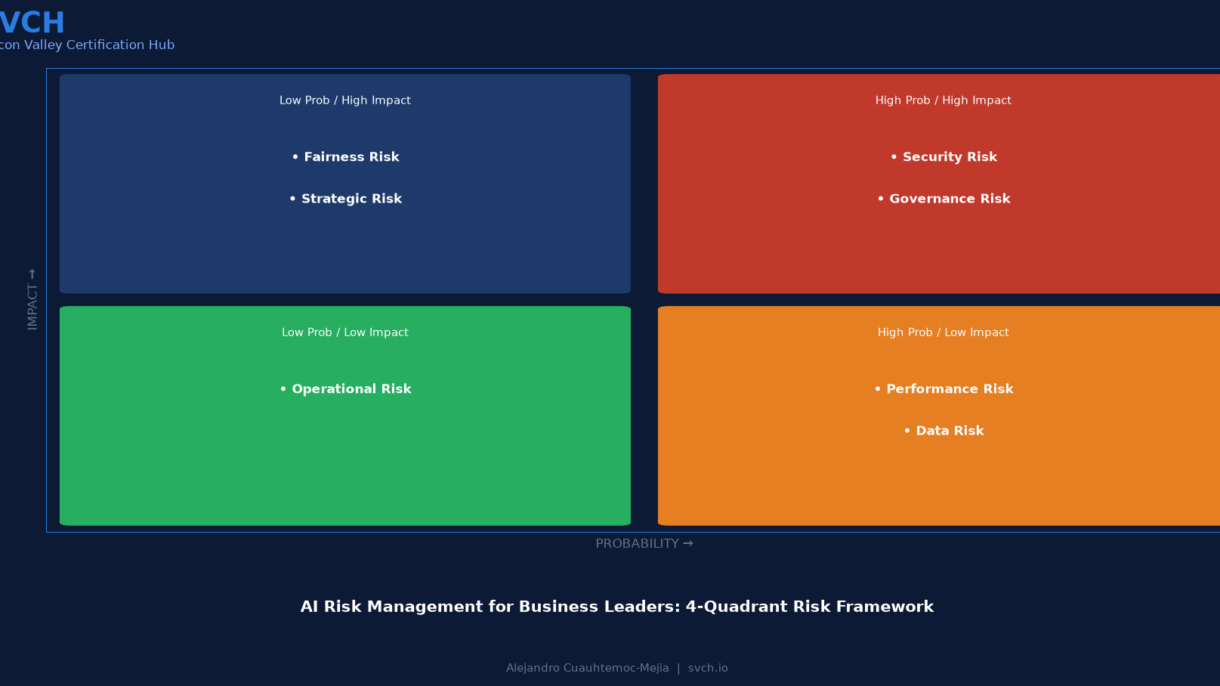
AI risk management is the discipline of identifying, assessing, and mitigating the risks that arise from deploying artificial intelligence systems in enterprise contexts. For business leaders in 2026, understanding AI risk is not optional — it is a fiduciary responsibility. AI systems can fail in ways that are fundamentally different from traditional software, and those failures can have material consequences for customers, regulators, and shareholders.
This article provides a practical AI risk management framework for non-technical business leaders: the categories of AI risk you need to manage, the governance structures that support effective risk oversight, and the accountability model that ensures no risk falls through the cracks between the CAIO, CRO, and General Counsel.
Silicon Valley Certification Hub works with executives across financial services, healthcare, and technology to build AI risk management frameworks that satisfy board oversight requirements and survive regulatory scrutiny. Here is what every senior leader needs to know.
The Four Categories of Enterprise AI Risk
AI models can fail silently, drift over time, and behave differently on edge cases than on training data. Model risk includes accuracy degradation, distributional shift (the real world changes and the model doesn’t), and adversarial manipulation. The consequence in high-stakes applications — credit scoring, medical diagnosis, fraud detection — is direct harm to customers or incorrect decisions with material financial impact.
AI is only as good as its training data. Data risk includes biased training data that encodes historical discrimination, data quality issues that produce unreliable outputs, data privacy violations (using personal data without consent), and data lineage gaps that make compliance attestation impossible.
Absent governance creates liability. Governance risk arises when there is no clear accountability for AI decisions, no process for reviewing high-risk AI deployments, no audit trail for model behavior, and no mechanism for affected individuals to challenge AI-driven decisions. Regulators are increasingly treating governance gaps as evidence of negligence.
The regulatory landscape is shifting rapidly. The EU AI Act, NIST AI RMF, financial services AI guidance from the OCC and FRB, and state-level AI laws create a complex compliance environment. Organizations that have not mapped their AI systems to applicable regulatory requirements face significant enforcement exposure as regulators begin active AI audits.
AI Risk Governance: Who Owns What
Effective AI risk governance requires clear role separation. The most common organizational failure is treating AI risk as purely an IT or engineering responsibility — meaning no one at the executive level is accountable when something goes wrong. The correct structure assigns four distinct roles:
The CAIO owns the AI risk framework design and the enterprise-level AI risk appetite statement. They define which AI risk categories the organization accepts, which it mitigates, and which it avoids entirely. CAIO-CP™ certified executives are trained specifically in this risk framework design role.
The CAIERO or AI Ethics Officer owns model-level risk assessment and ethical review of high-risk AI deployments. This role is supported by the CAIERO-CP™ AI Governance certification.
The CRO integrates AI risk into the enterprise risk management framework, ensuring AI risks are visible in risk committee reporting and appropriately capitalized (in financial services contexts).
Business unit leaders own operational AI risk within their functions — they are the first line of defense for the AI systems deployed in their operations.
Building an AI Risk Assessment Process
Every AI system deployment should go through a pre-deployment risk assessment before going live in a production environment. The assessment should evaluate: the population affected by the AI decision, the potential harm if the model makes an incorrect output, the data quality and bias profile of the training set, the monitoring and alerting infrastructure in place, and the governance approval required before deployment.
High-risk AI deployments — those affecting individual rights, financial decisions, employment, or medical outcomes — require additional scrutiny: bias testing across protected demographic groups, explainability assessment (can the decision be explained to the individual affected?), and a human oversight mechanism that allows escalation and appeal. For organizations building this capability, a structured AI Assessment for companies reveals which existing AI systems have not gone through this process — a common and significant gap in mid-market organizations. Enterprise AI programs from Silicon Valley Certification Hub include risk assessment framework development as a core deliverable.
Key Takeaways for Business Leaders
Create an AI risk registry
Catalog every AI system in production: what it decides, whose data it uses, what the failure mode looks like, and who is accountable for monitoring it. Most mid-market companies discover they have more AI systems deployed than they realized when they do this exercise for the first time.
Assign accountability for every AI system
Every AI system in production should have a named business owner who is accountable for its performance and risk profile — not just a technical owner in IT or engineering. Business owners are the first line of defense.
Build a pre-deployment review process
Require a risk assessment before any AI system that affects customers, employees, or financial decisions goes into production. The review should include data quality, bias testing, explainability assessment, and governance approval at the appropriate level of authority.
Monitor for model drift continuously
AI models degrade over time as the real world changes. Implement continuous monitoring with automated alerting when model performance metrics drop below defined thresholds. This is operational risk management — not a nice-to-have.
Integrate AI risk into enterprise risk reporting
AI risk should appear in your quarterly enterprise risk report, not in a separate technical report that the board never sees. Translate AI risks into financial and reputational impact terms that risk committee members can evaluate.
Frequently Asked Questions
What does this mean for a Chief AI Officer?
AI risk management is one of the CAIO’s most critical accountability areas. CAIOs who build a credible AI risk framework — with clear ownership, pre-deployment review processes, and continuous monitoring — position their organization as a responsible AI deployer and reduce the regulatory and reputational exposure that comes with ungoverned AI deployments.
What is the biggest AI risk for businesses in 2026?
Governance risk — the absence of clear accountability, audit trails, and oversight mechanisms for AI decisions — is consistently rated as the highest-priority AI risk by regulators and enterprise risk managers. Technical model failures are more visible, but governance gaps are what turn a model failure into a regulatory enforcement action or a class-action lawsuit.
How does AI governance certification help with risk management?
The CAIERO-CP™ from Silicon Valley Certification Hub provides a structured AI risk management framework that covers all four risk categories — model, data, governance, and regulatory. Certified professionals have the vocabulary and methodology to build risk assessment processes that satisfy both internal audit and external regulatory scrutiny.
What AI risk assessment tools should companies use?
The NIST AI Risk Management Framework (AI RMF) is the most widely adopted tool for enterprise AI risk assessment in the US. The EU AI Act provides a risk-tier classification system for AI systems in European contexts. Silicon Valley Certification Hub’s AI Assessment for companies applies both frameworks and produces a practical gap-to-control mapping.
Who should sit on an AI risk committee?
An effective AI risk committee includes the CAIO (chair), the CRO, the General Counsel or Chief Compliance Officer, the CISO, and a business unit representative from the highest-risk AI deployment area. Board-level AI risk oversight should be assigned to the audit or risk committee.
Want to know how this applies to your company?
At Silicon Valley Certification Hub, we help you align AI + Strategy. Our team works directly with your directors and teams to assess AI readiness, identify gaps, and build a clear path forward — tailored to your business context.
Book a time with our CEO, Alejandro Cuauhtemoc-Mejia
Silicon Valley Certification Hub | 3000 El Camino Real, Building 4, Palo Alto, CA


0 Comments