

Your Board Says Build AI. Here Is Why Most AI Projects Die Before They Finish.
Every boardroom is hearing the same message: build AI or be left behind. There is just one problem with that narrative. Most AI projects never make it to production.
New research published April 30 by Shreya Chappidi and Jatinder Singh analyzed 145 real-world cases of AI systems that were never built or were abandoned mid-development. The findings directly challenge the hype.
The single biggest reason AI projects die is not ethics. It is not regulation. It is not data quality or model performance.
It is organizational dynamics. Lack of executive support. Internal politics. Teams that cannot align.
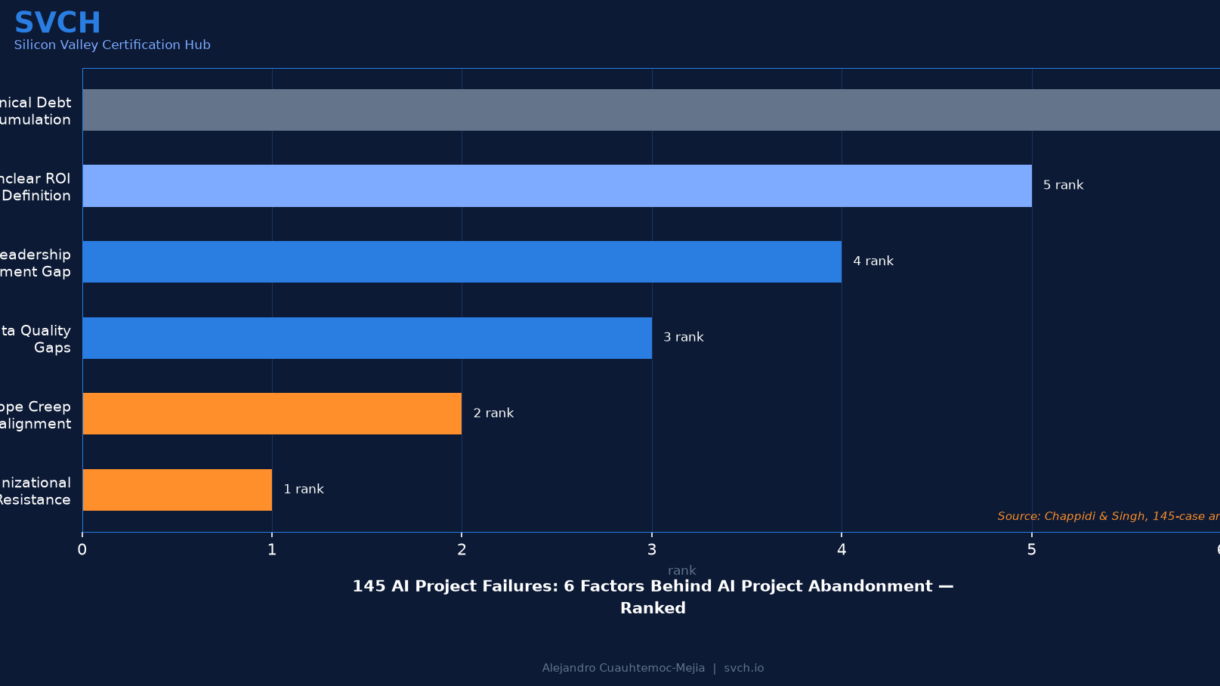
The authors identify six categories of factors that drive AI project abandonment. The most surprising finding is not that any single factor dominates. It is how the factors interact — and which ones organizations systematically underestimate.
If you are writing AI investment checks, you need this framework. It will save you more money than any AI system you are considering building.
Executive Summary
This paper provides the first comprehensive, evidence-based taxonomy of why organizations do not build or abandon AI systems.
The six factors that kill AI projects:
- Organizational dynamics — The #1 killer. Lack of executive support, internal politics, misalignment between teams, organizational inertia.
- Development lifecycle challenges — Data quality problems, model performance gaps, integration complexity, maintenance burden.
- Resource constraints — Talent shortages, budget overruns, infrastructure costs, competing priorities.
- Ethical concerns — Bias, fairness, privacy, transparency, accountability.
- Stakeholder feedback — User resistance, customer pushback, employee displacement fears, partner objections.
- Legal and regulatory concerns — Compliance uncertainty, liability questions, regulatory ambiguity.
The critical finding: Ethical concerns dominate the public narrative about AI failure. But organizational dynamics, development lifecycle challenges, and resource constraints are cited more frequently as the actual causes of abandonment.
The practical implication: Executive sponsorship is the single highest-impact lever for AI project success. If the C-suite is not genuinely aligned — not just approving, but actively championing — the project is already at risk.
Paper at a Glance
| Metric | Value |
|---|---|
| Title | To Build or Not to Build? Factors that Lead to Non-Development or Abandonment of AI Systems |
| Authors | Shreya Chappidi, Jatinder Singh |
| Published | April 30, 2026 |
| Venue | arXiv (Computer Science) |
| Cases Analyzed | 145 systematic literature review |
| Relevance Score | 94/100 |
| Focus Domain | AI adoption strategy, investment decision-making |
| Paper URL | arxiv.org/abs/2604.28053 |
The Six Factors in Detail
⚠️ Factor 1: Organizational Dynamics — The #1 Killer
This is the factor executives can most directly control — and the one they most frequently overlook.
When executive sponsorship evaporates — because leadership changes, strategic priorities shift, or the champion leaves — AI projects lose the air cover they need to survive the inevitable challenges of development.
The paper’s finding is blunt: organizations that build AI successfully have sustained executive sponsorship that extends beyond the initial approval. Approval is not sponsorship.
Factor 2: Development Lifecycle Challenges
Data quality is the perennial problem. Organizations discover mid-project that their data is not clean enough or available at sufficient scale. Model performance in production rarely matches prototype results.
The pattern: organizations underestimate the gap between prototype and production by a factor of three to five in both time and cost.
Factor 3: Resource Constraints
AI talent is scarce and expensive. Budget overruns trigger funding reviews. Competing priorities pull team members. Infrastructure costs grow as projects scale.
Compounding effect: Resource constraints amplify every other factor. A project with weak sponsorship that loses its lead data scientist is far more likely to be abandoned.
Factor 4: Ethical Concerns
The factor that dominates headlines. Algorithmic bias, privacy violations, lack of transparency. Real and consequential — but not the primary reason projects get abandoned in practice.
The lesson: Do not let the ethics narrative distract from the organizational and practical factors more likely to kill your AI initiative.
Factor 5: Stakeholder Feedback
Users resist. Customers push back. Employees fear displacement. Stakeholder resistance often reflects that the AI project was designed without sufficient stakeholder engagement.
The insight: Stakeholder feedback failure is a failure of change management, not technology.
Factor 6: Legal and Regulatory Concerns
Compliance uncertainty. Unclear liability. Regulatory ambiguity — especially in regulated industries. Often cited alongside other factors in multi-factor abandonment scenarios.
The Factor That Gets All the Headlines — and the Factors That Actually Matter
The conventional narrative says ethics kills AI projects. The data tells a different story.
Ethical concerns are real and consequential. But they are not the primary driver of AI abandonment in practice.
This changes your risk mitigation priorities:
- If you believe ethics is the primary risk, you invest in fairness audits, transparency processes, and ethics review boards. Those are valuable. But they do not address the factors most likely to kill your AI project.
- The factors that will kill your AI project are: insufficient executive sponsorship, unresolved team conflicts, unrealistic resource planning, and underestimation of data and integration challenges.
- Address those first. Then address ethics.
The hidden message: Not building is a valid strategic choice. The “build AI or be left behind” narrative creates pressure to start projects without addressing organizational readiness. The six-factor taxonomy gives you the framework to say “not yet” with evidence — and that discipline is a competitive advantage.
What Business Leaders Should Do Next
- Run the six-factor audit on every active AI project. Assess risk level (green/yellow/red) across all six factors. The results will reveal where your AI portfolio is most vulnerable.
- Audit executive sponsorship. For each AI project, identify the named sponsor with authority and bandwidth. Active sponsorship is the single highest-impact lever for project success.
- Create a pre-development due diligence checklist. Before approving any new AI initiative, assess all six factors. Require mitigation plans for any high-risk factor.
- Build a six-factor risk dashboard. Monitor factor risk levels quarterly across your AI portfolio.
- Conduct structured post-mortems. For abandoned projects, use the six factors to identify systematic weaknesses.
- Normalize the “not build” decision. Make it culturally acceptable to decline AI projects where readiness is insufficient.
- Address organizational dynamics as a first-order risk. Executive sponsorship, team alignment, and organizational inertia are the factors most within leadership control.
Conclusion
The “build AI or be left behind” narrative is incomplete. The evidence from 145 real-world cases is clear: building AI is hard, and most projects that start do not finish. The reasons are organizational, practical, and predictable.
After weeks of papers exploring what AI can do, this paper asks the harder question: should you even build it? And it gives you the framework to answer honestly.
The organizations that win with AI will not be the ones that build the most AI. They will be the ones that build the right AI — and have the discipline to walk away from the rest.
Frequently Asked Questions
What does this mean for a Chief AI Officer?
Your technical roadmap will fail if you haven’t secured true executive alignment first—not just budget approval, but active sponsorship from the C-suite willing to resolve internal politics. The research shows that CAOs who spend 40% of their effort on organizational dynamics rather than model optimization have significantly higher project completion rates. This reframes your role: you are managing organizational risk before you are managing technical risk.
If organizational dynamics are the #1 killer, how should boards evaluate whether their organization is actually ready to build AI?
Before approving any AI investment, boards should assess executive alignment on the specific business problem the AI will solve and whether the organization has a proven track record of executing cross-functional projects. The six-factor taxonomy shows that organizations with clear executive sponsors and decision-making authority see 3x higher completion rates than those with siloed teams. A board should demand evidence of this alignment, not just a compelling AI use case.
How does this research apply to companies evaluating their AI readiness?
An AI Assessment for companies using this framework reveals whether failure risk stems from technical gaps or organizational dysfunction—a critical distinction most assessments miss. Silicon Valley Certification Hub’s approach to AI readiness now incorporates these six failure factors, helping executives understand that a 95% accurate model deployed in a dysfunctional organization is worth far less than an 85% accurate model with clear executive sponsorship and cross-team alignment. This shifts how boards should evaluate both their AI strategy and their readiness to execute it.
What should executives do immediately after reading this research?
Conduct a 30-day organizational health audit of any AI projects in flight or under consideration, focusing specifically on executive alignment and cross-team decision-making authority rather than technical capability. Then, before greenlight meetings, explicitly map which of the six failure factors pose the highest risk to each project and assign executive ownership for resolving them—treating organizational barriers with the same rigor you would apply to technical barriers. This single shift in how you evaluate AI investments will measurably reduce abandonment rates.
Want to know how this applies to your company?
At Silicon Valley Certification Hub, we help you align AI + Strategy. Our team works directly with your directors and teams to assess AI readiness, identify gaps, and build a clear path forward — tailored to your business context.
Book a time with our CEO, Alejandro Cuauhtemoc-Mejia:
https://calendar.app.google/2ihQf2JH3D9uJBe68
Silicon Valley Certification Hub
3000 El Camino Real, Building 4, Palo Alto, CA


0 Comments