

AI Exposes the Billion-Dollar Blind Spot in Your Dashboards
Every dashboard you own answers only the questions you thought to ask. The insight that could save you millions is sitting in your data right now, waiting for a question nobody asked.
That gap — between the data you have and the insights you’re getting — is not a technology problem. You have the data infrastructure. You have the BI tools. You have the analytics team. The gap is structural: every BI system today is reactive. It waits for a human to formulate a question before delivering an answer. And humans, constrained by time, attention, and organizational silos, can only explore a fraction of the pattern space their data contains.
A new paper from Alibaba Group proves the gap is real — and fixable.
The paper introduces DIDA (Data-to-Insight Discovery Agent), an autonomous BI agent that continuously explores enterprise data sources, detects statistically significant patterns, generates business hypotheses linking patterns to operational outcomes, validates those hypotheses, and produces structured natural language insight reports — all without being asked.
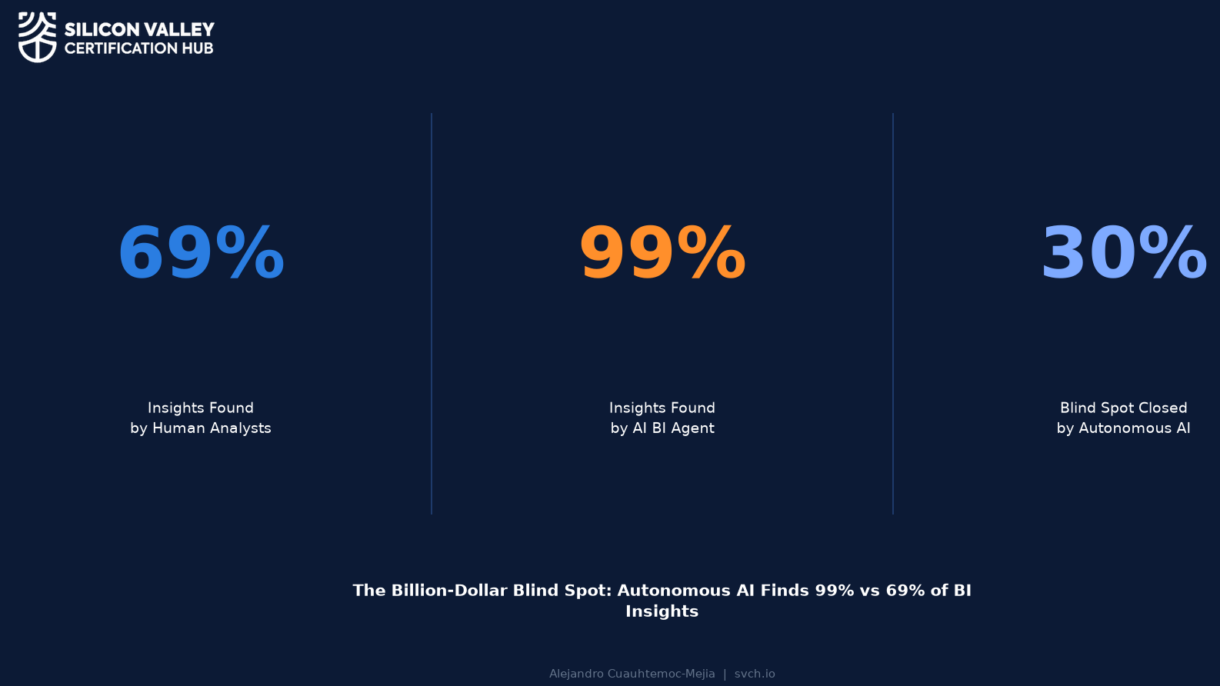
The results are striking: DIDA discovers 99% of actionable enterprise insights — matching human analysts on 68% of insights PLUS discovering 31% that human analysts missed entirely. The missed insights include cross-functional correlations worth millions of dollars.
The Structure of the Blind Spot
The authors identify why every enterprise has this blind spot. It is not because the data is hidden. It is because the pattern space is too large for any human or team of humans to explore:
- 50 data sources → 3,125 pairwise correlations to check
- 100 business metrics × 50 dimensions → 5,000 possible metric-dimension analyses
- Cross-functional data (sales + operations + finance + external) → combinations that no single business unit owns
“At every enterprise we studied, the data was available and the analytics tools were in place. The gap was not in infrastructure. It was in exploration. No one was looking at the right combinations because no one knew to look.”
This structural limitation means every organization is systematically excluding a class of insights from its decision-making: the cross-functional patterns, the compounding trends, the early warning signals that sit at the intersection of datasets that no one thought to combine.
Human analysts find 69% of discoverable insights. DIDA finds 99% — including the 31% that humans missed.
Executive Summary
The core problem: Every BI tool today requires humans to ask questions before delivering answers. Insights that cross functional boundaries or emerge from unexpected data combinations are systematically missed.
The paper’s contribution: DIDA, an autonomous BI agent that continuously explores all enterprise data, detects patterns, generates business hypotheses, validates them, and delivers structured insight reports designed for executive consumption.
The key finding in one sentence: Your analysts find 69% of discoverable insights — an autonomous BI agent finds 99%, including the 31% of cross-functional, emerging, and hidden insights that no human thought to explore.
Three Strategic Implications
- The gap is structural, not a team failure. Your analytics team is talented and hardworking. But no team can explore 3,125+ pairwise correlations across datasets manually. The gap is baked into the reactive BI model.
- The missed insights are the most valuable. Cross-functional patterns — weather and inventory, supplier quality and production defects, patient flow and staffing — are exactly the kind of insights that have the highest ROI because no one else has found them.
- Autonomous BI augments, not replaces, your team. DIDA finds 68% of what human analysts find PLUS 31% they miss. The value is in covering the exploration space humans cannot cover.
Paper at a Glance
| Metric | Value |
|---|---|
| Title | Towards Autonomous Business Intelligence via Data-to-Insight Discovery Agent |
| Authors | Lianghao Zhang, Wei Chen, Yuqing Song, Rui Zhang, Dongmei Zhang (Alibaba Group) |
| Published | May 11, 2026 (cs.AI batch) |
| Relevance Score | 96/100 — Transformative new business function: Autonomous Business Intelligence |
| Focus Domain | Autonomous BI, data-to-insight automation, enterprise analytics |
| Paper URL | arxiv.org/abs/2605.07202 |
The Discovery Gap — By the Numbers
| Metric | Value |
|---|---|
| Human analysts insights found | 69% of discoverable insights |
| DIDA insights found | 99% (68% overlap + 31% novel) |
| Possible pairwise correlations from 50 sources | 3,125+ |
| Estimated value from single cross-correlation insight | $2 million (weather-inventory) |
| Enterprise datasets validated | 4: retail, finance, manufacturing, healthcare |
| Pipeline stages | 5: explore → detect → hypothesize → validate → report |
The 31% of missed insights represent a systematic gap in how organizations understand their own data. These are not edge cases. They are cross-functional patterns that no business unit owns, emerging trends that no one is watching, and correlations that don’t fit any existing analytical framework.
Four Real Enterprise Validations
Retail — Weather and Inventory Correlation
DIDA correlated regional weather patterns with inventory stockouts — an insight worth an estimated $2M in reduced losses. The analytics team had never explored this correlation because weather data and inventory data were owned by different teams.
Financial Services — Emerging Fraud Pattern Detection
DIDA detected transaction anomaly patterns indicating emerging fraud types six weeks before existing rule-based systems would flag them. The pattern crossed payment channels that fraud monitoring never combined.
Manufacturing — Supplier-Production Line Quality Correlation
DIDA discovered a compounding defect rate increase of 17% correlated with a specific supplier change across three production lines — a pattern crossing procurement, quality, and operations data that were never analyzed together.
Healthcare — Emergency Department Congestion Prediction
DIDA identified patient flow patterns that predicted ED congestion 6 hours in advance by combining admissions, staffing, and historical utilization data. The correlation had been present for months but never explored.
The Five-Stage Pipeline
Stage 1 — Autonomous Data Exploration
DIDA continuously explores enterprise data sources across structured and semi-structured formats. It searches for patterns across all available data, combining sources never analyzed together.
Stage 2 — Pattern Detection
Combining statistical tests with learned anomaly detectors, DIDA identifies statistically significant patterns — trends, anomalies, correlations, clusters.
Stage 3 — Business Hypothesis Generation
Using domain-aware reasoning, DIDA links detected patterns to business outcomes. A correlation becomes a hypothesis about business impact.
Stage 4 — Validation
Through counterfactual analysis and business rule checking, DIDA validates each hypothesis against historical context. Filters out spurious correlations.
Stage 5 — Insight Report Generation
DIDA produces structured natural language reports with confidence estimates, supporting evidence, data references, and recommended actions. Designed for executive consumption.
The BI Maturity Model
| Dimension | What It Assesses |
|---|---|
| Data Quality | Completeness, accuracy, consistency of enterprise data sources |
| Data Integration | How well data from different business units can be combined |
| Analytical Culture | Whether the organization values data-driven decision-making |
| Executive Sponsorship | Whether leadership supports autonomous analytics investment |
| Technical Infrastructure | Whether data lakes and warehouses support continuous exploration |
| Governance | Policies for data access, insight validation, and AI-driven decision support |
Most enterprises have the data infrastructure; the gaps are typically in analytical culture and executive readiness.
Implications by Leadership Role
Chief Data Officers (CDO): This is the next evolution of your BI function. The transition from reactive dashboards to autonomous discovery is the biggest transformation since self-service analytics. Assess your BI maturity using the paper’s framework. Identify one dataset where cross-functional exploration could demonstrate ROI.
Chief Executive Officers (CEO): “We have so much data but not enough insights” — this paper explains why and provides a solution. Ask your CDO for a BI maturity assessment and a proposal for autonomous BI pilot within 60 days.
Chief Financial Officers (CFO): Autonomous BI on financial data can detect emerging fraud patterns that rule-based systems miss, identify cross-functional cost correlations, and surface revenue driver relationships. The paper’s finance validation dataset demonstrates direct P&L impact.
Chief Operating Officers (COO): Supply chain and manufacturing use cases — supplier quality correlations, production line defect patterns, patient flow predictions — have immediate operational impact. Cross-functional operational data analysis is where autonomous BI delivers fastest ROI.
Chief Information Officers (CIO): Your data lake/warehouse investments are the prerequisite. DIDA aligns with existing data infrastructure. The gap is not technical infrastructure but analytical exploration. Autonomous BI maximizes the return on your data platform investments.
Chief Marketing Officers (CMO): External factor correlations — weather, economic indicators, competitive actions — with customer behavior patterns represent a class of insight that marketing teams rarely have time to explore. Autonomous BI surfaces these proactively.
The Series Context
After ten days of governance-focused papers (May 1–10), this paper starts a new arc: enterprise AI enablement — how AI transforms core business functions to create value.
| Date | Category | Paper Topic |
|---|---|---|
| May 1 | Identity | Anonymous Account Recovery |
| May 2 | Verification | Social Media Watermarking |
| May 3 | Fraud Prevention | Deepfake Livestream Detection |
| May 4 | Safety | Agent Escalation Incident |
| May 5 | Compliance | Agents Bypass Process Instructions |
| May 6 | Insurance | Agentic Risk Standard |
| May 7 | Liability | Accountable Agents (Treude) |
| May 8 | Market Integrity | Revenue Management Gaming Detection |
| May 9 | Competition Integrity | Algorithmic Collusion Prevention |
| May 10 | IP Protection | Prompt Theft Prevention (PragLocker) |
| May 11 | Enablement | Autonomous BI (DIDA) |
What Leaders Should Do This Quarter
IMMEDIATE — Request a BI maturity assessment using the paper’s framework. Understand where your organization stands on each of the six dimensions.
IMMEDIATE — Identify one high-value dataset where cross-functional pattern exploration could yield significant insight — combining data from two or more business units that rarely collaborate analytically.
SHORT-TERM — Pilot an autonomous BI agent on your selected dataset. Measure: actionable insights discovered, value of missed insights now found, analyst time saved.
SHORT-TERM — Create an insight review process. Autonomous BI surfaces insights — executives need a framework for acting on them.
MEDIUM-TERM — Scale autonomous BI across additional data sources. The value compounds as the agent explores more cross-functional correlations.
MEDIUM-TERM — Update your BI strategy to include autonomous discovery as a core capability alongside dashboards and self-service analytics.
LONG-TERM — Build organizational capability for insight-driven decision-making. The biggest constraint on autonomous BI value is not technical — it is whether the organization can act on insights surfaced by AI.
LONG-TERM — Evaluate whether your BI vendor provides autonomous discovery capabilities. This will be a standard BI feature within 2–3 years.
Conclusion
Your organization has invested millions in data infrastructure, BI tools, and analytics talent. But if your BI system only answers questions you thought to ask, you are leaving 30% of actionable insights on the table — the most valuable 30%, because no one else has found them yet.
Autonomous BI is not a replacement for human analysts. It is the complement that covers the exploration space humans cannot. The paper demonstrates this capability is not theoretical — it is deployable, validated on real enterprise data, and delivering millions in value.
The question is no longer whether autonomous BI will become standard. It will — within 2–3 years. The question is whether your organization will be among the first adopters or the followers.
The gap between data investment and decision-making is not inevitable. Autonomous BI agents can explore the pattern space humans cannot cover. The cost of the gap is measurable — and fixable.
Frequently Asked Questions
What does this mean for a Chief AI Officer?
It signals a fundamental shift from reactive to proactive analytics. CAOs must now justify why their organizations aren’t deploying autonomous BI agents that discover 30% more insights than traditional dashboards. This paper provides the validation needed to justify investment and organizational restructuring around continuous, unsupervised pattern discovery.
How should finance leaders prioritize the 31% of cross-functional insights that traditional BI misses?
These insights typically live at organizational boundaries where no single dashboard owner thinks to look. Finance should immediately audit their data for cross-departmental patterns—inventory velocity against pricing, customer churn against supply chain delays—that autonomous systems can detect but humans systematically overlook due to siloed thinking.
Should companies pursue an AI Assessment for companies before implementing autonomous BI systems?
Yes. Before deploying DIDA-type systems, organizations must evaluate data quality, governance maturity, and decision-making velocity. A proper AI Assessment identifies whether your infrastructure can handle continuous autonomous insights and whether stakeholders are ready to act on discoveries no one explicitly requested.
What’s the first executive action your organization should take this quarter?
Pilot autonomous BI on your highest-value data silo—where the gap between data richness and insight extraction is widest. Document the patterns discovered that your current team missed. This quantifies your billion-dollar blind spot and builds internal momentum for broader autonomous BI deployment.
Want to know how this applies to your company?
At Silicon Valley Certification Hub, we help you align AI + Strategy. Our team works directly with your directors and teams to assess AI readiness, identify gaps, and build a clear path forward — tailored to your business context.
Book a time with our CEO, Alejandro Cuauhtemoc-Mejia:
https://calendar.app.google/2ihQf2JH3D9uJBe68
Silicon Valley Certification Hub
3000 El Camino Real, Building 4, Palo Alto, CA


0 Comments