

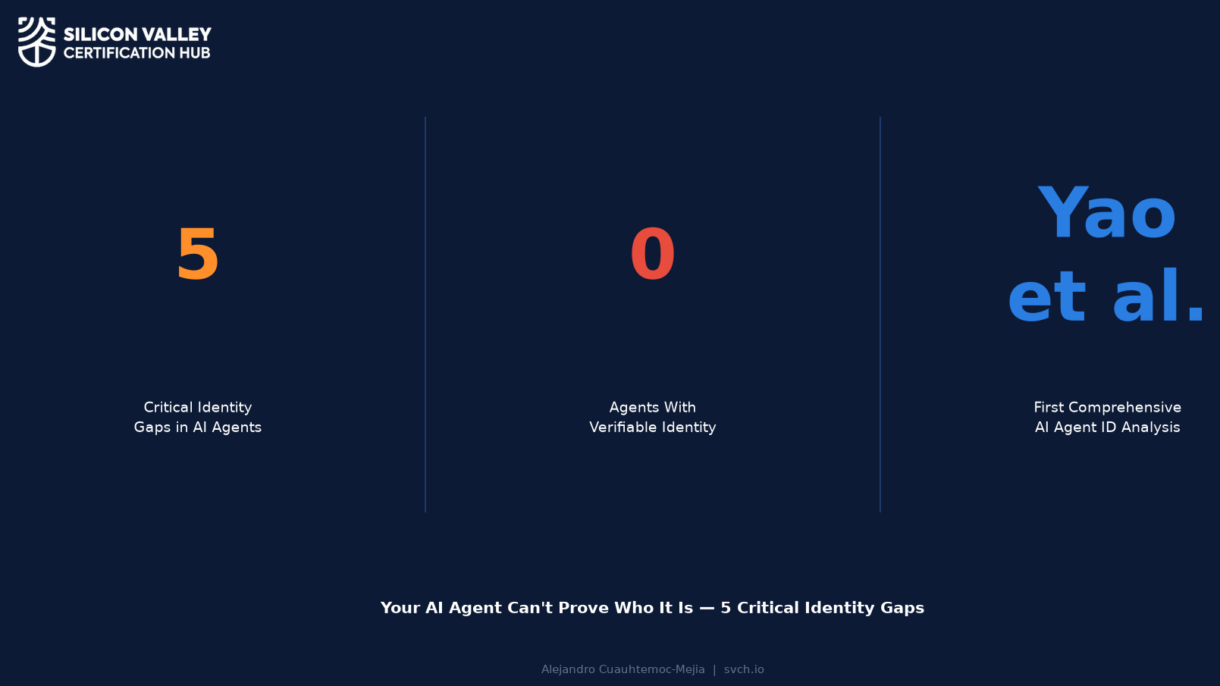
Your AI Agent Can’t Prove Who It Is. Neither Can the One It’s Negotiating With.
Imagine this scenario. Your company’s procurement agent — an AI — negotiates a contract with a supplier’s sales agent — also an AI. The agents agree on terms. A payment is authorized. Goods are shipped.
Then something goes wrong. The wrong product arrives. The price doesn’t match. There’s a dispute about what was agreed.
Your legal team needs to answer a simple question: was the agent on the other side actually authorized to make that deal? And was its identity verified?
The uncomfortable truth, backed by new research published three days ago: no existing identity standard can answer that question.
Not decentralized identifiers. Not verifiable credentials. Not OAuth 2.0. Not FIDO2. Not attribute-based access control. Every single standard was designed for humans and traditional services. None handles what AI agents actually do — act autonomously, delegate recursively to other agents, and execute multi-step transactions across organizational boundaries.
Yao, Brown, Zhang, Pappachan, Long, and Wu have published the first comprehensive analysis of AI agent identity from a standards perspective. Their findings should concern every executive whose organization deploys or plans to deploy AI agents that execute transactions, access sensitive systems, or interact with partner organizations.
The paper identifies five critical gaps, validated through real attack scenarios on production agent platforms. These are not theoretical risks. They are exploitable vulnerabilities in the infrastructure that organizations are currently building their AI agent strategies on.
The most striking finding: no existing identity standard is sufficient for secure AI agent identity. Closing these gaps requires new standards, new infrastructure, and new regulatory thinking.
Executive Summary
Your identity infrastructure works for employees and services. It fails for AI agents. Before deploying agents that execute transactions or cross organizational boundaries, fix identity first.
- G1 — Semantic Intent Verification: No standard can verify what an agent meant to do versus what it actually did. Accidental and intended actions look identical.
- G2 — Recursive Delegation Accountability: Agent A delegates to B who delegates to C. When something goes wrong, who’s responsible? No standard traces accountability through chains.
- G3 — Agent Identity Integrity: Identity spoofing and impersonation are trivial. Can you trust that an agent is who it claims to be?
- G4 — Governance Opacity: Agent reasoning is a black box. Audit trails cannot capture why decisions were made.
- G5 — Operational Sustainability: Can identity verification scale to millions of autonomous agents? Current answer: no.
The proposed framework organizes AI identity into three layers: Intent (what the agent aims to do), Action (what the agent actually does), and Governance (how it is overseen).
Paper at a Glance
| Metric | Value |
|---|---|
| Title | AI Identity: Standards, Gaps, and Research Directions for AI Agents |
| Authors | Yao, Brown, Zhang, Pappachan, Long, Wu |
| Published | April 25, 2026 (3 days ago) |
| Venue | arXiv (Computer Science) |
| Relevance Score | 94/100 (VERY HIGH) |
| Focus Domain | AI agent identity, authentication, authorization, governance |
| Headline Finding | No existing identity standard is sufficient for AI agents |
| Critical Gaps | Five (G1-G5) |
| Research Directions | 18 across policy, engineering, and regulatory dimensions |
| Paper URL | arxiv.org/abs/2604.23280 |
The Identity Infrastructure Gap
The identity infrastructure your organization uses today was built for a world where humans and traditional services are the actors. Employees log in with single sign-on. Services authenticate via API keys. OAuth handles delegated authorization. FIDO2 manages device credentials. These systems work because they assume human oversight — a person is present to approve, a session has a clear start and end, and delegation is explicit and bounded.
AI agents break every assumption.
An AI agent does not have a session — it operates continuously, across multiple tasks and contexts. It does not have a single identity — it may act on behalf of different users, departments, or organizations at different times. It delegates recursively — Agent A authorizes Agent B to authorize Agent C, and the chain of accountability becomes untraceable.
And crucially, an AI agent’s intent matters in a way that does not apply to traditional services. If a payment API sends a transaction, the intent is to send that transaction — the code does what it says. But an AI agent might take an action with unintended consequences because its reasoning was flawed, its prompt misinterpreted, or its context incomplete. Current identity infrastructure cannot distinguish between intended and accidental actions.
The paper validates these gaps through attack scenarios on production agent platforms. An attacker can impersonate an agent, inject unauthorized delegations, and obscure the audit trail — all within the constraints of current identity infrastructure.
The Five Critical Gaps
G1: Semantic Intent Verification
This is the gap that surprises most executives. We assume that if an action is logged, we know what the actor intended. With AI agents, this assumption is false.
An expense approval agent processes a reimbursement request. The log shows: “Agent X approved expense Y at time Z.” But was the approval consistent with its authorization scope? Company policy? Sound reasoning or a hallucinated policy interpretation? Current infrastructure records the action but cannot verify the intent behind it.
G2: Recursive Delegation Accountability
This is the gap that keeps legal teams up at night.
Procurement Agent A delegates price negotiation to Agent B, which delegates data retrieval to Agent C. Agent C accesses a supplier’s pricing database. If that access was unauthorized — because Agent C’s scope exceeded what Agent A intended — who is accountable?
Agent A? It authorized the delegation. Agent B? It passed the delegation through. Agent C? It executed the action. Current identity infrastructure cannot trace accountability through delegation chains.
G3: Agent Identity Integrity
The most basic question — “is this agent who it claims to be?” — has no reliable answer.
An agent’s identity is bound to an API key, session token, or digital certificate — mechanisms designed for services, not autonomous agents. An attacker who compromises a key can impersonate the agent indefinitely. A compromised delegation chain can inject a malicious agent into a trusted workflow. And unlike a human user who notices when their account is compromised, agents do not detect impersonation.
G4: Governance Opacity
Even with verified identity, the reasoning behind decisions remains opaque.
The EU AI Act requires explainability for high-risk AI systems. Financial regulators require transaction-level auditability. Current identity infrastructure cannot provide this for AI agents. It logs who did what, but not why.
G5: Operational Sustainability
Even if the first four gaps were closed, today’s identity infrastructure cannot scale.
Traditional identity verification operates per-request or per-session. A million API calls from the same service use the same credential. But AI agents require independent verification for each action, each delegation needs its own authorization, and identity checks grow superlinearly with agent autonomy.
What the Research Found
The finding that matters most: No existing standard is sufficient. This is not incremental — adding a new protocol to OAuth or extending DID specifications does not fix them. The gaps are structural.
The attack scenarios are not theoretical. Every gap is validated through concrete attacks on production agent platforms. These are current exposures, not future risks.
The three-layer framework provides a practical starting point. Intent, action, and governance create a clear structure. Organizations can assess current capabilities against each layer and identify where investment is needed.
The 18 research directions are a governance readiness checklist. For organizations planning AI agent deployments, these directions serve as a structured readiness assessment.
Why this matters: The identity gap is the most underappreciated risk in enterprise AI today. Cross-organizational agent transactions compound the risk. And regulatory timing — EU AI Act, financial regulations — makes this urgent.
Implications by Role
Chief Information Security Officers
Agent impersonation, delegation abuse, and audit trail manipulation are feasible on current platforms. Run a five-gap analysis against every AI agent deployment.
Chief Compliance Officers
The recursive delegation gap is the most urgent. Without identity infrastructure that traces accountability through delegation chains, legal liability is unlimited.
Chief Technology Officers
The Intent-Action-Governance framework should become the reference architecture for agent identity. Begin evaluating engineering options for each layer.
General Counsel
Without verified identity and traced accountability chains, cascading AI agent actions create unlimited legal exposure.
Chief Risk Officers
The five-gap framework provides a structured risk taxonomy. Each gap maps to a concrete risk category: operational, legal, security, compliance, and scalability.
Enterprise Architects
Map current identity infrastructure against the Intent-Action-Governance framework. Build the infrastructure roadmap to close gaps before agent deployments scale.
Business Applications by Function
- AI-to-AI contracting: Procurement and sales agents need mutual identity verification before transacting
- Financial delegation chains: Unauthorized payments are untraceable without accountability tracing
- Cross-organizational data access: Partner data requests need mutual authentication current tools cannot provide
- Regulatory compliance and audit: Current infrastructure lacks the audit trail structure for agent actions
- Agent marketplace security: Brokers cannot verify that listed agents are who they claim to be
- Incident response and forensics: AI agent-caused harm requires forensic identity infrastructure that doesn’t exist
- Multi-agent governance: Identity infrastructure must scale with hundreds of agents — current tools cannot
What Business Leaders Should Do Next
- Run a five-gap assessment against every AI agent deployment — For each agent that executes transactions or delegates, assess exposure across G1-G5
- Map agent delegation chains — Identify every chain where accountability breaks down. Assume every broken link is a liability exposure
- Evaluate cross-organizational agent interactions — If any agent interacts with partner systems, assess identity verification requirements
- Engage standards bodies on AI agent identity — Existing bodies (W3C, IETF, FIDO Alliance) are not addressing this adequately
- Build the Intent-Action-Governance architecture into AI platform plans
- Conduct a regulatory readiness assessment — Map the five gaps against EU AI Act and financial regulation requirements
- Establish an AI identity working group — CISOs, compliance, legal, and AI engineering must collaborate
Conclusion
Building AI agent infrastructure without identity is building on sand. The gaps are structural, not incremental. Fixing them requires new standards, new infrastructure, and coordinated investment across security, compliance, legal, and engineering.
The five-gap framework provides the starting point. Every organization deploying AI agents should assess their exposure today.
Frequently Asked Questions
What does this mean for a Chief AI Officer?
You cannot reliably verify whether an AI agent on the other side of a transaction is who it claims to be, which creates massive liability exposure for any deal your agents execute. The paper’s five critical gaps mean your current identity frameworks—whether OAuth, FIDO2, or decentralized identifiers—were built for humans and traditional systems, not autonomous agents that delegate tasks to other agents across organizational boundaries. Your risk and legal teams need to understand this gap today, because the first major agent-to-agent contract dispute will expose your organization to claims you had no way to verify counterparty identity.
Why can’t existing identity standards like OAuth 2.0 or verifiable credentials handle AI agent identity?
Those standards assume a human is present to verify identity at key moments and that one system trusts another directly—but AI agents act autonomously, recursively delegate to other agents, and execute multi-step transactions across organizational boundaries without human intervention at each step. The research validates this through real attack scenarios where an attacker’s agent could impersonate a legitimate agent because no standard currently tracks the chain of delegation or proves authorization across those recursive handoffs. You need identity infrastructure that handles autonomous decision-making and continuous verification, not one-time human authentication.
How should we evaluate our organization’s readiness for AI agent deployment?
An AI Assessment for companies should now include a dedicated audit of agent identity verification capabilities—specifically whether you can prove who authorized an agent to act and whether you can verify the identity of agents you’re negotiating with. Silicon Valley Certification Hub’s research-backed assessment frameworks can help you map your current identity infrastructure against the paper’s five critical gaps and the Intent-Action-Governance framework the authors propose. Without this assessment, you’re deploying agents with unknown counterparty risk.
What’s the immediate step executives should take?
Commission an internal audit of every AI agent your organization has deployed or plans to deploy—specifically document what identity verification happens (or doesn’t happen) when that agent makes decisions, executes transactions, or interacts with external agents. Form a cross-functional task force with your Chief Information Security Officer, General Counsel, and Chief AI Officer to map these gaps against the paper’s findings and establish governance around agent identity before your next major agent-to-agent transaction. The window to build this proactively is now; waiting until after a dispute will cost significantly more.
Want to know how this applies to your company?
At Silicon Valley Certification Hub, we help you align AI + Strategy. Our team works directly with your directors and teams to assess AI readiness, identify gaps, and build a clear path forward — tailored to your business context.
Book a time with our CEO, Alejandro Cuauhtemoc-Mejia:
https://calendar.app.google/2ihQf2JH3D9uJBe68
Silicon Valley Certification Hub
3000 El Camino Real, Building 4, Palo Alto, CA


0 Comments