

The AI Insurance Product Strategy Playbook — What Carriers Should Build Next
Paper: “The Insurability Frontier of AI Risk: A Crosswalk of 55 AI Threat Classes Against 26 Products and Endorsements in the US Commercial Insurance Market”
arXiv: 2605.18784
Published: May 2026
Researchers: Alex Leung, Rex Zhang, Ervin Ling, Kentaroh Toyoda, SiewMei Loh
The first systematic map of AI risk insurability is out, and for insurance carriers it reads less like a research paper and more like a product development roadmap disguised as an academic study.
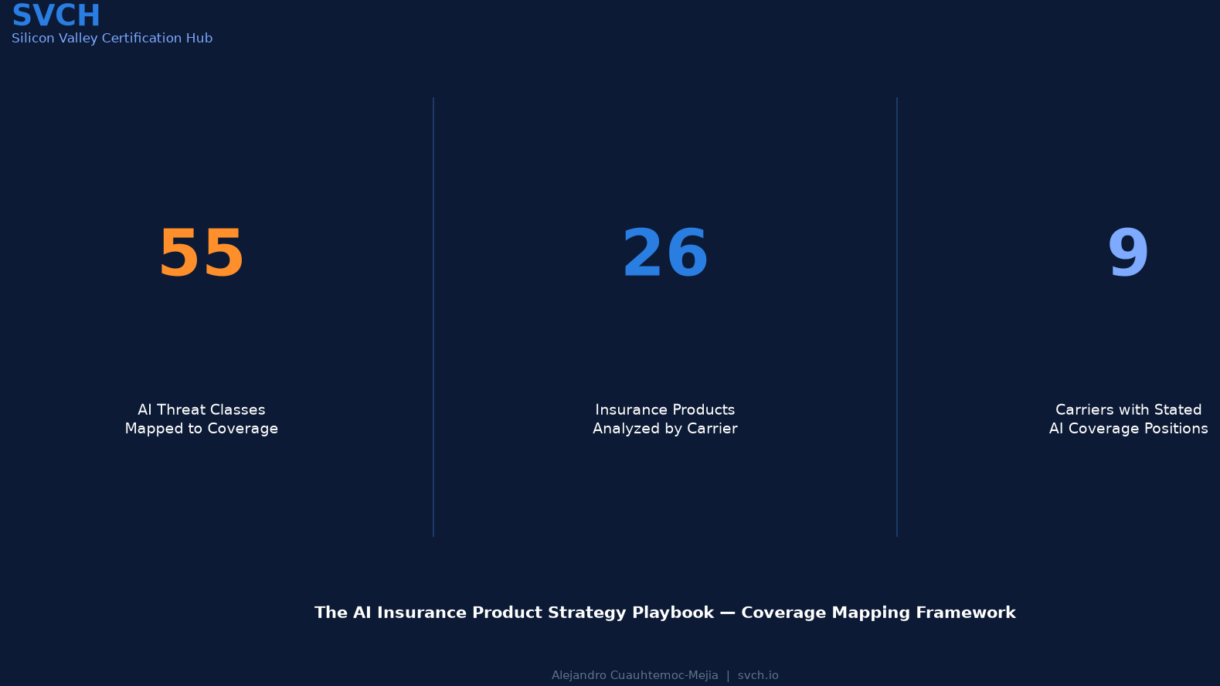
Fifty-five AI threat classes against twenty-six insurance products. One thousand four hundred and thirty cells in the matrix. And the picture it paints is of a market where affirmative AI coverage exists for roughly six perils across nine carriers — and most of those products are less than two years old.
For insurance CEOs, Chief Underwriting Officers, and heads of product development, the paper answers three questions that should define the next two years of strategy:
Which perils should we write next?
How do we capture the silent-AI exposure in legacy portfolios before a competitor does — or before a loss event forces the issue?
And what is the business case for addressing the one risk that no carrier has touched: foundation model concentration?
This article converts the paper’s findings into a product development agenda for carriers. If you are an insurer deciding where to invest in AI underwriting capability, this is your due diligence.
Why This Paper Matters More for Carriers Than for Buyers
The morning article on this paper addressed corporate insurance buyers — chief risk officers, CFOs, and general counsel asking “are we covered?” This article addresses the other side of the market: the carriers who decide what to cover, how to price it, and whether their existing portfolios are building silent exposure that will eventually surface as claims.
The paper’s main contribution is the 55-by-26 matrix — a complete crosswalk of every AI threat class against every insurance product. But from a carrier’s perspective, the matrix is only the starting point. The strategic questions are in the patterns the matrix reveals.
Pattern One: First-Mover Advantage Is Real but Narrow
The paper identifies nine carriers with publicly stated AI coverage positions. Six perils have affirmative coverage from at least one carrier. But no carrier covers more than three perils. The market is fragmented by peril specialization, and the fragmentation creates opportunity. Any carrier that builds a comprehensive AI product suite — covering multiple perils across multiple product lines — will hold a structural advantage over the single-peril specialists.
Pattern Two: Silent Exposure Is an Accumulation Problem
The paper codes 8.9 percent of cells as silent-AI exposure. From a carrier’s perspective, this is not simply a gap that needs filling. It is an accumulation of uncorrelated risk that has not been quantified or priced. Every legacy cyber, tech E&O, D&O, EPLI, and crime policy written without AI-specific wording contains embedded AI risk that the carrier has not charged premium for.
Pattern Three: The Exclusion Game Has Limits
Active exclusions are accelerating, particularly in D&O, crime, and professional liability. But exclusions create a vacuum: if carriers exclude more AI perils than they write affirmative coverage for, they push risk back onto balance sheets — and risk on balance sheets eventually becomes a regulatory and market problem that may force mandatory coverage regimes.
Pattern Four: The Novel Frontier Has No Competition
Foundation model concentration risk (T-45) appears in zero carriers’ product portfolios. No one is writing this risk. No one is pricing it. No one is building the actuarial models for it. The paper identifies this as the “clearest genuinely novel insurability frontier” — which in product development terms means a market with zero incumbents and growing demand.
The Raw Numbers That Every Carrier Should Internalize
243 affirmative coverage positions (17 percent of the 1,430-cell matrix)
127 silent-AI exposures (8.9 percent)
91 active exclusions (6.4 percent)
969 inapplicable combinations (67.8 percent)
Among populated cells: 52.7 percent affirmative, 27.5 percent silent, 19.7 percent excluded
The 27.5 percent silent figure is an upper bound — many of these would be contested or denied if a claim were actually filed. But the existence of plausible coverage paths means carriers have loss exposure on policies they wrote without AI-specific underwriting. The first large court decision on silent-AI coverage will set a precedent that could unlock a wave of claims across the 127 silent cells.
The 52.7 percent affirmative figure is also an upper bound. Actual claims-payment behavior will differ from marketing positioning. The first carrier that pays a large AI-caused hallucination claim under an affirmative policy will set a benchmark for what “affirmative” actually means in practice.
The 19.7 percent exclusion figure is the fastest-moving number. Carriers should benchmark their own exclusion positioning against the paper’s baseline.
The Product Development Agenda: Five Opportunities for First-Mover Carriers
Opportunity 1: The Multi-Peril AI Liability Product
No carrier covers all six perils. Munich Re covers drift. Armilla covers hallucination. Coalition covers deepfake. Apollo ibott covers agentic failure. Each carrier has a specialty.
The carrier that builds a single endorsement covering all six perils eliminates the fragmentation problem for corporate buyers. One product. Six perils. One underwriting and pricing framework.
Market size estimate: Every Fortune 500 company deploying AI agents is a potential buyer. At $50K–$200K per policy for six-peril coverage, the addressable market is $250M–$1B annually in the US alone.
Opportunity 2: Silent Exposure Remediation Products
The silent-AI exposure in legacy books is a ticking reserve problem for carriers. But it is also a product opportunity. A carrier could offer a “silent-AI exposure endorsement” that explicitly codifies the coverage position for the 27.5 percent of threat-by-product cells currently in the gray zone.
Market size estimate: The silent exposure pool covers eight product lines across thousands of policies. Even a 10 percent conversion rate represents hundreds of millions in incremental premium.
Opportunity 3: Foundation Model Concentration Risk Pooling
Threat T-45 — foundation model concentration — is the paper’s most important finding and the carrier industry’s biggest unanswered question. The problem is correlated loss. If one foundation model fails catastrophically, hundreds of downstream companies could file claims simultaneously. Traditional insurance pricing models break down when losses are correlated.
A carrier that proposes an industry-wide foundation model risk pool positions itself as the market leader for the next wave of AI risk transfer. The pool would define the trigger event, pre-allocate the correlated loss burden, create a premium structure based on each insured’s exposure, and establish the actuarial framework for a market that currently has no pricing models at all.
Market size estimate: If foundation model concentration risk is a $100M exposure per major model failure, and the market believes a 5–10 percent annual probability, the annual premium pool is $5M–$10M per model — growing as AI adoption increases. The carrier that builds this pool first owns the market definition.
Opportunity 4: AI Underwriting Data Platform
No carrier today has a systematic data platform for AI underwriting. The threat classes are evolving. The carrier positions are shifting. The actuarial data is nascent. A carrier that builds a proprietary AI underwriting data platform — aggregating threat intelligence, carrier positioning, claims data, and model performance metrics — creates a competitive advantage in pricing and underwriting every AI product it writes.
Market size estimate: Even a 5 percent improvement in combined ratio on a $500M AI premium portfolio is $25M annually.
Opportunity 5: AI D&O Exclusion Replacement
As carriers exclude AI-caused management misconduct, they create a gap in directors and officers’ personal liability coverage. The carrier that replaces the D&O AI exclusion with a separate, affirmatively priced AI D&O product solves a governance problem for boards while converting an exclusion into a premium stream.
Market size estimate: 4,000+ publicly traded companies in the US alone. D&O premium for AI coverage at $10K–$50K per company. Conservative TAM: $40M–$200M.
Strategic Implications for Insurance Leadership Teams
For Insurance CEOs
The paper reveals a market in active bifurcation — carriers are either building AI-specific products or adding AI exclusions to legacy lines. The middle ground is not a strategy; it is an accident waiting to happen. A single large AI-caused loss in the next 12 months will force the market to resolve the silent exposure question.
Recommendation: Commission an internal audit of your full book of business against the paper’s 55-threat taxonomy. Identify all silent-AI exposure in your portfolio. Quantify the accumulation. Then decide which cells to convert to affirmative coverage and which to exclude — before a loss event makes the decision for you.
For Chief Underwriting Officers
The paper’s six-peril crosswalk is a product development brief disguised as an academic table. Your competitors have staked claims on individual perils. The question is whether you build a multi-peril product that makes the single-peril specialists look narrow.
Recommendation: Build the multi-peril AI liability endorsement. Six perils. One product. One underwriting framework. The first carrier to market with comprehensive coverage will own the corporate AI insurance category for at least 12–18 months.
For Heads of Product Development
Foundation model concentration risk (T-45) is the most interesting product problem in commercial insurance right now. The risk is real, the demand is latent, and there are zero carriers competing for it.
Recommendation: Start building the actuarial framework for foundation model concentration risk. Partner with reinsurance for the correlated loss pool. The carrier that solves this first will be the market-defining player in an entirely new line of business.
For Chief Risk Officers at Insurance Companies
The paper’s 8.9 percent silent-AI exposure estimate applies to your own portfolio. If you are a carrier writing cyber, tech E&O, D&O, EPLI, crime, or media policies without AI-specific wording, you have embedded AI risk in your book that you have not quantified.
Recommendation: Run the paper’s audit on your own portfolio before you offer it to your clients. Your silent-AI accumulation is your own reserve problem waiting to surface.
Thanks to All Authors
Alex Leung — No institutional affiliation listed
Rex Zhang — No institutional affiliation listed
Ervin Ling — No institutional affiliation listed
Kentaroh Toyoda — No institutional affiliation listed
SiewMei Loh — No institutional affiliation listed
Want to know how this applies to your company?
At Silicon Valley Certification Hub, we help you align AI + Strategy. Our team works directly with your directors and teams to assess AI readiness, identify gaps, and build a clear path forward — tailored to your business context.
Book a time with our CEO, Alejandro Cuauhtemoc-Mejia:
https://calendar.app.google/2ihQf2JH3D9uJBe68
Silicon Valley Certification Hub
3000 El Camino Real, Building 4, Palo Alto, CA
Frequently Asked Questions
What does this mean for a Chief AI Officer?
It signals that AI risk is moving from your governance mandate into the carrier’s underwriting criteria. You’ll need to document AI threat exposures systematically because insurers are now mapping these risks with precision. This becomes a competitive advantage when seeking coverage.
With only six perils covered across nine carriers, which AI threat classes represent the biggest market opportunity for insurers?
The 49 uncovered threat classes represent white space. Model drift, prompt injection attacks, and data poisoning show high frequency but sparse coverage. Carriers who underwrite these emerging perils first will capture significant premium before competition arrives and loss history solidifies pricing.
How should companies leverage the Silicon Valley Certification Hub’s AI Assessment for companies to improve their insurability?
The Hub’s assessment framework aligns with the threat classification matrix in this research. Companies that document their AI risk mitigation against these 55 threat classes become more attractive to underwriters. This translates to better rates and faster policy placement.
What executive action should a carrier prioritize in the next 90 days?
Audit your legacy portfolio for silent AI exposure hiding in existing policies. Identify which of the 55 threat classes your current products inadvertently cover. Then build a roadmap to explicitly underwrite the highest-frequency gaps before competitors launch dedicated AI products.


0 Comments