

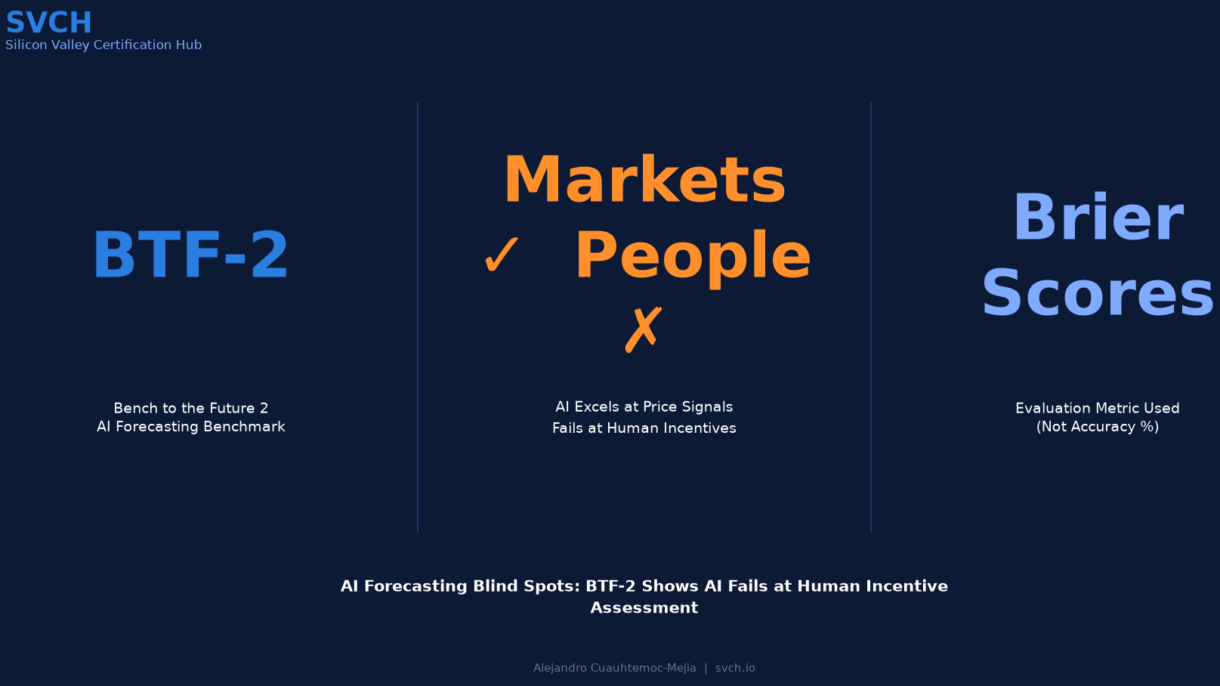
Your AI Forecaster Can Predict Markets. It Cannot Predict People.
Here is what the frontier AI models can do with remarkable skill: forecast GDP growth, predict quarterly sales trends, estimate the probability of an interest rate change by month-end.
Here is what they cannot do: tell you whether a competitor’s CEO will follow through on a stated strategy. Judge whether a regulator actually intends to enforce a new rule. Model how your own organization’s decision-making process will shift over the next quarter.
The difference is not one of degree. It is a systematic failure — and new research proves it.
A team of 81 researchers across multiple institutions has built the largest open forecasting benchmark ever constructed. Bench to the Future 2 (BTF-2) contains 1,417 pastcasting questions — forecasts about known outcomes asked as if unknown — backed by a frozen 15-million-document research corpus. Every agent’s reasoning traces are captured. The benchmark detects accuracy differences as small as 0.004 Brier score.
The hybrid advantage: A multi-agent system outperformed every single frontier model by 0.011 Brier. The differentiator: pre-mortem analysis and black swan consideration — the AI examining its own blind spots.
The blind spots — validated by expert human forecasters:
- G1: Human Incentive Assessment — AI cannot model why leaders really act
- G2: Follow-Through Likelihood — AI cannot judge whether stated plans will happen
- G3: Institutional Process Modeling — AI cannot model how organizations make decisions
Your AI forecaster can tell you the most likely market direction. It cannot tell you whether your board will approve the pivot. That is not a bug to be patched. It is a fundamental limit on what AI can do for strategic decision-making.
Executive Summary
The benchmark: 1,417 pastcasting questions, 15M documents, 0.004 Brier sensitivity, full reasoning trace capture — the most rigorous evaluation of AI strategic reasoning ever conducted.
The hybrid advantage: Multi-agent forecaster outperforms every single frontier model by 0.011 Brier through pre-mortem analysis and black swan consideration.
The three blind spots — validated by expert human forecasters:
- G1 — Human incentive assessment: Why leaders actually act, beyond stated rationale
- G2 — Follow-through likelihood: Whether stated plans will be executed as announced
- G3 — Institutional process modeling: How organizations actually make decisions
The Executive Decision Framework:
| Forecast Type | Trust Level | Action |
|---|---|---|
| Data-driven (GDP, market trends, demand) | ✅ Trust AI | Automate aggressively |
| Behavior-dependent (competitor moves, regulatory changes, org outcomes) | ⚠️ Human oversight | AI provides input, human provides judgment |
Paper at a Glance
| Metric | Value |
|---|---|
| Title | Evaluating Strategic Reasoning in Forecasting Agents |
| Authors | de Castro Alves et al. (81 authors across multiple institutions, incl. Eric Horvitz) |
| Published | April 28, 2026 |
| Venue | arXiv (Computer Science) |
| Relevance Score | 93/100 (VERY HIGH) |
| Focus Domain | Strategic forecasting, AI reasoning evaluation |
| Headline Contribution | Largest open forecasting benchmark with mapping of AI strategic reasoning failures |
| Paper URL | arxiv.org/abs/2604.26106 |
The Benchmark That Changes How We Evaluate AI Forecasters
BTF-2 is structurally different from previous benchmarks in ways that matter for executives who depend on forecasts.
Pastcasting methodology eliminates hindsight bias. Agents predict known outcomes against a frozen document corpus containing no outcome information. The agent cannot cheat — it must reason from the same information a human forecaster had at the time.
15 million documents ensure depth without contamination. Every agent searches the same dataset. If Agent A beats Agent B, you know it was better reasoning, not better data.
Full reasoning trace capture means evaluators see why an agent made its prediction — enabling expert human forecasters to identify the three blind spots. Without traces, the failures would remain invisible.
0.004 Brier sensitivity detects improvements lost in noise with less precise tools. This granularity enables optimization that compounds across thousands of forecasts.
The Three Blind Spots
G1 — Human Incentive Assessment
AI cannot model why leaders actually act beyond stated rationale.
Business example: A competitor CEO announces market exit. Your AI forecasts reduced competitive pressure. But the CEO’s bonus is tied to market share, not profitability. The exit announcement was strategic signaling. The AI cannot model the gap between stated and actual intent.
G2 — Follow-Through Likelihood
AI cannot judge whether stated plans will actually be executed.
Business example: A regulator announces aggressive data privacy enforcement. Your compliance team prepares. But the regulator’s budget was cut, enforcement is understaffed, political will is fading. The AI’s forecast was correct on paper — wrong in practice.
G3 — Institutional Process Modeling
AI cannot model how organizations actually make decisions.
Business example: A partner company announces an AI-first pivot. Your AI forecasts partnership impact. But the pivot requires board approval, three department reorganizations, and phased budget release over 18 months. The timeline depends on the organization’s process, not its strategy.
Why Business Leaders Should Care
Every strategic forecast contains a human element. Market forecasts depend on what regulators will do. Competitive forecasts depend on what rivals will decide. Organizational forecasts depend on execution.
The three blind spots have been validated by expert human forecasters across thousands of predictions. They are not edge cases. They are the central weakness of current AI forecasting.
The problem: AI forecasting is trusted uniformly when it should be trusted selectively. A company uses AI to inform market entry strategy. The AI predicts demand and regulatory timing. But the competitor response forecast — the one depending on the competitor CEO’s incentives — is wrong. The competitor, driven by pressures the AI could not model, responds aggressively. The entry fails to meet projections.
The paper’s finding: The failure mode is predictable. Predictable failure modes can be managed.
The Hybrid Forecasting Advantage
The paper’s other major finding — multi-agent systems outperform any single model — has a clear business implication: do not rely on one AI forecasting tool.
The 0.011 Brier improvement may sound small. In forecasting, it is not. The difference between first and second place in competitive tournaments is often less than 0.01 Brier. Across thousands of organizational forecasts, this compounds into materially better strategic decisions.
Practical implication: Organizations building forecasting pipelines should deploy multi-agent ensembles, not single models. The infrastructure cost is higher. The accuracy payoff is proven.
What Business Leaders Should Do Next
- Segment your forecasts — Categorize every strategic forecast by whether it depends on data trends or human behavior.
- Audit your AI forecasting tools — For each tool, assess performance on the three blind spots.
- Deploy multi-agent ensembles — Replace single-model forecasting with hybrid systems.
- Require pre-mortem analysis — Before every AI prediction, identify what the model might be missing.
- Adopt Brier score — Standardize forecasting accuracy measurement across AI and human teams.
- Train your teams — Help strategy and risk teams understand the three blind spots.
- Build human-in-the-loop processes — For behavior-dependent forecasts, AI provides input; humans provide judgment.
Conclusion
Your AI forecaster is a powerful tool. But it has a specific, measurable, predictable failure mode — and now you know exactly what it is.
The question is not “can I trust AI forecasting?” It is “which forecasts can I trust AI for, and which need human judgment?”
Organizations that answer that question correctly will make better strategic decisions than their competitors. Organizations that trust AI forecasting uniformly will discover the blind spots the hard way.
Frequently Asked Questions
What does this mean for a Chief AI Officer?
Your frontier AI models are likely overconfident in domains involving human behavior—competitor moves, regulatory enforcement, organizational decisions—where they systematically underperform against hybrid systems that incorporate human expert judgment. The BTF-2 research quantifies this gap at scale: you need to architect your AI strategy to explicitly separate prediction tasks that are purely quantitative from those requiring institutional or behavioral insight. Building governance around which forecasts to trust, and which to validate with human experts, is now a measurable competitive advantage.
Why do AI models fail at predicting human follow-through when they excel at market forecasts?
Market forecasts rely on aggregate patterns in historical data—price movements, economic indicators, supply-demand signals—which AI can learn at scale. Human follow-through requires understanding unstated incentives, competing priorities, and organizational friction: factors that don’t exist in clean datasets and demand contextual reasoning about individual psychology and institutional process. The 1,417 test questions in BTF-2 show that AI reasoning traces reveal confidence in answers where actual accuracy is near random, a systematic blind spot rooted in training data composition, not model capability.
How should we evaluate whether our current AI deployment is trustworthy for strategic decisions?
Silicon Valley Certification Hub’s AI Assessment for companies framework recommends auditing your AI forecasts by splitting decisions into three categories: quantitative market prediction (where frontier models are reliable), human incentive assessment (where they systematically fail), and institutional process modeling (where hybrid human-AI systems outperform either alone). Run a pre-mortem analysis on high-stakes forecasts your AI is recommending—ask explicitly what the model cannot see—and validate against your own expert forecasters before treating predictions as decision-ready inputs.
What should we do Monday morning with this research?
Immediately audit your current AI-driven forecasts for any that touch competitor strategy, regulatory behavior, or internal organizational decisions, and upgrade them to hybrid models that pair AI analysis with expert human review, particularly using pre-mortem and black swan questioning. Then establish a governance policy that treats AI forecasts about quantitative markets as high-confidence inputs and those about people and institutions as decision inputs requiring expert validation. This isn’t a reason to distrust AI—it’s a reason to deploy it where it wins and step in where it loses.
Want to know how this applies to your company?
At Silicon Valley Certification Hub, we help you align AI + Strategy. Our team works directly with your directors and teams to assess AI readiness, identify gaps, and build a clear path forward — tailored to your business context.
Book a time with our CEO, Alejandro Cuauhtemoc-Mejia:
https://calendar.app.google/2ihQf2JH3D9uJBe68
Silicon Valley Certification Hub
3000 El Camino Real, Building 4, Palo Alto, CA

0 Comments