

Measuring Brand Visibility Inside AI Answers — Silicon Valley Certification Hub Chief AI Officer Research
🏢 Independent Research (Authors in Japan)
📅 September 2026
Your customers are asking an AI which product to buy. Your brand shows up in some answers, vanishes in others, and your marketing-mix model has no idea any of it happened. That is the gap this paper walks straight into.
Masahiro Kato, Daiki Honma, and Taka Kato build something they call Generative Marketing Mix Modeling, or GMMM. It is a causal framework for two channels most finance teams cannot see: GEO, where you earn a mention inside a generated answer, and GEM, where you buy a sponsored placement inside a generative engine. Neither one shows up in your click logs. Both move revenue.
I have reviewed a lot of AI research for the SVCH blog. This is the first paper that treats “how often does the AI recommend us?” as something you can actually measure, attribute, and budget against. That matters more than it sounds.

Why This Paper Matters
Marketing mix modeling has been the workhorse of budget allocation for decades. You feed in spend by channel, you get back estimated contribution, and you argue about it in a quarterly review. The whole thing rests on an assumption that is quietly breaking: that your channels leave a record.
Generative engines do not leave that record. A buyer asks ChatGPT, Perplexity, or a Japanese-market assistant for a product recommendation. The model answers. Maybe your name is in it, maybe it isn’t. There is no impression, no click, no cookie. Ten years of demand-gen measurement assumes a paper trail that this channel simply doesn’t produce.
This is why I would put it on the desk of any Chief AI Officer at a consumer brand. The fastest-growing discovery channel your customers use is the one your attribution stack is blind to. The authors do not just flag the problem. They write down the conditions under which the effect is identifiable at all, which is the part most marketing “AI visibility” vendors skip.

Methodology, Explained Simply
Think of it like counting how many people walked past your storefront, when nobody installed a door counter. You can’t count every passerby directly. So you estimate. You count how many times a question gets asked in your category. You figure out what share of the market asks it on each engine. Then you estimate the odds that a person actually notices your name when it appears.
That is what GMMM does. For GEO, it combines repeated generated answers with question counts, share of use across generative systems, and notice probabilities. For GEM, it takes records of sponsored placements and multiplies them by the same notice probability. Two different channels, one shared idea: exposure is a product of placement and attention.
Then the model does what a good mix model always does. It captures carryover, so a mention today still works on someone next week. It captures saturation, so the hundredth mention does less than the fifth. And it links all of that to a business outcome.
The clever part is the output. The authors don’t just estimate an effect. They compare expected business responses under alternative treatment sequences, meaning you can ask what happens if you turn the channel off. They also lay out sufficient conditions for identifying the effect, a real methodological guardrail, because the naive version of this analysis is easy to get wrong. They test it with simulated product-recommendation answers in both English and Japanese.
Results and Practical Insights
Here is the number that stopped me. The paper’s Figure 2 shows how often the target brand name actually appears in generated answers, across seven real use cases: web highlighting, research capture, YouTube learning, knowledge management, social annotation, read-it-later, and AI summarization.
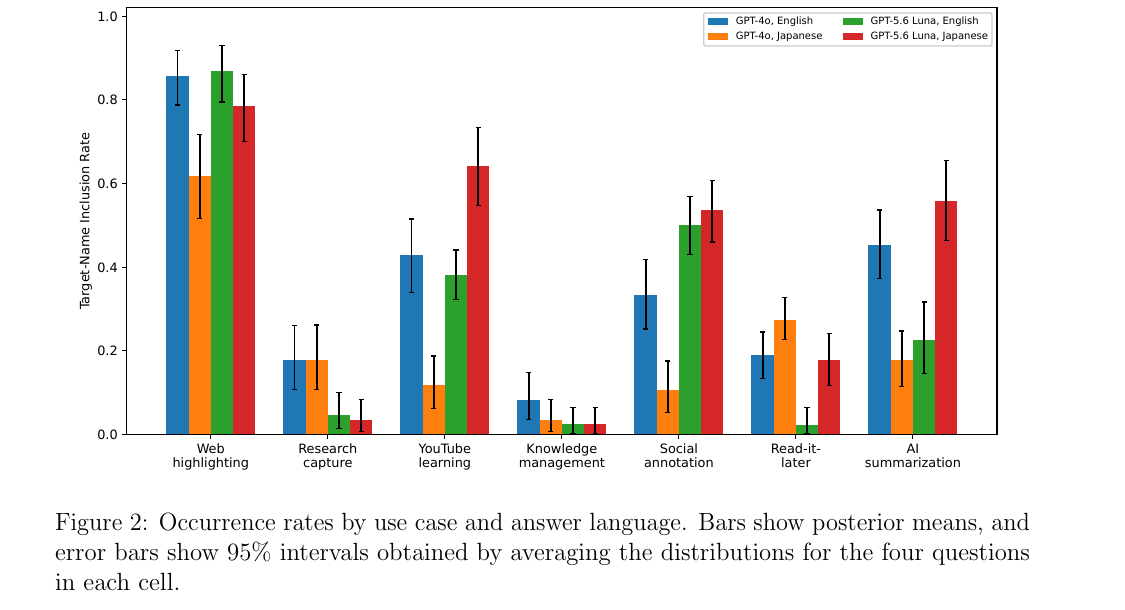
In the strongest case, the brand shows up in roughly 0.8 to 0.85 of answers. In the weakest, it is close to zero. Same brand. Same question type. Different context. The authors also run the same test across two models, GPT-4o and GPT-5.6 Luna, and across English and Japanese answers.
Well… that spread is the whole argument for doing an AI Assessment for companies before you spend a dollar on GEO. If you measured “AI visibility” as one blended score, you would average a near-total presence and a near-total absence into a comfortable middle number and conclude everything is fine. It isn’t. You are dominant in one context and invisible in another, and you probably don’t know which is which.
The second insight is the disablement framing. Because GMMM compares expected outcomes under different treatment sequences, you can finally ask the board-level question in numbers: what is the expected revenue effect of switching off our generative channel investment? That is a decision, not a dashboard. Most teams can’t answer it today.
If the AI stops recommending you tomorrow, could your marketing model tell you what it cost?
At Silicon Valley Certification Hub, we help marketing and operations leaders measure and govern the AI channels their attribution stack cannot see.
Key Takeaways for Marketing and Brand Leaders
Thanks to All Authors
Want to know how this applies to your company?
At Silicon Valley Certification Hub, we help you align AI + Strategy. Our team works directly with your directors and teams to assess AI readiness, identify gaps, and build a clear path forward — tailored to your business context.
Book a time with our CEO, Alejandro Cuauhtemoc-Mejia:
https://calendar.app.google/2ihQf2JH3D9uJBe68
Silicon Valley Certification Hub
3000 El Camino Real, Building 4, Palo Alto, CA


0 Comments