

Who Is Actually Using AI in Your Company? The First Real Answer
🏢 Duke · Wharton · OpenAI
📅 August 2026
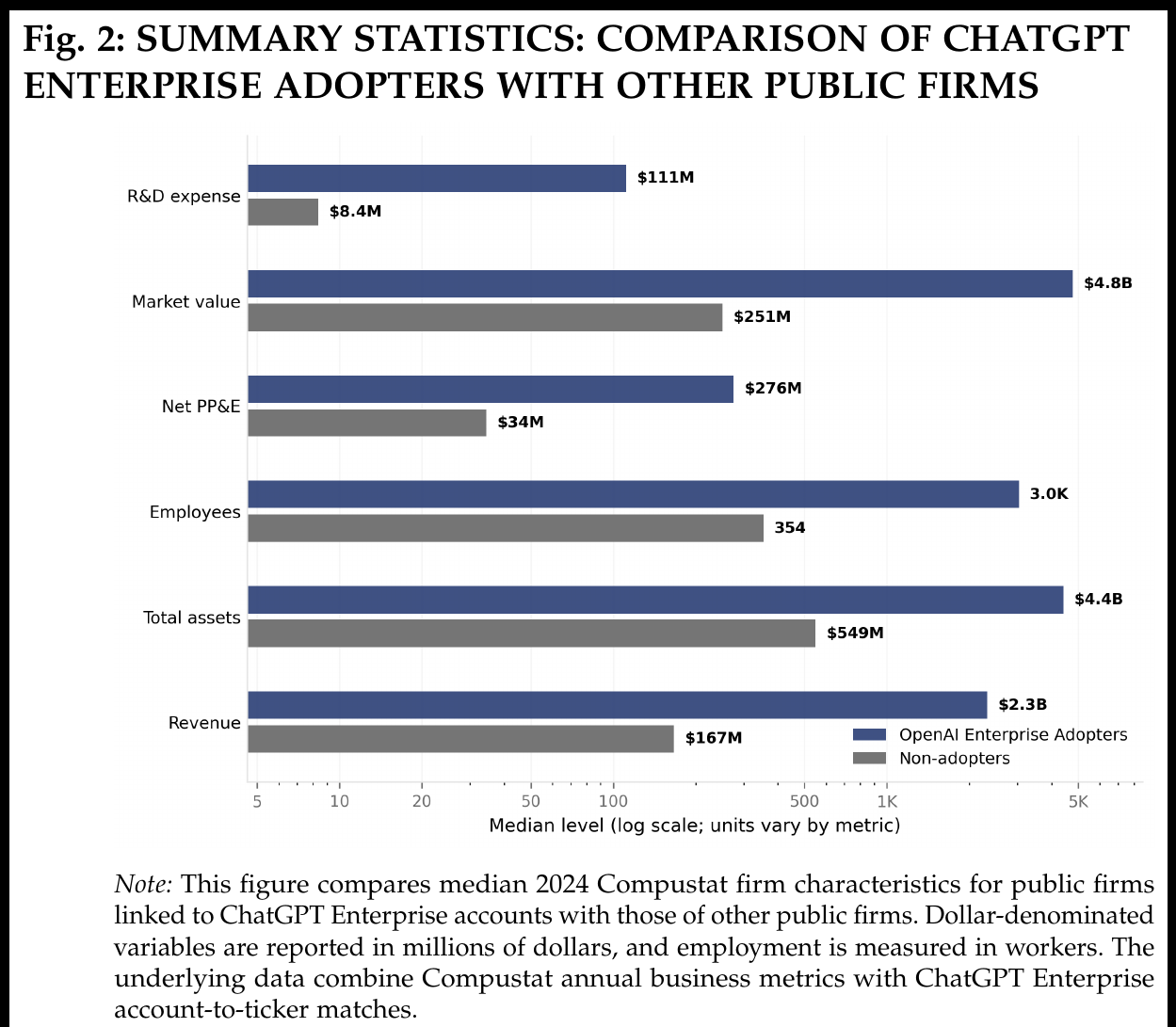
The firms adopting enterprise AI are not the average public company. The ones leaning in are roughly 19 times more valuable, spend about 13 times more on R&D, and employ 8.5 times more people than the firms that are not adopting. That gap is the single most important number in this paper, and it should reframe how any leader thinks about “who is winning at AI.”
Researchers at Duke, Wharton, and OpenAI linked ChatGPT Enterprise account records to real usage, worker roles, task classifications, and public-company financial data through March 2026. The dataset is enormous: over 1,500 organizations and more than 17 million messages analyzed at the worker level. It is the first large-scale, empirical answer to a question every boardroom has been guessing at.
Here’s the thing: adoption speed, breadth, and purpose vary wildly between firms. Most organizations are still actively learning how to integrate AI into their workflows. A license count or a slide that says “we use AI” tells you almost nothing about real capability.

Why This Paper Matters
Every CEO has sat through a board update claiming the company is “all in on AI.” The problem is there has been no way to verify that claim. Headcount-weighted adoption numbers and seat-license counts are weak proxies. They tell you someone bought software, not whether anyone is actually using it or whether the use is creating value.
This paper closes that gap with real behavioral data at massive scale. It answers the questions behind the claims: Which firms adopt? Who inside them actually uses the tool? What are they doing with it? For a Chief AI Officer or a CEO running an AI Assessment for companies, this is the kind of benchmark every plan was missing. You can now compare your own adoption profile against what real organizations actually look like.
Well… here is what surprised me most. The heaviest users are not senior leaders or engineers. Usage spans every job function and every seniority level, but early-career workers are the ones driving adoption. The junior talent you might not be tracking is the group actually building your AI capability. That is both a opportunity and a blind spot.
Methodology, Explained Simply
Imagine you could take the anonymous, aggregated activity records from a workplace software tool and line them up against who those people are and what their companies report to shareholders. That is exactly what the researchers did. They linked ChatGPT Enterprise usage records to worker roles, task classifications, and the public financial data those firms file. The linkage is privacy-preserving, so no individual user or message is exposed, but the patterns at scale become visible.
The scale is what makes it credible. At the six-month adoption horizon alone, the worker-level sample covers more than 1,500 organizations and over 17 million messages. That is not a survey of a few hundred people guessing at their habits. It is observed behavior across a huge slice of the actual enterprise economy. Think of it like studying a city’s commuters not by asking them how they travel, but by watching the trains, roads, and bikes all at once.
Four facts came out of this. First, enterprise AI usage has grown rapidly through both new firms adopting and existing adopters going deeper, roughly seven times over the study window. Second, adoption concentrates in larger, more valuable, more R&D- and SG&A-intensive firms. Third, active use spans all functions and seniority levels, but early-career workers are the heaviest users. Fourth, the task mix is broad: writing, technical work, communication, and information synthesis, not just coding.
Results and Practical Insights
Start with the headline: adopters versus non-adopters is not a close race. Adopting firms have a median market value of about $4.8 billion versus $251 million for non-adopters, median R&D of $111 million versus $8.4 million, and about 3,000 employees versus 354. The pattern holds on every measure the researchers tested. The firms leaning into AI are precisely the ones that already invest heavily in the knowledge work and go-to-market muscle that make a tool productive. Buying software is not the differentiator. Organizational capacity to invest in the complements is.
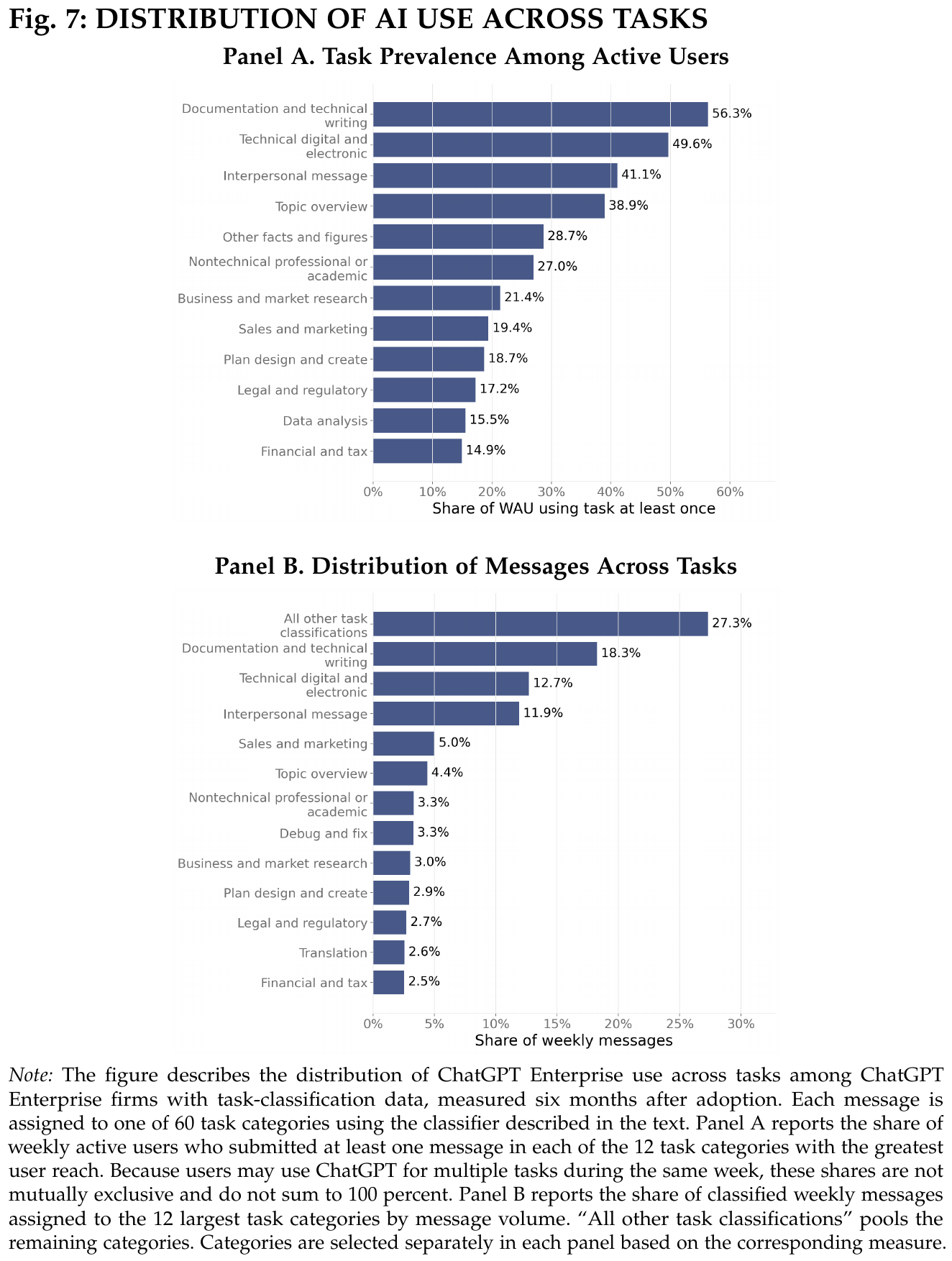
On the “what are they doing with it” side, the picture is equally clear. AI is now a full-workflow assistant, not a narrow coding tool. Documentation and technical writing lead, used by 56.3% of active users and driving 18.3% of messages. Technical digital work and interpersonal messaging sit close behind, with a long tail across sales, legal, finance, and other functions. One task can matter because it reaches many people, or because it drives heavy usage, and these are two separate margins. Leaders should measure both.
Is your company measuring who uses AI, or just how many licenses you bought?
At Silicon Valley Certification Hub, we help operations and revenue leaders evaluate and deploy AI that fits their actual business processes, not just their software budget.
What This Means for Your Chief AI Officer
The practical takeaway for anyone running an AI Assessment for companies is simple: stop benchmarking on seats and start benchmarking on breadth and depth of actual use. Breadth means who inside the company is using AI, across functions and seniority. Depth means how much and on what tasks. A firm can have broad reach and shallow use, or narrow reach and deep use, and the two require very different strategies.
Here is the uncomfortable part. If your heaviest users are early-career workers, as this paper shows is true across organizations, then the people doing the most to build your AI capability are probably not in your formal AI governance process at all. Their use is happening bottom-up, function by function. That is not a threat to control and remove. It is a resource to measure, guide, and intentionally spread around.
The firms winning here are not the ones with the flashiest demos. They are the larger, more R&D-heavy, more marketing-intense organizations that already had the complementary muscle. So the real question for every other firm is not “should we adopt AI.” It is “what are we doing to build the organizational capacity that makes AI productive in our specific context.” A Silicon Valley Certification Hub review can help you assess where you actually stand on that, rather than where your marketing materials claim you stand.
Key Takeaways for Company Leaders
Thanks to All Authors
Want to know how this applies to your company?
At Silicon Valley Certification Hub, we help you align AI + Strategy. Our team works directly with your directors and teams to assess AI readiness, identify gaps, and build a clear path forward — tailored to your business context.
Book a time with our CEO, Alejandro Cuauhtemoc-Mejia:
https://calendar.app.google/2ihQf2JH3D9uJBe68
Silicon Valley Certification Hub
3000 El Camino Real, Building 4, Palo Alto, CA


0 Comments