

arXiv: 2605.17036 | Published: May 2026
Researchers: Carol Xuan Long, David Simchi-Levi, Feng Zhu, Huangyuan Su, Andre P. Calmon
SVCH Research Review — May 2026
The MIT Beer Game has been the supply chain gold standard for 40 years.
An AI just destroyed every human score on record.
The MIT Beer Game is not obscure. Every supply chain professional knows it: a four-stage simulation, retailer to factory, with two-week lead times and stochastic demand. For 40 years it has been the canonical experiment for studying the bullwhip effect. David Simchi-Levi, one of the most cited supply chain academics in the world, just ran it with eight large language models instead of human teams.
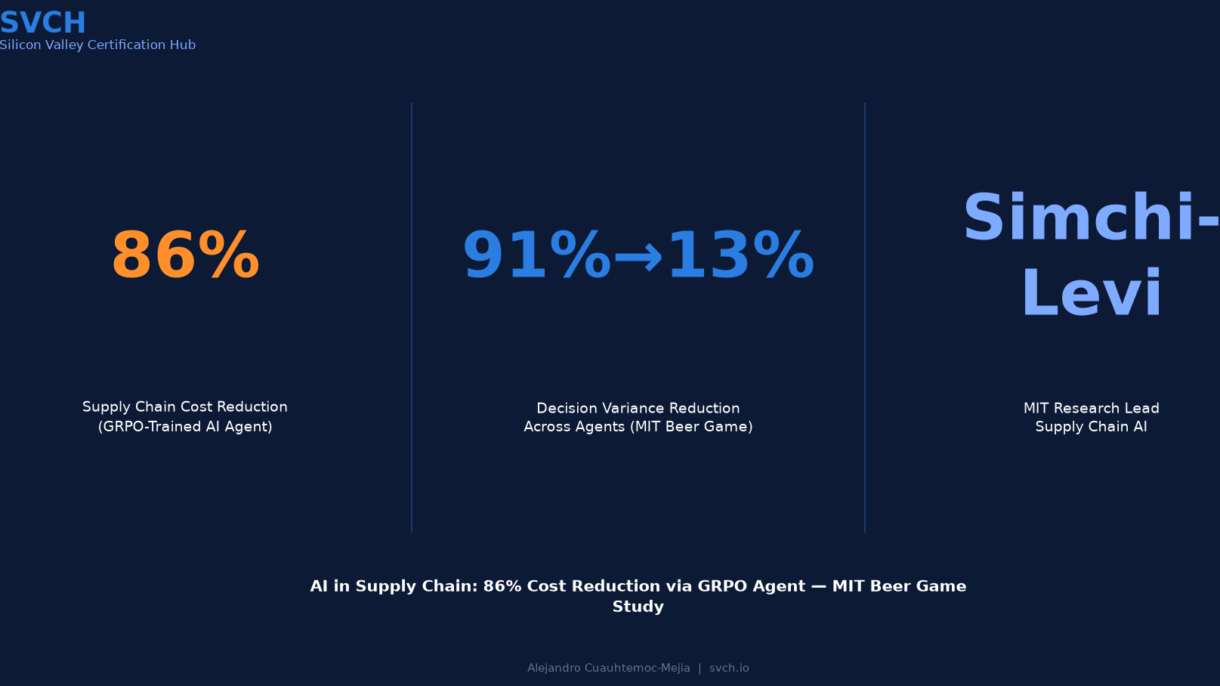
What came back was not incremental. A reasoning model out of the box beats human performance. An optimized reasoning model cuts costs by 67 percent. And a model post-trained with Group Relative Policy Optimization (GRPO) reduces costs by 86 percent while collapsing decision variance from 91 percent to 13 percent.
The bottom line: the best autonomous AI agent runs the same four-echelon supply chain for $952 total cost. Human teams cost $6,739. Seven times more expensive. Seven times less predictable.
Why This Paper Matters More Than Any Supply Chain AI Demo
Most AI supply chain papers test narrow, deterministic problems: route optimization, demand forecasting, single-warehouse inventory. The Beer Game is different. It is a multi-echelon, multi-agent coordination problem where each player makes decisions under uncertainty with incomplete information and delayed feedback. It is exactly what real supply chains look like.
Core Finding
AI agents coordinate better under uncertainty than human teams
The bullwhip effect has persisted for 60 years because humans over-respond to demand signals. The GRPO model learns to dampen those responses systematically. The result is not just lower cost, it is lower variance, making the AI supply chain both cheaper and more predictable than any human-managed alternative tested.
The Model Hierarchy: What Each Tier Delivers
Best performer. $952 total cost. 13% variance. Post-trained with reinforcement learning on supply chain trajectories. The 86% cost reduction represents the value created by domain-specific fine-tuning beyond what base reasoning models deliver. First evidence that task-specific RL transfers directly to multi-echelon inventory coordination.
Accessible today. 67% cost reduction without fine-tuning. A frontier reasoning LLM with no supply chain customization already outperforms human teams significantly. Any organization with API access can run this benchmark against their own inventory data right now.
Mixed results. High average, high variance. Non-reasoning frontier models show variable performance. Some beat humans on average costs but produce higher variance, creating a different operational risk profile that may not suit production deployment.
The baseline. $6,739. 91% variance. Experienced supply chain professionals in the Beer Game produce $6,739 in total costs and 91% decision variance. The bullwhip effect persists even with training. This is the benchmark every AI model is measured against.
Key Takeaways for Supply Chain and AI Leaders
Baseline a frontier reasoning model against your current inventory decisions today
The 67% cost improvement is available without any fine-tuning or custom infrastructure. Run your last quarter of inventory decisions through a reasoning LLM and compare the recommended order quantities against what your team actually ordered. The gap is the business case for your board presentation.
The variance reduction is the story for your CFO
The collapse from 91% to 13% decision variance means predictable supply chains, fewer emergency orders, lower safety stock requirements, and better cash flow forecasting. Frame the AI investment around balance sheet improvement, not just cost reduction.
Post-training on your own supply chain data is the competitive moat
The gap between the base reasoning model (67%) and the GRPO model (86%) is the value of domain-specific training. Organizations that invest in fine-tuning on their own historical trajectories build capabilities that generic AI vendors cannot replicate.
The Chief AI Officer must own the governance framework for autonomous agents
When an AI agent is autonomously adjusting purchase orders across a four-echelon network, who reviews anomalies? Who has override authority? What triggers a human escalation? The Chief AI Officer must define these protocols before deployment, not after the first incident.
This is not a five-year roadmap item
The base reasoning model capability exists in production today. The conversation with your board is not whether this is coming, it is how quickly your organization builds the governance and data infrastructure to deploy it responsibly.
Thanks to the Researchers
Frequently Asked Questions
What does this mean for a Chief AI Officer?
A Chief AI Officer reviewing this paper should initiate an immediate inventory of multi-echelon supply chain operations where autonomous agents can replace human decision loops. The 86% cost reduction benchmark creates a clear ROI threshold and the variance reduction gives CFOs a concrete operational benefit beyond cost savings.
Does the Beer Game result translate to real supply chain complexity?
The Beer Game is a deliberately simplified model. Real supply chains have more product SKUs, seasonal demand patterns, supplier reliability variation, and regulatory constraints. The 86% improvement will not transfer at full magnitude to production environments. But the directional finding, that AI coordination under uncertainty outperforms human coordination, is structurally sound and supported by the multiple model variants tested.
How does an AI Assessment for companies from Silicon Valley Certification Hub address supply chain AI readiness?
The AI Assessment for companies at Silicon Valley Certification Hub evaluates whether you have the data infrastructure, governance model, and human oversight protocols needed to deploy autonomous inventory agents. We help you build the business case and define the oversight structure before you engage vendors or start pilots.
What are the risks of fully autonomous supply chain agents?
The primary risks are model drift as demand patterns shift, concentration risk if the same system manages multiple tiers simultaneously, and accountability gaps when the agent makes a suboptimal decision affecting a supplier relationship. Operational deployment requires continuous monitoring, clear override protocols, and human escalation paths for anomalous recommendations.
What should executives do this quarter?
Run the benchmark first: compare a frontier reasoning model recommendation against you’re team decisions on last quarter’s inventory data. The base model’s 67% improvement gives you a no-investment data point for the board conversation. Then assign your Chief AI Officer to define the governance framework for autonomous agents before the next budget cycle.
Want to know how this applies to your company?
At Silicon Valley Certification Hub, we help you align AI + Strategy. Our team works directly with your directors and teams to assess AI readiness, identify gaps, and build a clear path forward — tailored to your business context.
Book a time with our CEO, Alejandro Cuauhtemoc-Mejia
Silicon Valley Certification Hub | 3000 El Camino Real, Building 4, Palo Alto, CA


0 Comments