

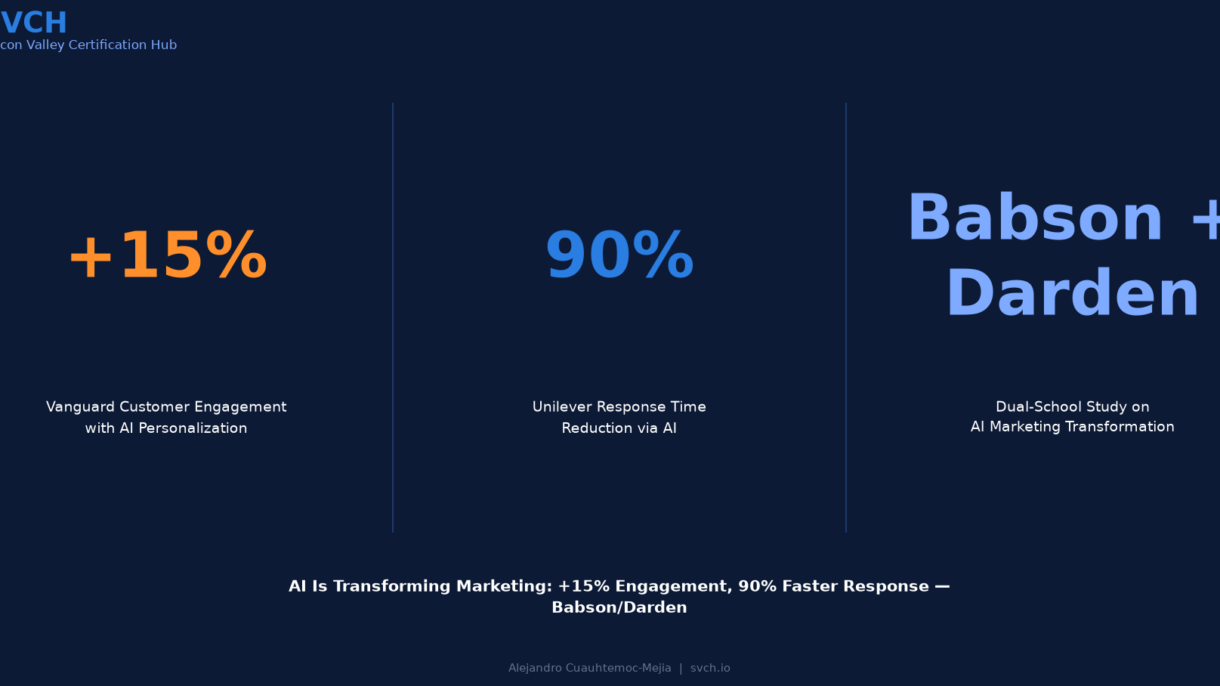
Generative AI isn’t just changing how we create — it’s redefining how marketing works.
A study published in the Journal of the Academy of Marketing Science (2025) by Dhruv Grewal, Cinthia Satornino, Thomas Davenport, and Abhijit Guha explores how Gen AI is reshaping every layer of marketing strategy, from product ideation to customer service.
“Generative AI (Gen AI) will influence how marketers interact and communicate with customers, help create and deliver marketing content, and inform methods for developing new products and services.” — Grewal et al., 2025
🔍 What the Paper Shows
1️⃣ Analytical AI vs. Generative AI (Table 1)
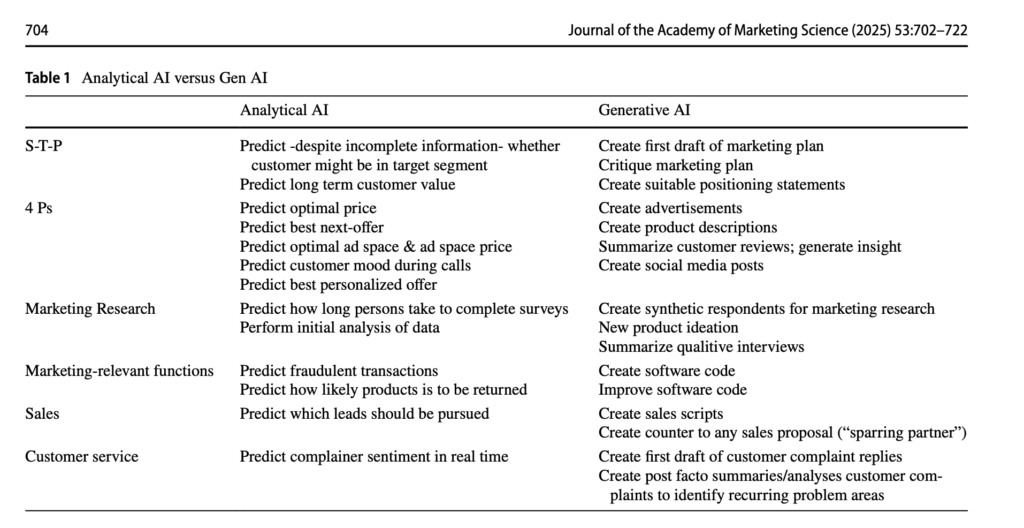
The authors contrast “Analytical AI,” which predicts and optimizes (e.g., next-best-offer, optimal price, fraud detection), with “Generative AI,” which creates—marketing plans, ad copy, social posts, synthetic respondents, even first drafts of complaint replies.
| Function | Analytical AI | Generative AI |
|---|---|---|
| S-T-P | Predict if a customer belongs in a target segment | Create the first draft of a marketing plan |
| 4 Ps | Predict optimal price / next offer | Create ads, product descriptions, or social posts |
| Research | Predict survey times, analyze data | Generate synthetic respondents, summarize interviews |
| Sales | Predict leads | Write sales scripts, act as sparring partner |
| Customer Service | Predict complaint sentiment | Draft replies, summarize recurring issues |
In short: Analytical AI tells you what to do; Generative AI drafts how to say it.
2️⃣ The Generative AI Selection Framework (Figure 2)
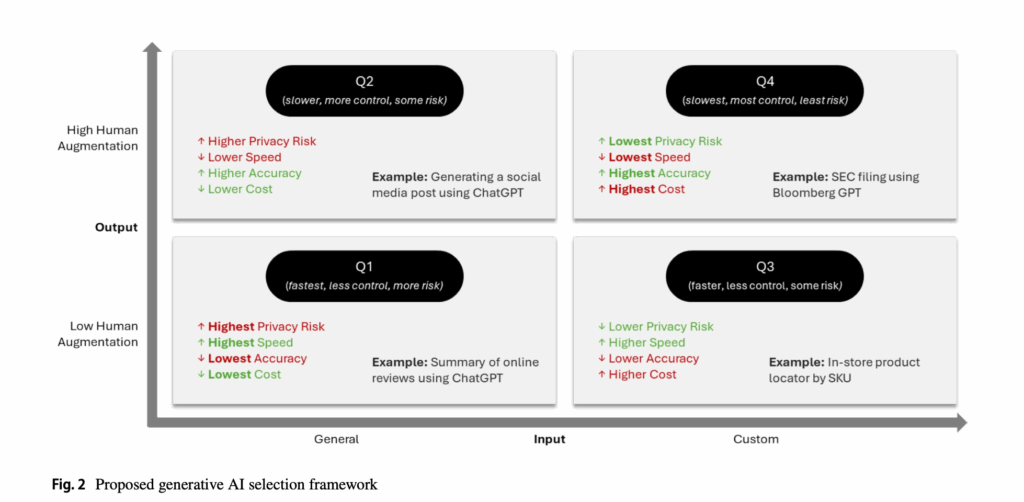
One of the study’s most practical contributions is a 4-quadrant matrix that helps marketers balance speed, cost, privacy, and control.
- Q1 (Fastest, least control): e.g., summarizing online reviews with ChatGPT. 🔺 Highest privacy risk | 🔺 Highest speed | 🔻 Lowest accuracy | 🔻 Lowest cost.
- Q2 (Slower, more control): generating social-media content with human editing. ⚖️ Better balance of accuracy and privacy but slower.
- Q3 (Faster custom): e.g., in-store product locator using internal data. 🔽 Lower risk | 🔼 Higher cost | 🔼 Higher accuracy.
- Q4 (Most controlled): using a private model like BloombergGPT for SEC filings. 🟢 Lowest risk | 🟢 Highest accuracy | 🔴 Highest cost.
This model helps executives pick between general LLMs (ChatGPT, Claude) and custom or multimodal systems—depending on how much privacy, precision, and human oversight they require.
3️⃣ Research Avenues (Table 4)
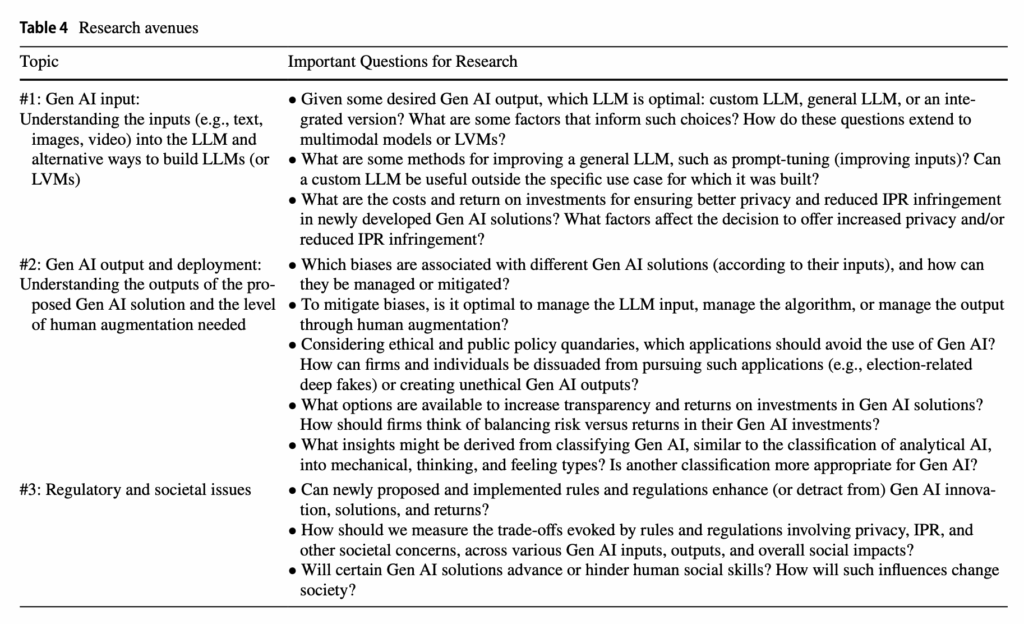
The authors close with a call to action for marketers and policymakers. Their framework proposes three future priorities:
- Gen AI Inputs: How do firms choose between general vs. custom models? What ROI trade-offs come from higher privacy and IPR protection?
- Gen AI Outputs & Human Augmentation: Which tasks should remain human-supervised? How can biases and ethical risks (deepfakes, misinformation) be mitigated?
- Regulatory & Societal Impacts: Can Gen AI enhance or harm human creativity and social skills? What regulations best encourage innovation and accountability?
“To mitigate biases, it may be optimal to manage not only the algorithm, but also the inputs and human augmentation process.” — Grewal et al., 2025
The paper details how global brands already test these ideas:
- Vanguard boosted campaign conversions +15 % via AI-generated LinkedIn ads.
- Unilever cut response time 90 % using Gen AI-assisted replies.
- Walmart saved 3 % in vendor-negotiation costs through chat-based automation.
- Emirates NBD increased credit-card leads 177 % with AI-personalized offers.
For executives and marketers, this research offers an academic foundation for what we teach at Silicon Valley Certification Hub (SVCH):
- Strategic Readiness: Choosing the right AI-human balance.
- Governance & Trust: Managing privacy, IPR, and ethical risk.
- Capability Building: Upskilling teams to move from using AI tools to orchestrating AI systems.
Gen AI’s future isn’t about replacing creativity—it’s about scaling it responsibly.
✨ Key Takeaway
Generative AI is the new creative partner in marketing.
The leaders who master its frameworks—balancing innovation, risk, and human oversight—will define the next decade of brand growth.
#AI #Marketing #Research #GenerativeAI #Leadership #Innovation #DigitalTransformation #SVCH
Frequently Asked Questions
What does this mean for a Chief AI Officer?
Your role is expanding beyond optimizing existing processes—you now need to govern both analytical and generative AI systems with different risk profiles and use cases. The research shows generative AI requires new oversight frameworks because it creates novel content and strategies, not just predictions, meaning your governance model needs to address quality, brand safety, and intellectual property concerns that analytical AI doesn’t present.
How should we decide between analytical AI and generative AI for our marketing function?
Use analytical AI when you need precision and risk management—like pricing optimization or lead scoring—and generative AI when you need speed and creativity, such as drafting marketing plans or customer service responses. The Grewal study suggests the most effective marketing organizations will deploy both in tandem, with analytical AI identifying what to do and generative AI executing how to communicate it at scale.
Where should we start if we’re assessing our AI maturity?
Begin by mapping your current marketing workflows against the paper’s framework—identify which decisions are analytical (prediction-based) versus generative (creation-based), then assess where you have AI capability gaps. Silicon Valley Certification Hub’s AI Assessment for companies helps executives conduct this mapping and establish a baseline readiness score before investing in new generative AI tools or training your teams.
What should our team do in the next 90 days?
Pilot generative AI in one high-volume, lower-risk marketing function—such as first-draft ad copy creation or customer service response summarization—to build organizational comfort while measuring output quality and brand alignment. Simultaneously, conduct an audit of your analytical AI investments to ensure they’re feeding clean, strategic inputs into these new generative workflows, creating an integrated AI-powered marketing engine rather than disconnected tools.
Want to know how this applies to your company?
At Silicon Valley Certification Hub, we help you align AI + Strategy. Our team works directly with your directors and teams to assess AI readiness, identify gaps, and build a clear path forward — tailored to your business context.
Book a time with our CEO, Alejandro Cuauhtemoc-Mejia:
https://calendar.app.google/2ihQf2JH3D9uJBe68
Silicon Valley Certification Hub
3000 El Camino Real, Building 4, Palo Alto, CA


0 Comments